
Academia Aeternum
तमसो मा ज्योतिर्गमय

Numbers are the basic tools of Mathematics. A Number System is a way of representing and expressing numbers using a set of symbols and rules. The study of the number system enables us to classify numbers into distinct groups and comprehend their properties.
In mathematics, numbers are broadly divided into:
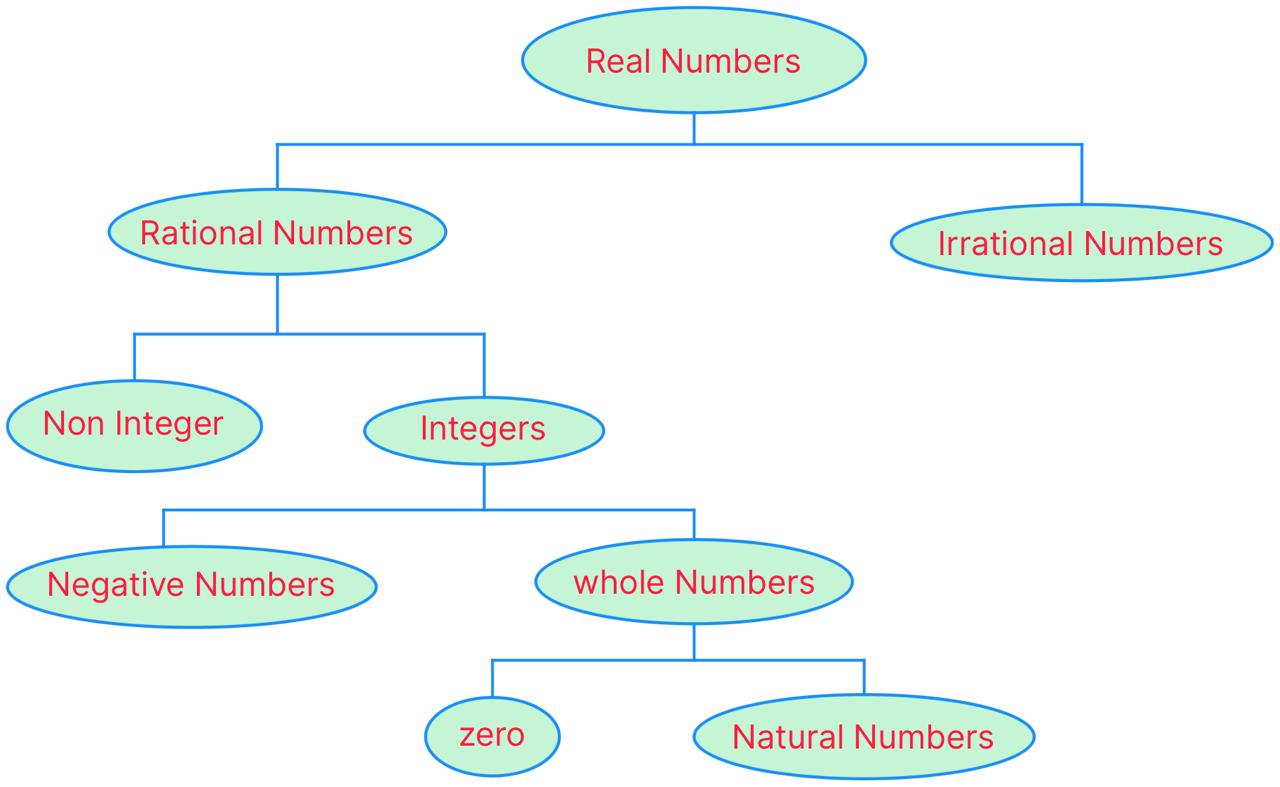
whole number is a number without fractions or decimals. It includes 0 and all natural numbers (1, 2, 3, 4, …).
In short:
An Integer is a number that can be positive, negative, or zero, but it
cannot be a fraction or a decimal.
Set of integers:
\[\scriptsize Integers \mathbb{(Z)}=\left\{\cdots, -3, -2, -1, 0, 1, 2, 3,\cdots \right\}\]

The collection of rational numbers is denoted by \(\mathbb{Q}\).
‘Rational’ comes from the word ‘ratio’,
and Q comes from
the word ‘quotient’.
A number ‘r’ is called a rational number if it can be written in the form
\(\frac{p}{q}\), where p and q are integers and \(q \neq
0\).
Examples:
Fractions: \(\frac{1}{2}, \frac{-3}{4},
\frac{5}{1}\)
Integers: (since they can be written as \(\frac{n}{1})\): -3, 0,
5
Repeating Decimals: \(0.333\cdots = \frac{1}{3},
0.142857\cdots\frac{1}{7}\)
Terminating Decimals: \(0.5 = \frac{1}{2}, 1.25 =
\frac{5}{4}\)
Key Points:
Note: There are infinitely many rational
numbers between any two given rational
numbers
An irrational number is a real number that cannot be expressed as a ratio of two integers; it cannot be
written
in the form \(\frac{p}{q}\), where p and q are integers and \(q\neq 0\).
Key Features of Irrational Numbers:
Their decimal expansion is non-terminating and non-repeating.
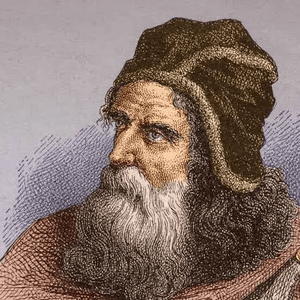
The Greek genius Archimedes was the first to compute digits in the decimal system. expansion of π. He showed 3.140845< π < 3.142857.

Aryabhatta (476 – 550 C.E.), the great Indian mathematician and astronomer, found the value of π correct to four decimal places (3.1416).
Found this helpful? Share this chapter with your friends and classmates.
💡 Exam Tip: Share helpful notes with your study group. Teaching others is one of the fastest ways to reinforce your own understanding.
Get in Touch
Questions, feedback, or suggestions?
We'd love to hear from you.