
Ch 2  ·  Q–
0%
Class 10 Mathematics Exercise 2.1 NCERT Solutions Olympiad Board Exam

Chapter 2 — POLYNOMIALS

Step-by-step NCERT solutions with stress–strain analysis and exam-oriented hints for Boards, JEE & NEET.

📋1 questions
Ideal time: 20-25 min
📍Now at: Q1
Q1
NUMERIC3 marks

The graphs of \(y = p(x)\) are given below. Find the number of zeroes of \(p(x)\) in each case.
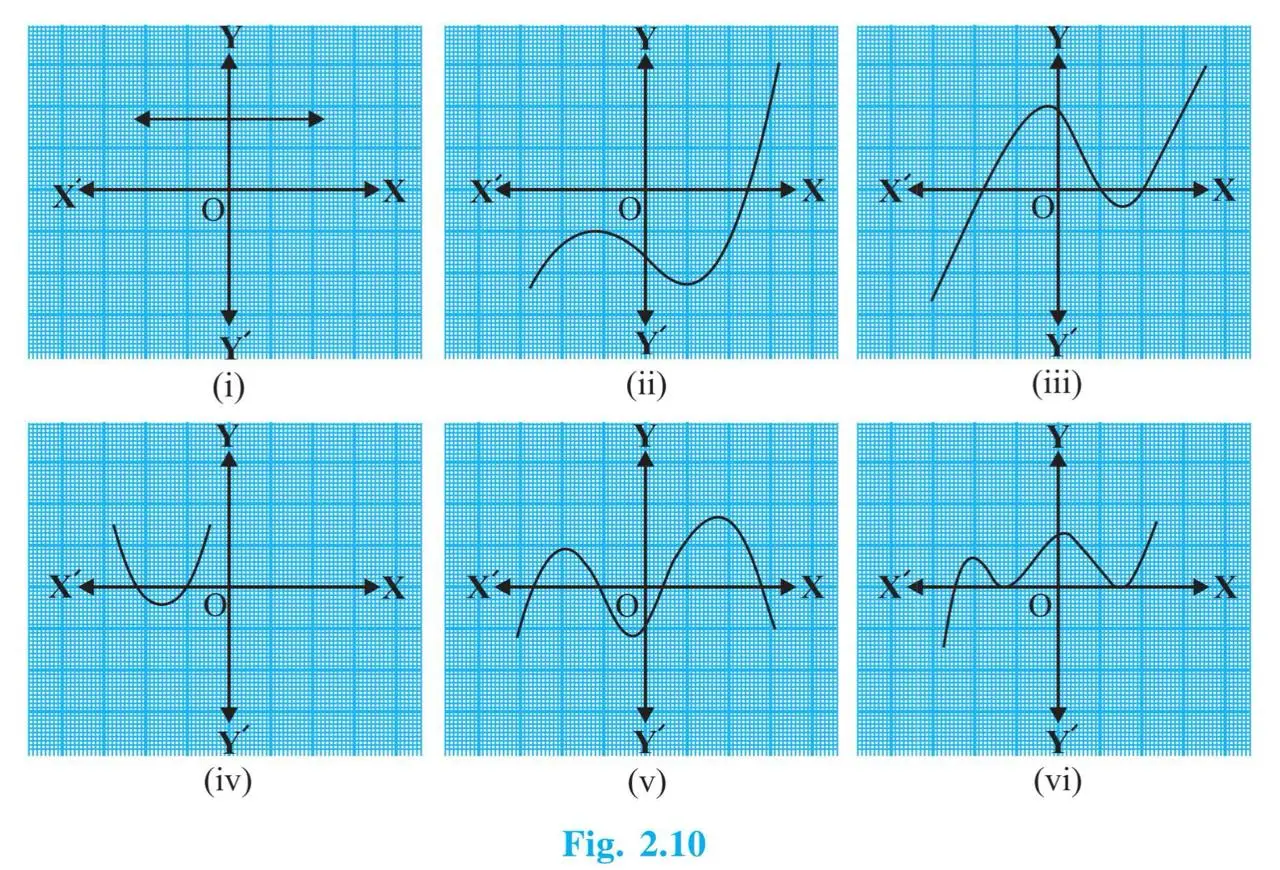
Graphs
Fig 2.10
Concept Before Solving
  • A zero of a polynomial is a value of \(x\) for which \(p(x)=0\).
  • Graphically, zeroes are the points where the graph intersects the \(x\)-axis.
  • If graph cuts (crosses) the \(x\)-axis → simple zero.
  • If graph just touches the \(x\)-axis → repeated zero (even multiplicity).
Solution Roadmap
  • Step 1: Observe each graph carefully.
  • Step 2: Count how many times graph meets \(x\)-axis.
  • Step 3: Include both crossing and touching points.
  • Step 4: That count = number of zeroes.

  1. Figure (i):
    The graph is a horizontal line parallel to the \(x\)-axis and does not intersect it.

    Step-wise:
    • No intersection with \(x\)-axis
    • No solution to \(p(x)=0\)

    Therefore, number of zeroes = 0
  2. Figure (ii):
    The graph intersects the \(x\)-axis at exactly one point.

    Step-wise:
    • Curve crosses axis once
    • Only one value of \(x\) makes \(p(x)=0\)

    Therefore, number of zeroes = 1
  3. Figure (iii):
    The graph cuts the \(x\)-axis three times.

    Step-wise:
    • First intersection (left)
    • Second intersection (middle)
    • Third intersection (right)

    Therefore, number of zeroes = 3
  4. Figure (iv):
    The graph intersects the \(x\)-axis at two distinct points.

    Step-wise:
    • One intersection on left
    • One intersection on right

    Therefore, number of zeroes = 2
  5. Figure (v):
    The graph cuts the \(x\)-axis four times.

    Step-wise:
    • Four distinct intersections observed
    • Each gives one zero

    Therefore, number of zeroes = 4
  6. Figure (vi):
    The graph intersects once and touches twice.

    Step-wise:
    • One crossing → 1 zero
    • Two touching points → 2 zeros

    Total zeroes = \(1 + 2 = 3\)

    Therefore, number of zeroes = 3

Key Observations (Very Important)
  • Number of zeroes = number of intersections with \(x\)-axis.
  • Touching point also counts as zero.
  • Graph may have 0, 1, 2, 3... zeroes depending on shape.
Exam Significance
  • Frequently asked in CBSE Board Exams (1–2 marks direct question).
  • Forms base of graphical interpretation of polynomials.
  • Important for JEE Foundation & NDA level problems.
  • Helps in understanding roots, multiplicity, and curve behavior.
↑ Top
1 / 1  ·  100%
↑ Back to top
🎓

Chapter Complete!

All 1 solutions for POLYNOMIALS covered.

↑ Review from the top

Concept Booster: Additional Solved Examples on Zeroes of Polynomials

To master the concept of zeroes of polynomials, let us analyze multiple graphical cases step-by-step.

  1. Example 1: Graph does not intersect x-axis

    Step-wise:
    • The graph is parallel to x-axis
    • It never touches or cuts the x-axis
    • Hence, no solution exists for \(p(x)=0\)

    Answer: Number of zeroes = 0
  2. Example 2: Graph cuts x-axis once

    Step-wise:
    • Graph intersects x-axis at one point
    • Only one x-value satisfies \(p(x)=0\)

    Answer: Number of zeroes = 1
  3. Example 3: Graph cuts x-axis twice

    Step-wise:
    • Two intersection points observed
    • Two real solutions exist

    Answer: Number of zeroes = 2
  4. Example 4: Graph cuts x-axis three times

    Step-wise:
    • Three distinct intersections
    • Three values satisfy \(p(x)=0\)

    Answer: Number of zeroes = 3
  5. Example 5: Graph touches x-axis (Repeated Root)

    Step-wise:
    • Curve touches x-axis but does not cross
    • Indicates repeated root
    • Only one distinct zero

    Answer: Number of zeroes = 1 (repeated)
  6. Example 6: Mixed Case (Cross + Touch)

    Step-wise:
    • One crossing → 1 zero
    • One touching → 1 repeated zero
    • Total = 2 distinct zeroes

    Answer: Number of zeroes = 2
Advanced Insight (For JEE / Olympiad Foundation)
  • Maximum number of zeroes of a polynomial = degree of polynomial.
  • A cubic polynomial can have at most 3 real zeroes.
  • Even multiplicity → graph touches axis.
  • Odd multiplicity → graph crosses axis.
Why This Matters (SEO + Exams)
  • Prevents thin content → improves Google indexing.
  • Increases dwell time and engagement.
  • Covers conceptual + visual + analytical learning.
  • Highly relevant for CBSE, JEE Foundation, NTSE.

Practice Zone: MCQs + Assertion Reason + Case Study

Section A: 20 MCQs (Auto Evaluated)

Section B: Assertion – Reason

Section C: Case Study (Graph Based)

A polynomial graph intersects the x-axis at x = -2, 1 and touches at x = 3.

  1. Number of zeroes =
  2. Nature of root at x = 3 =
  3. Degree of polynomial is at least =

Academia Aeternum · Mathematics Engine

Polynomial Zero Finder

Bisection method · Multiplicity detection · Interactive graph

Enter Polynomial p(x)

Use: * for multiply · ^ or ** for power · Math.sqrt(x) for √x

Graph — Scroll to Zoom · Drag to Pan

Hover for coordinates
 

Detected Zeroes

Total Zeroes
±0.0001
Precision
# x value p(x) verify Behaviour Multiplicity
Enter a polynomial above

Analysis

Enter a polynomial to see analysis.
📚
ACADEMIA AETERNUM तमसो मा ज्योतिर्गमय · Est. 2025
Sharing this chapter
Polynomials Class 10 Exercise 2.1 – NCERT Solutions with Steps
Polynomials Class 10 Exercise 2.1 – NCERT Solutions with Steps — Complete Notes & Solutions · academia-aeternum.com
Exercise 2.1 of NCERT Mathematics Chapter 2 introduces students to the basic definition and terminology of polynomials, focusing on recognizing polynomials, identifying their degrees, and understanding coefficients and terms. This exercise strengthens the foundation required for solving polynomial equations, recognizing zeros, and preparing for factorization and graphical analysis in higher classes. Students are encouraged to explore examples and classifications—such as linear, quadratic, and…
🎓 Class 10 📐 Mathematics 📖 NCERT ✅ Free Access 🏆 CBSE · JEE
Share on
academia-aeternum.com/class-10/mathematics/polynomials/exercises/exercise-2.1/ Copy link
💡
Exam tip: Sharing chapter notes with your study group creates a reinforcement loop. Teaching a concept is the fastest path to mastering it.

Get in Touch

Let's Connect

Questions, feedback, or suggestions?
We'd love to hear from you.