Ch 14  ·  Q–
0%
Class 10 Mathematics Exercise 14.1 NCERT Solutions Olympiad Board Exam

Chapter 14 — Probability

Step-by-step NCERT solutions with stress–strain analysis and exam-oriented hints for Boards, JEE & NEET.

📋25 questions
Ideal time: 75-100 min
📍Now at: Q1
Q1
NUMERIC3 marks

Complete the following statements:
(i) Probability of an event E + Probability of the event ‘not E’ = ______________.
(ii) The probability of an event that cannot happen is called __________________. Such an event is called ___________.
(iii) The probability of an event that is certain to happen is _______________. Such an event is called ____________.
(iv) The sum of the probabilities of all the elementary events of an experiment is ___________________.
(v) The probability of an event is greater than or equal to ________________ and less than or equal to _______________ .

Basic Theory of Probability

In probability, we study the likelihood of occurrence of events.

  • An event is a possible outcome or a set of outcomes of an experiment.
  • The probability of an event E is denoted as \( P(E) \).
  • For any event: \[ 0 \leq P(E) \leq 1 \]
  • The complement of an event E is ‘not E’, denoted by \( E' \).
  • \[ P(E) + P(E') = 1 \]
Sample Space (S) E Not E

Solution Roadmap

  • Recall basic definitions of probability.
  • Use standard results like complement rule.
  • Identify types of events: impossible, sure, elementary.
  • Apply known probability limits.

Solution

(i) Using complement rule:

\[ P(E) + P(E') = 1 \]

Therefore, Probability of an event E + Probability of ‘not E’ = 1.

(ii) An event that cannot occur has no favorable outcomes.

\[ P(\text{impossible event}) = 0 \]

Hence, it is called 0 and such an event is called an impossible event.

(iii) An event that always occurs has probability:

\[ P(\text{sure event}) = 1 \]

Hence, it is called 1 and such an event is called a sure (certain) event.

(iv) Let total sample space be S.

Sum of probabilities of all elementary events in S:

\[ \sum P(\text{all elementary events}) = 1 \]

Therefore, the answer is 1.

(v) For any event E:

\[ 0 \leq P(E) \leq 1 \]

Hence, probability lies between 0 and 1.

Exam Significance

  • These are fundamental identities of probability frequently asked in CBSE board exams.
  • Direct 1-mark or fill-in-the-blank questions are common.
  • Concepts like complement rule are heavily used in higher problems.
  • Important for competitive exams like NTSE, SSC, Banking, CUET.
↑ Top
1 / 25  ·  4%
Q2 →
Q2
NUMERIC3 marks

Which of the following experiments have equally likely outcomes? Explain.

Theory: Equally Likely Outcomes

Two or more outcomes are said to be equally likely if each outcome has the same chance of occurring.

For example, when a fair coin is tossed: \[ P(\text{Head}) = P(\text{Tail}) = \frac{1}{2} \]

H T Equal Chance Equal Chance

Solution Roadmap

  • Check whether outcomes depend on external factors.
  • If probability varies → not equally likely.
  • If no bias or influencing factor → equally likely.
  • Apply standard school-level assumptions where required.

Solution

(i) A driver attempts to start a car

The result depends on multiple real-life factors such as engine condition, fuel, battery, and maintenance.

Therefore, the outcomes "car starts" and "car does not start" do not have equal chances.

Conclusion: Not equally likely.

(ii) A player attempts to shoot a basketball

The result depends on skill level, distance, practice, and external conditions.

Hence, "shoot" and "miss" do not have equal probability.

Conclusion: Not equally likely.

(iii) A trial is made to answer a true–false question

If a student guesses without any knowledge, there are only two possible outcomes:

\[ \text{Right or Wrong} \]

Both outcomes are equally possible under random guessing:

\[ P(\text{Right}) = P(\text{Wrong}) = \frac{1}{2} \]

Conclusion: Equally likely.

(iv) A baby is born

In elementary probability, we assume:

\[ P(\text{Boy}) = P(\text{Girl}) = \frac{1}{2} \]

Although real-world data may slightly vary, this assumption is valid at the school level.

Conclusion: Equally likely.

Final Answer: Only (iii) and (iv) have equally likely outcomes.

Exam Significance

  • Tests conceptual clarity rather than calculation.
  • Frequently asked as reason-based questions in CBSE exams.
  • Helps in understanding assumptions used in probability problems.
  • Important for competitive exams like NTSE, CUET, SSC.
← Q1
2 / 25  ·  8%
Q3 →
Q3
NUMERIC3 marks

Why is tossing a coin considered to be a fair way of deciding which team should get the ball at the beginning of a football game?

Theory: Fair Experiment

An experiment is said to be fair if all possible outcomes are equally likely.

For a fair coin: \[ P(\text{Head}) = P(\text{Tail}) = \frac{1}{2} \]

A fair method ensures no bias and gives equal opportunity to all participants.

Head Tail 1/2 1/2

Solution Roadmap

  • Identify number of possible outcomes.
  • Check whether outcomes are equally likely.
  • Verify absence of bias.
  • Conclude fairness based on equal probability.

Solution

Step 1: Identify possible outcomes

When a coin is tossed, there are two possible outcomes:

\[ \text{Head or Tail} \]

Step 2: Assign probabilities

For a fair coin:

\[ P(\text{Head}) = \frac{1}{2}, \quad P(\text{Tail}) = \frac{1}{2} \]

Step 3: Compare chances

Since both outcomes have equal probability, neither outcome is favoured.

Step 4: Application in the game

One team selects "Head" and the other selects "Tail".

Therefore, each team has an equal probability of winning:

\[ P(\text{winning}) = \frac{1}{2} \]

Final Conclusion:

Tossing a coin is a fair method because it gives both teams an equal chance of winning, ensuring a completely unbiased decision.

Exam Significance

  • Frequently asked as a reason-based conceptual question in CBSE exams.
  • Tests understanding of equally likely outcomes and fairness.
  • Foundation for advanced probability problems in higher classes.
  • Useful in competitive exams like NTSE, CUET, SSC.
← Q2
3 / 25  ·  12%
Q4 →
Q4
NUMERIC3 marks

Which of the following cannot be the probability of an event?

Theory: Range of Probability

The probability of any event always lies between 0 and 1 (inclusive).

\[ 0 \leq P(E) \leq 1 \]
  • \( P(E) = 0 \) → Impossible event
  • \( 0 < P(E) < 1 \) → Possible event
  • \( P(E) = 1 \) → Sure event
0 1 Valid Probability Range

Solution Roadmap

  • Convert all values into decimal form.
  • Check whether each value lies between 0 and 1.
  • Reject values outside this interval.
  • (A) \( \frac{2}{3} \)
  • (B) –1.5
  • (C) 15%
  • (D) 0.7

Solution

Step 1: Convert values into decimal form

(A) \[ \frac{2}{3} = 0.666\ldots \]

(C) \[ 15\% = \frac{15}{100} = 0.15 \]

(D) \[ 0.7 = 0.7 \]

Step 2: Check range condition

  • (A) \(0.666\ldots\) lies between 0 and 1 → Valid
  • (C) \(0.15\) lies between 0 and 1 → Valid
  • (D) \(0.7\) lies between 0 and 1 → Valid

(B) \[ -1.5 < 0 \]

Since probability cannot be negative, this value is not valid.

Final Answer: (B) –1.5 cannot be the probability of an event.

Exam Significance

  • Very common MCQ / 1-mark question in CBSE exams.
  • Tests understanding of probability bounds.
  • Useful for eliminating options quickly in competitive exams.
  • Frequently used in exams like NTSE, SSC, Banking, CUET.
← Q3
4 / 25  ·  16%
Q5 →
Q5
NUMERIC3 marks

If \( P(E) = 0.05 \), what is the probability of ‘not E’?

Theory: Complement of an Event

The complement of an event E is the event ‘not E’, denoted by \( E' \).

The sum of probabilities of an event and its complement is always:

\[ P(E) + P(E') = 1 \]
Sample Space (S) E Not E P(E) + P(E') = 1

Solution Roadmap

  • Use complement rule of probability.
  • Substitute given value.
  • Simplify step-by-step.

Solution

Step 1: Write the complement formula

\[ P(E) + P(E') = 1 \]

Step 2: Substitute the given value

\[ 0.05 + P(E') = 1 \]

Step 3: Solve for \( P(E') \)

\[ P(E') = 1 - 0.05 \] \[ P(E') = 0.95 \]

Final Answer: Probability of ‘not E’ = 0.95

Exam Significance

  • Direct application of complement rule, frequently asked in CBSE exams.
  • Common 1-mark or 2-mark question.
  • Useful shortcut in complex probability problems.
  • Important for exams like NTSE, CUET, SSC.
← Q4
5 / 25  ·  20%
Q6 →
Q6
NUMERIC3 marks

A bag contains lemon-flavoured candies only. Malini takes out one candy without looking into the bag. What is the probability that she takes out:

Theory: Impossible and Sure Events

  • An impossible event has no favourable outcomes: \[ P(\text{impossible event}) = 0 \]
  • A sure (certain) event includes all possible outcomes: \[ P(\text{sure event}) = 1 \]
L L L Bag with only Lemon Candies

Solution Roadmap

  • Identify total possible outcomes.
  • Check whether the required outcome exists.
  • Apply definition of probability.
  • Classify as impossible or sure event.
  1. an orange-flavoured candy
  2. a lemon-flavoured candy

Solution

Given: The bag contains only lemon-flavoured candies.

(i) Probability of taking out an orange-flavoured candy

Step 1: Identify favourable outcomes

There are no orange-flavoured candies in the bag.

Step 2: Apply probability definition

\[ \begin{aligned} P(\text{orange candy}) &= \frac{\text{Number of favourable outcomes}}{\text{Total outcomes}} \\&= \frac{0}{\text{Total}} \\&= 0 \end{aligned} \]

Conclusion: This is an impossible event.

(ii) Probability of taking out a lemon-flavoured candy

Step 1: Identify favourable outcomes

All candies in the bag are lemon-flavoured.

Step 2: Apply probability definition

\[ P(\text{lemon candy}) = \frac{\text{Total favourable outcomes}}{\text{Total outcomes}} = 1 \]

Conclusion: This is a sure event.

Final Answers:
(i) 0
(ii) 1

Exam Significance

  • Tests understanding of impossible and sure events.
  • Frequently appears as a conceptual 1–2 mark question.
  • Helps build intuition for probability limits.
  • Important for exams like NTSE, CUET, SSC.
← Q5
6 / 25  ·  24%
Q7 →
Q7
NUMERIC3 marks

It is given that in a group of 3 students, the probability of 2 students not having the same birthday is 0.992. What is the probability that the 2 students have the same birthday?

Theory: Complementary Events

If E is an event, then the probability of its complement \( \overline{E} \) is given by:

\[ P(E) + P(\overline{E}) = 1 \]

or,

\[ P(\overline{E}) = 1 - P(E) \]
Total = 1 E Not E P(E) + P(E') = 1

Solution Roadmap

  • Identify the given probability.
  • Recognize the required event as complement.
  • Apply complement formula.
  • Compute carefully (avoid arithmetic mistakes).

Solution

Step 1: Define the event

Let E = event that 2 students do not have the same birthday.

\[ P(E) = 0.992 \]

Step 2: Identify required probability

Required: Probability that 2 students have the same birthday.

This is the complement of E:

\[ P(\overline{E}) \]

Step 3: Apply complement formula

\[ P(\overline{E}) = 1 - P(E) \]

Step 4: Substitute value

\[ P(\overline{E}) = 1 - 0.992 \]

Step 5: Calculate

\[ P(\overline{E}) = 0.008 \]

Final Answer: Probability that 2 students have the same birthday = 0.008

Exam Significance

  • Direct application of complement rule.
  • Frequently asked in 1–2 mark questions.
  • Tests both concept clarity and arithmetic accuracy.
  • Important for exams like NTSE, CUET, SSC.
← Q6
7 / 25  ·  28%
Q8 →
Q8
NUMERIC3 marks

A bag contains 3 red balls and 5 black balls. A ball is drawn at random. Find the probability that the ball drawn is:

Theory: Classical Probability

If all outcomes are equally likely, then:

\[ P(E) = \frac{\text{Number of favourable outcomes}}{\text{Total number of outcomes}} \]

Also, for any event E:

\[ P(\text{not }E) = 1 - P(E) \]
3 Red, 5 Black Balls

Solution Roadmap

  • Find total number of balls.
  • Count favourable outcomes for each event.
  • Apply probability formula.
  • Use complement rule where needed.
  1. red
  2. not red

Solution

Step 1: Total number of outcomes

\[ \text{Total balls} = 3 + 5 = 8 \]

(i) Probability of drawing a red ball

Step 2: Favourable outcomes

\[ \text{Number of red balls} = 3 \]

Step 3: Apply probability formula

\[ P(\text{red}) = \frac{3}{8} \]

(ii) Probability of drawing a ball that is not red

Method 1: Direct counting

\[ \text{Number of black balls} = 5 \] \[ P(\text{not red}) = \frac{5}{8} \]

Method 2: Using complement rule

\[ \begin{aligned} P(\text{not red}) &= 1 - P(\text{red}) \\&= 1 - \frac{3}{8} \\&= \frac{5}{8} \end{aligned} \]
Final Answers:
(i) \( \frac{3}{8} \)
(ii) \( \frac{5}{8} \)

Exam Significance

  • Classic probability formula application question.
  • Tests both direct counting and complement method.
  • Very common in CBSE board exams (2–3 marks).
  • Important for competitive exams like NTSE, CUET, SSC.
← Q7
8 / 25  ·  32%
Q9 →
Q9
NUMERIC3 marks

A box contains 5 red, 8 white and 4 green marbles. One marble is taken at random. Find the probability that the marble is:

Theory: Probability with Multiple Outcomes

When outcomes are equally likely:

\[ P(E) = \frac{\text{Number of favourable outcomes}}{\text{Total number of outcomes}} \]

Also, for complement:

\[ P(\overline{E}) = 1 - P(E) \]
5 Red, 8 White, 4 Green

Solution Roadmap

  • Find total number of marbles.
  • Count favourable outcomes for each case.
  • Apply probability formula.
  • Use complement or direct counting.
  1. red
  2. white
  3. not green

Solution

Step 1: Total number of outcomes

\[ \text{Total marbles} = 5 + 8 + 4 = 17 \]

(i) Probability of drawing a red marble

\[ P(\text{red}) = \frac{5}{17} \]

(ii) Probability of drawing a white marble

\[ P(\text{white}) = \frac{8}{17} \]

(iii) Probability of drawing a marble that is not green

Method 1: Direct counting

\[ \text{Not green} = \text{red} + \text{white} = 5 + 8 = 13 \] \[ P(\text{not green}) = \frac{13}{17} \]

Method 2: Complement method

\[ P(\text{green}) = \frac{4}{17} \] \[ P(\text{not green}) = 1 - \frac{4}{17} = \frac{13}{17} \]
Final Answers:
(i) \( \frac{5}{17} \)
(ii) \( \frac{8}{17} \)
(iii) \( \frac{13}{17} \)

Exam Significance

  • Standard 3-mark probability problem in CBSE exams.
  • Tests clarity in multi-category outcomes.
  • Reinforces use of complement method.
  • Important for exams like NTSE, CUET, SSC.
← Q8
9 / 25  ·  36%
Q10 →
Q10
NUMERIC3 marks

A piggy bank contains 100 fifty-paise coins, 50 one-rupee coins, 20 two-rupee coins and 10 five-rupee coins. One coin is drawn at random. Find the probability that the coin:

Theory: Probability with Multiple Categories

If all outcomes are equally likely:

\[ P(E) = \frac{\text{Number of favourable outcomes}}{\text{Total number of outcomes}} \]

For complement:

\[ P(\text{not }E) = 1 - P(E) \]
50p × 100 ₹1 × 50 ₹2 × 20 ₹5 × 10 Total Coins = 180

Solution Roadmap

  • Find total number of coins.
  • Identify favourable outcomes for each case.
  • Apply probability formula.
  • Use complement where needed.
  1. is a 50p coin
  2. is not a ₹5 coin

Solution

Step 1: Total number of outcomes

\[ \text{Total coins} = 100 + 50 + 20 + 10 = 180 \]

(i) Probability of drawing a 50p coin

Step 2: Favourable outcomes

\[ \text{Number of 50p coins} = 100 \]

Step 3: Apply formula

\[ P(\text{50p}) = \frac{100}{180} \]

Step 4: Simplify

\[ P(\text{50p}) = \frac{5}{9} \]

(ii) Probability of drawing a coin that is not ₹5

Method 1: Direct counting

\[ \text{Coins not ₹5} = 180 - 10 = 170 \] \[ P(\text{not ₹5}) = \frac{170}{180} = \frac{17}{18} \]

Method 2: Complement method

\[ P(\text{₹5}) = \frac{10}{180} = \frac{1}{18} \] \[ P(\text{not ₹5}) = 1 - \frac{1}{18} = \frac{17}{18} \]
Final Answers:
(i) \( \frac{5}{9} \)
(ii) \( \frac{17}{18} \)

Exam Significance

  • Classic multi-category probability question (2–3 marks).
  • Tests both direct counting and complement approach.
  • Very common in CBSE board exams.
  • Important for exams like NTSE, CUET, SSC.
← Q9
10 / 25  ·  40%
Q11 →
Q11
NUMERIC3 marks

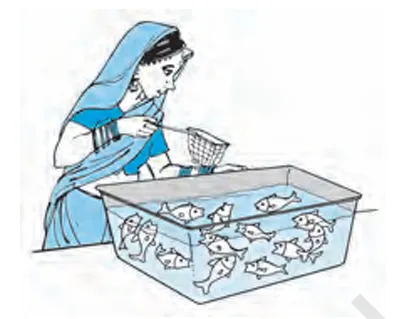
Gopi buys a fish from a shop. The tank contains 5 male fish and 8 female fish. What is the probability that the fish taken out is a male fish?

Fig. 14.4
Fig. 14.4

Theory: Probability of Selecting an Object

When one object is selected at random from a group of equally likely objects:

\[ P(E) = \frac{\text{Number of favourable outcomes}}{\text{Total number of outcomes}} \]

Solution Roadmap

  • Identify total number of fish.
  • Identify favourable outcomes (male fish).
  • Apply probability formula.

Solution

Step 1: Total number of outcomes

\[ \text{Total fish} = 5 + 8 = 13 \]

Step 2: Number of favourable outcomes

\[ \text{Number of male fish} = 5 \]

Step 3: Apply probability formula

\[ P(\text{male}) = \frac{5}{13} \]

Final Answer: Probability that the fish taken out is a male fish = \(\frac{5}{13}\)

Exam Significance

  • Direct application of basic probability formula.
  • Common 1–2 mark question in CBSE exams.
  • Tests clarity in identifying favourable outcomes.
  • Important for exams like NTSE, CUET, SSC.
← Q10
11 / 25  ·  44%
Q12 →
Q12
NUMERIC3 marks

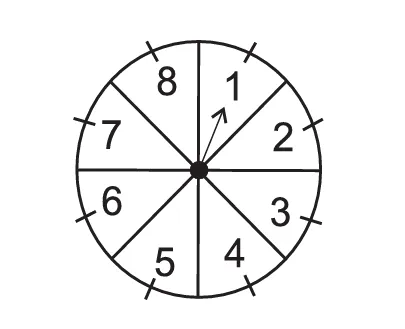
A spinner has numbers 1 to 8, all equally likely. Find the probability that it points at:

Fig. 14.5
Fig. 14.5

Theory: Equally Likely Outcomes

When all outcomes are equally likely:

\[ P(E) = \frac{\text{Number of favourable outcomes}}{\text{Total number of outcomes}} \]

Solution Roadmap

  • List all possible outcomes (1 to 8).
  • Identify favourable outcomes for each case.
  • Apply probability formula.
  • Simplify the result.
  1. 8
  2. an odd number
  3. a number greater than 2
  4. a number less than 9

Solution

Step 1: Total outcomes

\[ \begin{aligned} S &= \{1,2,3,4,5,6,7,8\}, \\ n(S) &= 8 \end{aligned} \]

(i) Probability of getting 8

\[ \begin{aligned} \text{Favourable outcomes} &= \{8\}, \\ n &= 1 \end{aligned} \] \[ P(8) = \frac{1}{8} \]

(ii) Probability of getting an odd number

\[ \begin{aligned} \text{Odd numbers} &= \{1,3,5,7\}, \\ n &= 4 \end{aligned} \] \[ \begin{aligned} P(\text{odd}) &= \frac{4}{8} \\&= \frac{1}{2} \end{aligned} \]

(iii) Probability of getting a number greater than 2

\[ \begin{aligned} \text{Numbers} &= \{3,4,5,6,7,8\}, \\ n &= 6 \end{aligned} \] \[ \begin{aligned} P(>2) &= \frac{6}{8} \\&= \frac{3}{4} \end{aligned} \]

(iv) Probability of getting a number less than 9

\[ \begin{aligned} \text{Numbers} &= \{1,2,3,4,5,6,7,8\}, \\ n &= 8 \end{aligned} \] \[ P(<9) = \frac{8}{8} = 1 \]
Final Answers:
(i) \( \frac{1}{8} \)
(ii) \( \frac{1}{2} \)
(iii) \( \frac{3}{4} \)
(iv) \( 1 \)

Exam Significance

  • Classic sample space-based probability question.
  • Tests ability to list outcomes correctly.
  • Very common in CBSE board exams (3–4 marks).
  • Useful for competitive exams like NTSE, CUET, SSC.
← Q11
12 / 25  ·  48%
Q13 →
Q13
NUMERIC3 marks

A die is thrown once. Find the probability of getting
(i) a prime number;
(ii) a number lying between 2 and 6;
(iii) an odd number.

Theory Used

When all outcomes of an experiment are equally likely, the probability of an event is

\[ P(E)=\frac{\text{Number of favourable outcomes}}{\text{Total number of possible outcomes}} \]

For a standard die, the sample space is:

\[ S=\{1,2,3,4,5,6\} \]

Hence, total number of possible outcomes is

\[ n(S)=6 \]

Solution Roadmap

  • Write the sample space of a die.
  • Identify the favourable outcomes for each part carefully.
  • Apply the probability formula step by step.
  • Simplify each fraction.
1 2 3 4 5 6 Sample space of a die: 1, 2, 3, 4, 5, 6 All 6 outcomes are equally likely

Solution

Step 1: Write the sample space

\[ S=\{1,2,3,4,5,6\} \] \[ n(S)=6 \]

(i) Probability of getting a prime number

Prime numbers on a die are:

\[ \{2,3,5\} \]

So, number of favourable outcomes

\[ n(E)=3 \]

Therefore,

\[ P(\text{prime number})=\frac{3}{6}=\frac{1}{2} \]

(ii) Probability of getting a number lying between 2 and 6

Numbers lying between 2 and 6 are:

\[ \{3,4,5\} \]

So, number of favourable outcomes

\[ n(F)=3 \]

Therefore,

\[ P(\text{number between }2\text{ and }6)=\frac{3}{6}=\frac{1}{2} \]

(iii) Probability of getting an odd number

Odd numbers on a die are:

\[ \{1,3,5\} \]

So, number of favourable outcomes

\[ n(G)=3 \]

Therefore,

\[ P(\text{odd number})=\frac{3}{6}=\frac{1}{2} \]

Final Answers

(i) Probability of getting a prime number = \(\frac{1}{2}\)
(ii) Probability of getting a number lying between 2 and 6 = \(\frac{1}{2}\)
(iii) Probability of getting an odd number = \(\frac{1}{2}\)

Why This Solution Matters for Exams

  • This question strengthens the idea of writing the sample space correctly before solving.
  • It is important for CBSE Board Exams because such direct probability questions are common as 1-mark and 2-mark questions.
  • It also helps competitive entrance exam aspirants practise quick identification of prime numbers, odd numbers, and interval-based outcomes.
  • Students often lose marks by missing favourable outcomes, so the explicit listing method used here is very useful.
← Q12
13 / 25  ·  52%
Q14 →
Q14
NUMERIC3 marks

One card is drawn from a well-shuffled deck of 52 cards. Find the probability of getting:
(i) a king of red colour
(ii) a face card
(iii) a red face card
(iv) the jack of hearts
(v) a spade
(vi) the queen of diamonds

Theory: Probability with Playing Cards

A standard deck of playing cards contains:

  • Total cards = \(52\)
  • 4 suits: hearts, diamonds (red), clubs, spades (black)
  • Each suit has 13 cards
  • Face cards = Jack, Queen, King (3 per suit)

Solution Roadmap

  • Total outcomes = 52
  • Identify favourable cards carefully
  • Apply probability formula
  • Simplify fractions

Solution

Total number of outcomes

\[ n(S)=52 \]

(i) A king of red colour

Red suits: hearts and diamonds → 2 kings

\[ P=\frac{2}{52}=\frac{1}{26} \]

(ii) A face card

Face cards per suit = 3 → total = \(4 \times 3 = 12\)

\[ P=\frac{12}{52}=\frac{3}{13} \]

(iii) A red face card

Red suits = 2, each has 3 face cards → total = 6

\[ P=\frac{6}{52}=\frac{3}{26} \]

(iv) The jack of hearts

Only one such card exists.

\[ P=\frac{1}{52} \]

(v) A spade

Spade suit contains 13 cards.

\[ P=\frac{13}{52}=\frac{1}{4} \]

(vi) The queen of diamonds

Only one such card exists.

\[ P=\frac{1}{52} \]
Final Answers:
(i) \( \frac{1}{26} \)
(ii) \( \frac{3}{13} \)
(iii) \( \frac{3}{26} \)
(iv) \( \frac{1}{52} \)
(v) \( \frac{1}{4} \)
(vi) \( \frac{1}{52} \)

Exam Significance

  • Tests understanding of card classification.
  • Very common CBSE board question (2–4 marks).
  • Helps in solving advanced probability problems.
  • Important for exams like NTSE, CUET, SSC.
← Q13
14 / 25  ·  56%
Q15 →
Q15
NUMERIC3 marks

Five cards—the 10, Jack, Queen, King and Ace of diamonds—are shuffled. One card is picked at random.

Theory: Probability without Replacement

When an object is drawn and not replaced, the total number of outcomes changes.

Probability formula:

\[ P(E)=\frac{\text{Number of favourable outcomes}}{\text{Total number of outcomes}} \]

Solution Roadmap

  • Identify total cards.
  • Count favourable outcomes.
  • Adjust total when a card is removed.

Solution

Step 1: Total number of cards

\[ n(S)=5 \]

(i) Probability of getting a queen

Only one queen is present.

\[ P(\text{queen})=\frac{1}{5} \]

(ii) Queen is drawn and removed

Remaining cards = 4

(a) Probability of getting an ace

One ace is present among 4 cards.

\[ P(\text{ace})=\frac{1}{4} \]

(b) Probability of getting a queen

Queen has already been removed.

\[ P(\text{queen})=0 \]
Final Answers:
(i) \( \frac{1}{5} \)
(ii) (a) \( \frac{1}{4} \), (b) \( 0 \)

Exam Significance

  • Tests understanding of without replacement concept.
  • Common mistake: forgetting total reduces after first draw.
  • Important for CBSE and competitive exams.
← Q14
15 / 25  ·  60%
Q16 →
Q16
NUMERIC3 marks

12 defective pens are mixed with 132 good pens. One pen is selected at random. Find the probability that it is a good pen.

Theory: Probability from Mixed Objects

When objects are mixed randomly, each has equal chance of being selected.

Solution Roadmap

  • Find total number of pens.
  • Identify favourable outcomes (good pens).
  • Apply probability formula.

Solution

Step 1: Total number of pens

\[ \text{Total} = 12 + 132 = 144 \]

Step 2: Favourable outcomes

\[ \text{Good pens} = 132 \]

Step 3: Apply formula

\[ P(\text{good pen})=\frac{132}{144} \]

Step 4: Simplify

\[ P(\text{good pen})=\frac{11}{12} \]
Final Answer: \( \frac{11}{12} \)

Exam Significance

  • Classic ratio-based probability question.
  • Tests simplification accuracy.
  • Frequently asked in CBSE exams (1–2 marks).
← Q15
16 / 25  ·  64%
Q17 →
Q17
NUMERIC3 marks

(i) A lot of 20 bulbs contains 4 defective ones. One bulb is drawn at random. Find the probability that it is defective.
(ii) If the bulb drawn is not defective and not replaced, find the probability that the next bulb drawn is also not defective.

Theory: Probability Without Replacement

When an object is drawn and not replaced, the total number of outcomes changes.

Probability formula:

\[ P(E)=\frac{\text{Number of favourable outcomes}}{\text{Total number of outcomes}} \]

Solution Roadmap

  • Find total bulbs and defective bulbs.
  • Compute probability using formula.
  • Update counts after first draw (without replacement).
  • Recalculate probability for second draw.

Solution

(i) Probability of drawing a defective bulb

Step 1: Total number of bulbs

\[ \text{Total bulbs} = 20 \]

Step 2: Number of defective bulbs

\[ \text{Defective bulbs} = 4 \]

Step 3: Apply probability formula

\[ P(\text{defective})=\frac{4}{20}=\frac{1}{5} \]

(ii) Second draw (first bulb was NOT defective)

Step 1: Update total bulbs

One non-defective bulb is removed.

\[ \text{Remaining bulbs} = 20 - 1 = 19 \]

Step 2: Update non-defective bulbs

\[ \text{Non-defective bulbs initially} = 20 - 4 = 16 \]

One non-defective bulb is removed:

\[ \text{Remaining non-defective bulbs} = 16 - 1 = 15 \]

Step 3: Apply probability formula

\[ P(\text{non-defective})=\frac{15}{19} \]
Final Answers:
(i) \( \frac{1}{5} \)
(ii) \( \frac{15}{19} \)

Exam Significance

  • Very important question on without replacement.
  • Tests logical updating of sample space.
  • Common 2–3 mark question in CBSE exams.
  • Highly useful for competitive exams like NTSE, CUET, SSC.
← Q16
17 / 25  ·  68%
Q18 →
Q18
NUMERIC3 marks

A box contains 90 discs numbered from 1 to 90. One disc is drawn at random. Find the probability that it bears:

Theory: Counting-Based Probability

When outcomes are equally likely:

\[ P(E)=\frac{\text{Number of favourable outcomes}}{\text{Total number of outcomes}} \]

Here, discs are numbered from 1 to 90.

Solution Roadmap

  • Identify total number of discs.
  • List/count favourable numbers carefully.
  • Apply probability formula.
  1. a two-digit number
  2. a perfect square number
  3. a number divisible by 5

Solution

Step 1: Total outcomes

\[ n(S)=90 \]

(i) Probability of a two-digit number

Two-digit numbers range from 10 to 90.

\[ \text{Count} = 90 - 10 + 1 = 81 \] \[ P(\text{two-digit})=\frac{81}{90}=\frac{9}{10} \]

(ii) Probability of a perfect square number

Perfect squares less than or equal to 90:

\[ 1,4,9,16,25,36,49,64,81 \] \[ \text{Count} = 9 \] \[ P(\text{perfect square})=\frac{9}{90}=\frac{1}{10} \]

(iii) Probability of a number divisible by 5

Numbers divisible by 5 between 1 and 90:

\[ 5,10,15,\dots,90 \] \[ \text{Count} = \frac{90}{5} = 18 \] \[ P(\text{divisible by 5})=\frac{18}{90}=\frac{1}{5} \]
Final Answers:
(i) \( \frac{9}{10} \)
(ii) \( \frac{1}{10} \)
(iii) \( \frac{1}{5} \)

Exam Significance

  • Tests number system concepts inside probability.
  • Common 3–4 mark question in CBSE exams.
  • Important for competitive exams (NTSE, CUET, SSC).
  • Students often lose marks in counting — careful listing is key.
← Q17
18 / 25  ·  72%
Q19 →
Q19
NUMERIC3 marks

A die has faces marked A, B, C, D, A, B. Find the probability of getting:

Theory: Probability with Repeated Outcomes

When outcomes repeat, probability depends on how many times a result appears.

\[ P(E)=\frac{\text{Number of favourable outcomes}}{\text{Total number of outcomes}} \]
A B C D A B Faces: A, B, C, D, A, B

Solution Roadmap

  • Identify total faces of the die.
  • Count how many times each letter appears.
  • Apply probability formula.
  1. A
  2. D

Solution

Step 1: Total outcomes

\[ n(S)=6 \]

(i) Probability of getting A

Letter A appears 2 times.

\[ P(A)=\frac{2}{6}=\frac{1}{3} \]

(ii) Probability of getting D

Letter D appears 1 time.

\[ P(D)=\frac{1}{6} \]
Final Answers:
(i) \( \frac{1}{3} \)
(ii) \( \frac{1}{6} \)

Exam Significance

  • Tests concept of repeated outcomes in probability.
  • Common 1–2 mark question in CBSE exams.
  • Important for logical counting in competitive exams.
← Q18
19 / 25  ·  76%
Q20 →
Q20
NUMERIC3 marks

A die is dropped randomly on a rectangular region. Find the probability that it lands inside a circle of diameter 1 m.

Fig. 14.6
Fig. 14.6

Theory: Geometric Probability

When outcomes depend on area:

\[ P(E)=\frac{\text{Favourable area}}{\text{Total area}} \]

Solution Roadmap

  • Find area of rectangular region.
  • Find radius and area of circle.
  • Apply probability formula.

Solution

Step 1: Area of rectangle

\[ \text{Length} = 3\,m,\quad \text{Breadth} = 2\,m \] \[ \text{Area of rectangle} = 3 \times 2 = 6\,m^2 \]

Step 2: Radius of circle

\[ \text{Diameter} = 1\,m \Rightarrow \text{Radius} = \frac{1}{2} = 0.5\,m \]

Step 3: Area of circle

\[ A_{\text{circle}}=\pi r^2 \] \[ = \pi (0.5)^2 = \pi \times 0.25 = \frac{\pi}{4} \]

Step 4: Apply probability formula

\[ P(E)=\frac{\text{Area of circle}}{\text{Area of rectangle}} \] \[ P(E)=\frac{\frac{\pi}{4}}{6} \]

Step 5: Simplify

\[ P(E)=\frac{\pi}{24} \]
Final Answer: \( \frac{\pi}{24} \)

Exam Significance

  • Important example of geometric probability.
  • Tests integration of mensuration + probability.
  • Common 3–4 mark question in CBSE exams.
  • Useful for higher-level exams and aptitude tests.
← Q19
20 / 25  ·  80%
Q21 →
Q21
NUMERIC3 marks

A lot contains 144 ball pens, of which 20 are defective. Nuri buys a pen only if it is good. One pen is drawn at random. Find the probability that:

Theory: Complementary Events

If E is an event, then:

\[ P(E)+P(\overline{E})=1 \]

Also,

\[ P(E)=\frac{\text{Number of favourable outcomes}}{\text{Total number of outcomes}} \]

Solution Roadmap

  • Find total pens and classify into good and defective.
  • Compute probability of selecting a good pen.
  • Use complement rule for defective case.
  1. she will buy it
  2. she will not buy it

Solution

Step 1: Total number of pens

\[ n(S)=144 \]

Step 2: Number of good pens

\[ \text{Good pens}=144-20=124 \]

(i) Probability that she will buy the pen (good pen)

\[ P(\text{buy})=\frac{124}{144} \]

Step 3: Simplify

\[ P(\text{buy})=\frac{31}{36} \]

(ii) Probability that she will not buy the pen (defective pen)

Method 1: Complement method

\[ P(\text{not buy})=1-P(\text{buy})=1-\frac{31}{36}=\frac{5}{36} \]

Method 2: Direct method

\[ P(\text{not buy})=\frac{20}{144}=\frac{5}{36} \]
Final Answers:
(i) \( \frac{31}{36} \)
(ii) \( \frac{5}{36} \)

Exam Significance

  • Tests understanding of real-life probability interpretation.
  • Important application of complement rule.
  • Common 2–3 mark question in CBSE exams.
  • Useful for competitive exams (NTSE, CUET, SSC).
← Q20
21 / 25  ·  84%
Q22 →
Q22
NUMERIC3 marks

efer to Example 13. (i) Complete the following table:

Event: ‘Sum on 2 dice’ 2 3 4 5 6 7 8 9 10 11 12
Probability \(\dfrac{1}{36}\) \(\color{orange}\dfrac{2}{36}\) \(\color{orange}\dfrac{3}{36}\) \(\color{orange}\dfrac{4}{36}\) \(\color{orange}\dfrac{5}{36}\) \(\color{orange}\dfrac{6}{36}\) \(\dfrac{5}{36}\) \(\color{orange}\dfrac{4}{36}\) \(\color{orange}\dfrac{3}{36}\) \(\color{orange}\dfrac{2}{36}\) \(\dfrac{1}{36}\)

Theory: Sum of Two Dice

When two dice are thrown, total outcomes are:

\[ 6 \times 6 = 36 \]

Each outcome is equally likely and represented as an ordered pair \((i,j)\).

Solution Roadmap

  • Total outcomes = 36
  • List all ordered pairs for each sum
  • Count favourable outcomes
  • Apply probability formula
All Possible Outcomes of Two Dice (36 outcomes) 1 2 3 4 5 6 1 2 3 4 5 6 (1,1) (1,2) (1,3) (1,4) (1,5) (1,6) (2,1) (2,2) (2,3) (2,4) (2,5) (2,6) (3,1) (3,2) (3,3) (3,4) (3,5) (3,6) (4,1) (4,2) (4,3) (4,4) (4,5) (4,6) (5,1) (5,2) (5,3) (5,4) (5,5) (5,6) (6,1) (6,2) (6,3) (6,4) (6,5) (6,6)

Solution

Total possible outcomes

\[ n(S)=36 \]

Sum = 2

\[ (1,1) \Rightarrow P=\frac{1}{36} \]

Sum = 3

\[ (1,2),(2,1) \Rightarrow P=\frac{2}{36} \]

Sum = 4

\[ (1,3),(2,2),(3,1) \Rightarrow P=\frac{3}{36} \]

Sum = 5

\[ (1,4),(2,3),(3,2),(4,1) \Rightarrow P=\frac{4}{36} \]

Sum = 6

\[ (1,5),(2,4),(3,3),(4,2),(5,1) \Rightarrow P=\frac{5}{36} \]

Sum = 7

\[ (1,6),(2,5),(3,4),(4,3),(5,2),(6,1) \Rightarrow P=\frac{6}{36} \]

Sum = 8

\[ (2,6),(3,5),(4,4),(5,3),(6,2) \Rightarrow P=\frac{5}{36} \]

Sum = 9

\[ (3,6),(4,5),(5,4),(6,3) \Rightarrow P=\frac{4}{36} \]

Sum = 10

\[ (4,6),(5,5),(6,4) \Rightarrow P=\frac{3}{36} \]

Sum = 11

\[ (5,6),(6,5) \Rightarrow P=\frac{2}{36} \]

Sum = 12

\[ (6,6) \Rightarrow P=\frac{1}{36} \]
Final Observation: Probabilities increase from sum 2 to 7 and then decrease symmetrically.

Exam Significance

  • Very important for sample space understanding.
  • Frequently used in higher probability problems.
  • Common base for conditional probability and games.
  • Asked in CBSE and competitive exams.
← Q21
22 / 25  ·  88%
Q23 →
Q23
NUMERIC3 marks

A die is thrown twice. Find the probability that:
5 does not come up either time
5 comes up at least once

Theory: Complement Rule in Probability

For any event E:

\[ P(E) + P(\overline{E}) = 1 \]

This is useful when “at least once” type questions are asked.

Solution Roadmap

  • Total outcomes for two dice = 36
  • Find outcomes where 5 appears
  • Use complement for “not coming”

Solution

Step 1: Total outcomes

\[ n(S)=6 \times 6 = 36 \]

Step 2: Count outcomes where 5 appears

5 can appear in:

  • First throw: (5,1),(5,2),(5,3),(5,4),(5,5),(5,6) → 6 outcomes
  • Second throw: (1,5),(2,5),(3,5),(4,5),(6,5) → 5 outcomes

Total outcomes where 5 appears = \(6 + 5 = 11\)

(i) Probability that 5 does NOT come at all

Using complement:

\[ P(\text{no 5}) = 1 - P(\text{at least one 5}) \] \[ = 1 - \frac{11}{36} = \frac{25}{36} \]

(ii) Probability that 5 comes at least once

\[ P(\text{at least one 5}) = \frac{11}{36} \]
Final Answers:
(i) \( \frac{25}{36} \)
(ii) \( \frac{11}{36} \)
Shortcut: Instead of counting 11 outcomes, you can directly compute:
Probability of NOT getting 5 in one throw = \( \frac{5}{6} \)
For two throws: \[ P(\text{no 5})=\left(\frac{5}{6}\right)^2=\frac{25}{36} \]

Exam Significance

  • Very important for “at least once” probability questions.
  • Tests understanding of complement rule.
  • Common 3-mark CBSE question.
  • Highly useful in competitive exams.
← Q22
23 / 25  ·  92%
Q24 →
Q24
NUMERIC3 marks

Which of the following arguments are correct? Give reasons.

Theory: Equally Likely Outcomes

Probability is based on equally likely outcomes in the sample space. Events may consist of one or more outcomes.

Solution Roadmap

  • Write correct sample space.
  • Check if outcomes are equally likely.
  • Count outcomes inside each event carefully.

Solution

(i) Statement about two coins

The argument is not correct.

Correct sample space:

\[ S=\{HH, HT, TH, TT\} \]

These are 4 equally likely outcomes.

Event breakdown:

  • Two heads → \(HH\) → 1 outcome
  • Two tails → \(TT\) → 1 outcome
  • One of each → \(HT, TH\) → 2 outcomes

Probabilities:

\[ P(\text{two heads})=\frac{1}{4} \] \[ P(\text{two tails})=\frac{1}{4} \] \[ P(\text{one of each})=\frac{2}{4}=\frac{1}{2} \]

These are not equal, so the claim of \( \frac{1}{3} \) each is incorrect.

(ii) Statement about a die

The argument is correct.

Sample space:

\[ S=\{1,2,3,4,5,6\} \]

Odd numbers:

\[ \{1,3,5\} \Rightarrow 3 \text{ outcomes} \]

Even numbers:

\[ \{2,4,6\} \Rightarrow 3 \text{ outcomes} \]

Probability:

\[ P(\text{odd})=\frac{3}{6}=\frac{1}{2} \]
Final Conclusion:
(i) Incorrect
(ii) Correct

Exam Significance

  • Tests conceptual clarity of sample space vs event.
  • Very common reasoning-based CBSE question.
  • Important for avoiding logical mistakes in probability.
  • Highly relevant for competitive exams.
← Q23
24 / 25  ·  96%
Q25 →
Q25
NUMERIC3 marks

One card is drawn from a well-shuffled deck of 52 cards. Find the probability of getting:
{i} a king of red colour
(ii) a face card
(iii) a red face card
(iv) the jack of hearts
(vi)the queen of diamonds<

Theory: Probability with Playing Cards

A standard deck of playing cards contains:

  • Total cards = \(52\)
  • 4 suits: hearts, diamonds (red), clubs, spades (black)
  • Each suit has 13 cards
  • Face cards = Jack, Queen, King (3 per suit)

Solution Roadmap

  • Total outcomes = 52
  • Identify favourable cards carefully
  • Apply probability formula
  • Simplify fractions

Solution

Total number of outcomes

\[ n(S)=52 \]

(i) A king of red colour

Red suits: hearts and diamonds → 2 kings

\[ P=\frac{2}{52}=\frac{1}{26} \]

(ii) A face card

Face cards per suit = 3 → total = \(4 \times 3 = 12\)

\[ P=\frac{12}{52}=\frac{3}{13} \]

(iii) A red face card

Red suits = 2, each has 3 face cards → total = 6

\[ P=\frac{6}{52}=\frac{3}{26} \]

(iv) The jack of hearts

Only one such card exists.

\[ P=\frac{1}{52} \]

(v) A spade

Spade suit contains 13 cards.

\[ P=\frac{13}{52}=\frac{1}{4} \]

(vi) The queen of diamonds

Only one such card exists.

\[ P=\frac{1}{52} \]
Final Answers:
(i) \( \frac{1}{26} \)
(ii) \( \frac{3}{13} \)
(iii) \( \frac{3}{26} \)
(iv) \( \frac{1}{52} \)
(v) \( \frac{1}{4} \)
(vi) \( \frac{1}{52} \)

Exam Significance

  • Tests understanding of card classification.
  • Very common CBSE board question (2–4 marks).
  • Helps in solving advanced probability problems.
  • Important for exams like NTSE, CUET, SSC.
← Q24
25 / 25  ·  100%
↑ Back to top
🎓

Chapter Complete!

All 25 solutions for Probability covered.

↑ Review from the top
NCERT Class X  ·  Chapter 14  ·  Exercise 14.1

Probability
Learning Engine

A complete, interactive study companion with formulas, step-by-step solutions, concept questions, and hands-on simulators — all in one place.

18
Concept Questions
6
Core Formulas
4
Interactive Modules
12
Tips & Traps
📐 Core Probability Formulas
All formulas you need for NCERT Class X Chapter 14, Exercise 14.1
Formula 01
Probability of an Event
P(E) = Number of favourable outcomes
─────────────────────────
Total number of outcomes
This is the foundational formula. Every probability problem roots here. Favourable outcomes = outcomes where the event occurs.
Formula 02
Complementary Events
P(E) + P(Ē) = 1
⟹ P(Ē) = 1 − P(E)
Ē (read: E-bar) is the complement of E. If E = "getting a 6", then Ē = "not getting a 6". Together they cover all possibilities.
Formula 03
Probability Bounds
0 ≤ P(E) ≤ 1
Probability is always between 0 and 1 inclusive. P(E) = 0 means impossible; P(E) = 1 means certain.
Formula 04
Impossible & Sure Events
P(impossible event) = 0
P(sure/certain event) = 1
E.g. rolling a 7 on a standard die → P = 0. Rolling a number ≤ 6 on a standard die → P = 1.
Formula 05
Sample Space of Cards (52-card deck)
Total = 52
Suits: ♠ ♥ ♦ ♣ (13 each)
Face cards per suit: J, Q, K (= 3)
Total face cards = 12
Aces are NOT face cards. Red cards = ♥ + ♦ = 26. Black cards = ♠ + ♣ = 26.
Formula 06
Expected Value (Weighted Average)
E(X) = Σ [ xᵢ × P(xᵢ) ]
Used when outcomes have numerical values and known probabilities. Multiply each outcome by its probability and sum them all.
🎲 Key Sample Spaces at a Glance
Reference these while solving problems — no need to re-derive each time
Standard Die
1 Dice Roll
S = {1, 2, 3, 4, 5, 6}
n(S) = 6
Even: {2,4,6} → P = 3/6 = 1/2
Prime: {2,3,5} → P = 3/6 = 1/2
Perfect square: {1,4} → P = 2/6 = 1/3
Two Dice
2 Dice Roll
n(S) = 6 × 6 = 36
Sum range: 2 to 12
Sum = 7 → 6 ways: (1,6),(2,5),(3,4),(4,3),(5,2),(6,1) → P = 6/36 = 1/6
Coin Toss
1 Coin Toss
S = {H, T}
n(S) = 2
2 Coins: n(S) = 4 → {HH, HT, TH, TT}
3 Coins: n(S) = 8
🤖 Step-by-Step AI Solver
Select a problem type or describe your question — get a fully worked solution
💡 Concept-Building Questions
Original questions organised by concept — not from the textbook, but built to deepen understanding
Easy A box contains 4 green, 6 white, and 5 yellow marbles. If one marble is picked at random, what is the probability it is NOT yellow?
1
Identify total outcomes.
Total marbles = 4 + 6 + 5 = 15
2
Favourable outcomes (NOT yellow).
Non-yellow = green + white = 4 + 6 = 10
3
Apply the formula.
P(not yellow) = 10 / 15 = 2/3
4
Verify with complement.
P(yellow) = 5/15 = 1/3
P(not yellow) = 1 − 1/3 = 2/3
∴ P(not yellow) = 2/3 ≈ 0.667
Easy The probability that it will rain tomorrow is 0.35. What is the probability that it will NOT rain tomorrow?
1
Identify known probability.
P(rain) = 0.35
2
Use complementary rule.
P(not rain) = 1 − P(rain) = 1 − 0.35 = 0.65
3
Check bounds.
0.35 + 0.65 = 1 ✓ (probabilities sum to 1)
∴ P(no rain) = 0.65
Medium A bag contains 3 defective and 9 non-defective bulbs. Two scenarios: (i) What is the probability of picking a non-defective bulb? (ii) If the first bulb picked was non-defective and set aside, what is the probability the second pick is also non-defective?
1
Part (i): First pick.
Total = 12, Non-defective = 9
P(non-defective) = 9/12 = 3/4
2
Part (ii): Second pick (conditional).
After removing 1 non-defective: Total = 11, Non-defective remaining = 8
P(2nd non-defective | 1st was non-defective) = 8/11
3
Key insight: When items are removed without replacement, the sample space shrinks. Always update the total!
∴ (i) P = 3/4  |  (ii) P = 8/11
Medium Numbers 1 to 20 are written on slips of paper and placed in a box. One slip is drawn at random. Find the probability that the number on the slip is: (i) a multiple of 3 or 5, (ii) a perfect square.
1
Identify the sample space.
S = {1,2,3,...,20}, n(S) = 20
2
Part (i): Multiples of 3 or 5.
Multiples of 3 in 1–20: {3,6,9,12,15,18} → 6 numbers
Multiples of 5 in 1–20: {5,10,15,20} → 4 numbers
Common (both 3 and 5 = 15): {15} → 1 number
Union = 6 + 4 − 1 = 9
P = 9/20
3
Part (ii): Perfect squares.
{1, 4, 9, 16} → 4 numbers
P = 4/20 = 1/5
∴ (i) P = 9/20  |  (ii) P = 1/5
Easy In a class of 40 students, the probability of selecting a student who passed the exam is 7/8. How many students failed?
1
Find P(failed).
P(failed) = 1 − P(passed) = 1 − 7/8 = 1/8
2
Convert to number of students.
Number who failed = (1/8) × 40 = 5 students
∴ 5 students failed the exam.
Medium Can the probabilities of three mutually exclusive events A, B, and C be 0.3, 0.4, and 0.4 respectively? Justify your answer.
1
Check the total.
If A, B, C are mutually exclusive and exhaustive, then P(A) + P(B) + P(C) must equal 1.
2
Add the given probabilities.
0.3 + 0.4 + 0.4 = 1.1 > 1
3
Conclusion.
Since 1.1 exceeds 1, which violates the axiom P(S) = 1, this set of probabilities is not valid.
∴ No — these probabilities are impossible. The sum exceeds 1.
Hard Event A has probability p and event B has probability 2p. If A and B are mutually exclusive and exhaustive (cover the entire sample space with a third event C of probability 1/4), find p.
1
Set up equation using P(S) = 1.
P(A) + P(B) + P(C) = 1
p + 2p + 1/4 = 1
2
Solve for p.
3p = 1 − 1/4 = 3/4
p = 1/4
3
Verify.
P(A) = 1/4, P(B) = 1/2, P(C) = 1/4
Sum = 1/4 + 1/2 + 1/4 = 1 ✓
∴ p = 1/4
Easy From a well-shuffled deck of 52 cards, one card is drawn. Find the probability of getting a card that is either a King or a Heart.
1
Total cards = 52.
2
Count Kings: 4 (one per suit)
3
Count Hearts: 13 (one full suit)
4
Overlap (King of Hearts): 1 card is both King and Heart
5
Apply Addition Rule:
Favourable = 4 + 13 − 1 = 16
P = 16/52 = 4/13
∴ P(King or Heart) = 4/13
Medium From a deck of 52 cards, all face cards are removed. A card is then drawn at random. Find: (i) P(a prime number card) (ii) P(a card with value > 7)
1
After removing face cards:
Face cards = 12 (J, Q, K × 4 suits)
Remaining = 52 − 12 = 40 cards
These are: A (=1), 2, 3, 4, 5, 6, 7, 8, 9, 10 × 4 suits
2
Part (i): Prime number cards.
Primes in {1,2,...,10}: {2, 3, 5, 7} → 4 values
Each appears in 4 suits → 4 × 4 = 16 cards
P = 16/40 = 2/5
3
Part (ii): Value > 7.
Cards with value > 7: {8, 9, 10} → 3 values
3 × 4 = 12 cards
P = 12/40 = 3/10
∴ (i) P = 2/5  |  (ii) P = 3/10
Hard Two cards are drawn simultaneously from a well-shuffled deck of 52 cards. Find the probability that both are red cards.
1
Total ways to choose 2 from 52.
n(S) = C(52,2) = (52 × 51) / 2 = 1326
2
Favourable: choose 2 red cards from 26.
n(E) = C(26,2) = (26 × 25) / 2 = 325
3
Calculate probability.
P = 325/1326 = 25/102
∴ P(both red) = 25/102 ≈ 0.245
Easy A fair die is rolled once. What is the probability that the outcome is an odd prime number?
1
Sample space: S = {1, 2, 3, 4, 5, 6}, n(S) = 6
2
Odd primes in S:
Primes = {2, 3, 5}  |  Odd primes = {3, 5} → 2 outcomes
(Note: 2 is prime but even; 1 is neither prime nor composite)
3
Probability: P = 2/6 = 1/3
∴ P(odd prime) = 1/3
Medium Two dice are thrown simultaneously. Find the probability that the product of the numbers appearing is 12.
1
Total outcomes: 6 × 6 = 36
2
Find pairs where product = 12.
(2,6), (6,2), (3,4), (4,3) → 4 pairs
3
Calculate: P = 4/36 = 1/9
∴ P(product = 12) = 1/9
Hard Three dice are thrown simultaneously. Find the probability that the sum of all three dice is exactly 10.
1
Total outcomes: 6³ = 216
2
Enumerate triples (a,b,c) with a+b+c = 10, each 1–6.
This requires careful counting:
• (1,3,6)→6 perms, (1,4,5)→6, (2,2,6)→3, (2,3,5)→6, (2,4,4)→3, (3,3,4)→3
Total favourable = 6+6+3+6+3+3 = 27
3
Probability: P = 27/216 = 1/8
∴ P(sum = 10) = 1/8
Easy A traffic signal is green for 45 seconds and red for 30 seconds out of every 90-second cycle. A car arrives randomly. What is the probability it sees a red signal?
1
Understand the cycle:
Total cycle = 90 sec. Red = 30 sec. Yellow = 90 − 45 − 30 = 15 sec.
2
Treat time as proportion of outcomes.
P(red) = 30/90 = 1/3
∴ P(red signal) = 1/3 ≈ 0.333
Medium In a school, 52 students play cricket, 30 play football, and 18 play both. If a student is selected at random from 100 students, find the probability that the student plays at least one sport.
1
Apply Union Formula.
|Cricket ∪ Football| = 52 + 30 − 18 = 64
2
Calculate probability.
P(at least one sport) = 64/100 = 16/25
3
P(no sport): 1 − 16/25 = 9/25
∴ P(at least one sport) = 16/25 = 0.64
Hard A manufacturing unit produces 500 pens per day. On a given day, 15 are found defective. A quality inspector picks 2 pens at random. What is the probability that exactly one is defective?
1
Setup: Defective = 15, Non-defective = 485, Total = 500
2
Total ways to pick 2 pens:
C(500,2) = (500 × 499)/2 = 124,750
3
Favourable (1 defective, 1 non-defective):
C(15,1) × C(485,1) = 15 × 485 = 7,275
4
Probability:
P = 7275/124750 = 291/4990 ≈ 0.0583
∴ P(exactly 1 defective) = 291/4990 ≈ 5.83%
Tips, Tricks & Common Mistakes
Master these patterns to avoid losing marks in exams
Pro Tips
💡
Always simplify fractionsP(E) = 6/52 should be written as 3/26 in the final answer. Examiners expect simplified form.
🎯
Use the complement trickWhen it's hard to count favourable outcomes, count the unfavourable ones and use P(E) = 1 − P(Ē). This often simplifies calculations dramatically.
📊
List out the sample spaceFor problems with small sample spaces (dice, coins, cards with conditions), physically listing all outcomes prevents errors in counting.
🔢
Memorise key card deck facts52 cards, 4 suits (13 each), 12 face cards, 4 aces, 26 red, 26 black. These come up in nearly every exam paper.
⚖️
Sanity check with boundsAfter computing, confirm: 0 ≤ P(E) ≤ 1. If your answer is negative or greater than 1, you've made an error somewhere.
🔁
Without replacement changes the denominatorWhen problems say "drawn one after another without replacement", remember to reduce the total after each draw.
⚠️ Common Mistakes to Avoid
Treating 1 as a prime number1 is NOT a prime number. If a question asks for prime outcomes on a die, the answer is {2, 3, 5}, not {1, 2, 3, 5}.
Including Ace as a face cardAces are NOT face cards. Face cards = Jack, Queen, King only (12 total). Aces are separate number cards.
Forgetting ordered vs unordered pairs in dice(2, 3) and (3, 2) are TWO different outcomes when rolling two dice — they are ordered pairs.
Double-counting overlapping eventsWhen finding P(A or B), always subtract the overlap: n(A∪B) = n(A) + n(B) − n(A∩B). Forgetting this is the #1 error in card problems.
Not considering ALL favourable outcomesFor "sum > 9" with two dice, students often miss outcomes like (4,6), (5,5), (5,6), (6,4), (6,5), (6,6). List them systematically.
Confusing experimental and theoretical probabilityThe formula P(E) = favourable/total gives THEORETICAL probability. Experimental probability is based on actual trials and may differ.
🎮 Interactive Learning Lab
Choose a module to practice, simulate, and build intuition for probability
🧠
MCQ Quiz
Test your understanding with 10 carefully crafted multiple-choice questions. Instant feedback with explanations.
Start Quiz →
🎲
Probability Simulator
Run hundreds of random trials for dice, coins, and cards. See how experimental probability converges to theoretical.
Open Simulator →
🎡
Spinner Wheel
Spin a customisable probability wheel. Visually understand equally and unequally likely outcomes.
Spin the Wheel →
🔵
Venn Diagram Explorer
Visualise union, intersection, and complement of events through interactive Venn diagrams.
Explore →
🧠 Probability MCQ Quiz
🎲 Probability Simulator
Click "Run" to start the simulation
🎡 Probability Spinner
Choose a spinner type below. Each coloured section represents an event. The size of the section corresponds to the probability of landing on it.
🔵 Venn Diagram Explorer
📖 Notation Guide
All symbols and terms used in Chapter 14 — Probability
Symbol / Term Meaning Example
P(E) Probability of event E occurring P(Head) = 1/2
P(Ē) Probability of event E NOT occurring (complement) P(not Head) = 1/2
S Sample space — set of all possible outcomes S = {H, T} for a coin
n(S) Number of elements in sample space n(S) = 6 for a die
n(E) Number of favourable outcomes for event E n(prime on die) = 3
A ∪ B Union — A or B (or both) occur King or Heart
A ∩ B Intersection — both A and B occur King AND Heart = King of Hearts
A − B A but not B King but not Heart (3 cards)
Mutually Exclusive Events that cannot occur simultaneously Getting Head and Tail in 1 toss
Exhaustive Events Events that together cover the entire sample space {Head, Tail} for a coin toss
Equally Likely Each outcome has an equal chance of occurring Each side of a fair die
Empirical P Based on actual experiment: freq/total trials Getting 3 heads in 10 tosses → P = 3/10
Theoretical P Based on logic/formula, ideal conditions P(Head) = 1/2 by symmetry
🃏 Playing Card Quick Reference
TOTAL CARDS
52
4 suits × 13 cards each
FACE CARDS
12
J, Q, K × 4 suits (no Ace)
RED CARDS
26
♥ Hearts + ♦ Diamonds
BLACK CARDS
26
♠ Spades + ♣ Clubs
📚
ACADEMIA AETERNUM तमसो मा ज्योतिर्गमय · Est. 2025
Sharing this chapter
Probability | Mathematics Class 10 | Academia Aeternum
Probability | Mathematics Class 10 | Academia Aeternum — Complete Notes & Solutions · academia-aeternum.com
The textbook exercises of Probability serve as a critical bridge between conceptual understanding and confident application. This chapter requires students to move beyond memorising formulas and engage deeply with logical reasoning, accurate outcome identification, and disciplined counting. The solutions presented here are structured to guide learners step by step, ensuring clarity at every stage of reasoning. Each solution emphasises the correct formation of the sample space, careful…
🎓 Class 10 📐 Mathematics 📖 NCERT ✅ Free Access 🏆 CBSE · JEE
Share on
academia-aeternum.com/class-10/mathematics/probability/exercises/exercise-14.1/ Copy link
💡
Exam tip: Sharing chapter notes with your study group creates a reinforcement loop. Teaching a concept is the fastest path to mastering it.

Recent posts

    Get in Touch

    Let's Connect

    Questions, feedback, or suggestions?
    We'd love to hear from you.