Ch 6  ยท  Qโ€“
0%
Class 10 Mathematics Exercise 6.3 NCERT Solutions Olympiad Board Exam

Chapter 6 โ€” TRIANGLES

Step-by-step NCERT solutions with stressโ€“strain analysis and exam-oriented hints for Boards, JEE & NEET.

๐Ÿ“‹16 questions
โฑIdeal time: 50-70 min
๐Ÿ“Now at: Q1
Q1
NUMERIC3 marks

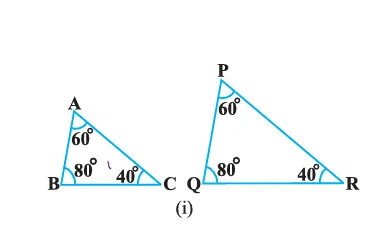
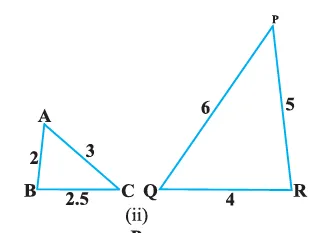
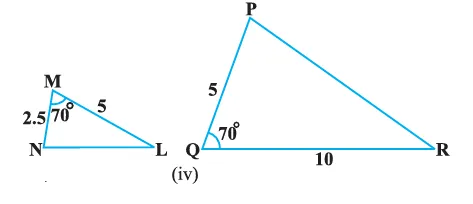
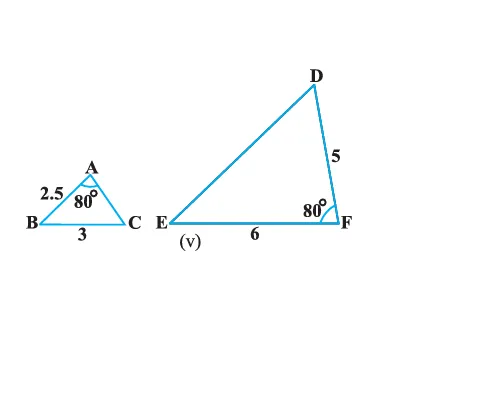
State which pairs of triangles in Fig. 6.34 are similar. Write the similarity criterion used by you for answering the question and also write the pairs of similar triangles in the symbolic form :

Concept Used

  • Two triangles are similar if:
    • AAA (or AA): Corresponding angles are equal
    • SSS: Corresponding sides are proportional
    • SAS: Two sides are proportional and included angle is equal
  • Correct order of vertices must be maintained while writing similarity
  • Ratios must be consistent across all corresponding sides

Solution Roadmap

  • Step 1: Identify given angles or sides
  • Step 2: Match corresponding vertices carefully
  • Step 3: Check one similarity criterion (AAA / SSS / SAS)
  • Step 4: Verify ALL required conditions
  • Step 5: Write symbolic form correctly
Fig. 6.34
Fig. 6.34.1

In ฮ”ABC and ฮ”PQR:

\[\angle A = \angle P\] \[\angle B = \angle Q\] \[\angle C = \angle R\]

All three corresponding angles are equal.

\[\therefore \triangle ABC \sim \triangle PQR\]

Criterion: AAA similarity


Fig. 6.34-2
Fig. 6.34.2

Given sides:

\[\frac{AB}{PQ} = \frac{2}{4} = \frac{1}{2}\] \[\frac{BC}{QR} = \frac{2.5}{5} = \frac{1}{2}\] \[\frac{AC}{PR} = \frac{3}{6} = \frac{1}{2}\]

All three ratios are equal.

\[\therefore \triangle ABC \sim \triangle PQR\]

Criterion: SSS similarity

Correction Applied: Earlier side pairing was incorrect (BC matched with PR). Now corrected.
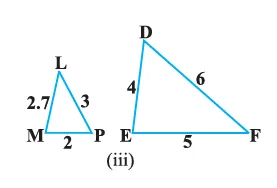

Fig. 6.34-3
Fig. 6.34.3
\[\frac{MP}{DE} = \frac{2}{4} = \frac{1}{2}\] \[\frac{LP}{DF} = \frac{3}{6} = \frac{1}{2}\] \[\frac{LM}{EF} = \frac{2.7}{5} \neq \frac{1}{2}\]

Since all three ratios are NOT equal:

\[\therefore \triangle LMP \not\sim \triangle DEF\]

Reason: SSS condition fails


Fig. 6.34-4
Fig. 6.34.4
\[\frac{MN}{PQ} = \frac{5}{10} = \frac{1}{2}\] \[\frac{ML}{QR} = \frac{5}{10} = \frac{1}{2}\] \[\angle M = \angle Q\]

Two sides are proportional and included angle is equal.

\[\therefore \triangle MNL \sim \triangle QRP\]

Criterion: SAS similarity

Correction Applied: Earlier expression "2ยท5/5" was invalid and removed.


Fig. 6.34-5
Fig. 6.34.5
\[\angle A = \angle F\] \[\frac{AB}{FD} = \frac{2}{5}\]

Only one angle and one side ratio is known.

Second side or angle is missing.

Conclusion: Similarity cannot be established.
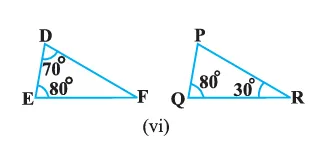

Fig. 6.34.6
Fig. 6.34.6
\[\angle D = \angle P = 70^\circ\] \[\angle E = \angle Q = 80^\circ\] \[\angle F = \angle R = 30^\circ\]

All corresponding angles are equal.

\[\therefore \triangle DEF \sim \triangle PQR\]

Criterion: AAA similarity

Exam Significance

  • Very important for CBSE Board Exams (2โ€“4 marks direct questions)
  • Forms base for height-distance and trigonometry applications
  • Frequently used in:
    • NTSE
    • Olympiads
    • JEE Foundation level
  • Common mistakes tested:
    • Wrong correspondence of vertices
    • Incorrect ratio pairing
    • Using incomplete conditions
โ†‘ Top
1 / 16  ยท  6%
Q2 โ†’
Q2
NUMERIC3 marks

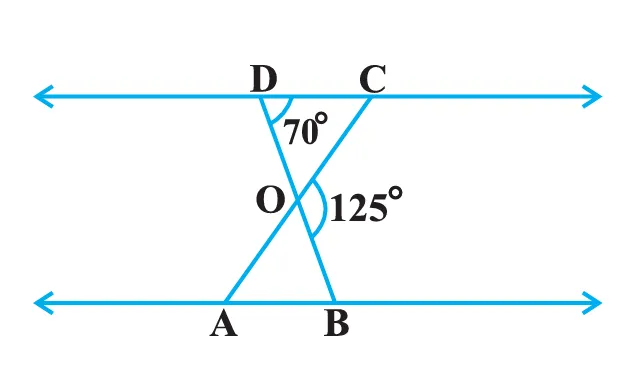
In Fig. 6.35, \( \triangle ODC \sim \triangle OBA \), \( \angle BOC = 125^\circ \), \( \angle CDO = 70^\circ \). Find \( \angle DOC \), \( \angle DCO \) and \( \angle OAB \).

Fig. 6.35
Fig. 6.35

Solution

\[\triangle ODC \sim \triangle OBA \quad \text{(Given)}\]

From similarity, corresponding angles are equal:

\[\angle ODC = \angle OBA\] \[\angle CDO = 70^\circ \Rightarrow \angle OBA = 70^\circ\]

Now consider angles around point O:

\[\angle BOC = 125^\circ\] \[\angle DOA = 125^\circ \quad \text{(Vertically opposite)}\]

Let \( \angle DOC = x \)

\[\text{Sum of angles around point } O = 360^\circ\] \[125^\circ + 125^\circ + x + x = 360^\circ\] \[250^\circ + 2x = 360^\circ\] \[2x = 110^\circ\] \[x = 55^\circ\] \[\therefore \angle DOC = 55^\circ\]

Now in \( \triangle ODC \):

\[\angle DOC + \angle ODC + \angle DCO = 180^\circ\] \[55^\circ + 70^\circ + \angle DCO = 180^\circ\] \[\angle DCO = 180^\circ - 125^\circ\] \[\angle DCO = 55^\circ\]

Now in \( \triangle OBA \):

\[\angle OAB + \angle OBA + \angle AOB = 180^\circ\] \[\angle OAB + 70^\circ + 55^\circ = 180^\circ\] \[\angle OAB = 180^\circ - 125^\circ\] \[\angle OAB = 55^\circ\]

Final Answers:

\[\angle DOC = 55^\circ\] \[\angle DCO = 55^\circ\] \[\angle OAB = 55^\circ\]

Exam Significance

  • Classic CBSE Board question combining similarity + angle properties
  • Tests multi-step reasoning (not direct formula)
  • Frequently appears in 3โ€“5 mark questions
  • Important for:
    • NTSE Stage 1
    • Olympiad geometry
    • JEE Foundation
  • Common traps:
    • Wrong angle correspondence
    • Forgetting angles around a point
    • Skipping triangle angle sum step
โ† Q1
2 / 16  ยท  13%
Q3 โ†’
Q3
NUMERIC3 marks

Diagonals AC and BD of a trapezium ABCD with AB โˆฅ DC intersect at O. Prove that \( \dfrac{OA}{OC} = \dfrac{OB}{OD} \)

Concept Used

  • If two lines are parallel, alternate interior angles are equal
  • Vertically opposite angles are equal
  • If two triangles are similar, corresponding sides are proportional
  • AA similarity is sufficient to prove triangles similar

Solution Roadmap

  • Identify triangles formed by diagonals
  • Use parallel lines to establish equal angles
  • Apply AA similarity
  • Use proportional sides property of similar triangles
A B C D O

Trapezium ABCD with AB โˆฅ DC

Solution

Given:

\[AB \parallel DC\]

Consider triangles \( \triangle AOB \) and \( \triangle COD \)


Step 1: Establish angle equality

\[\angle ABO = \angle CDO \quad \text{(Alternate interior angles)}\] \[\angle BAO = \angle DCO \quad \text{(Alternate interior angles)}\] \[\angle AOB = \angle COD \quad \text{(Vertically opposite angles)}\]

Step 2: Apply similarity

Since two angles are equal, triangles are similar by AA criterion:

\[\therefore \triangle AOB \sim \triangle COD\]

Step 3: Use proportional sides

\[\frac{AO}{CO} = \frac{BO}{DO}$$

Final Result:

\[\boxed{\dfrac{OA}{OC} = \dfrac{OB}{OD}}\]

Exam Significance

  • Highly important proof question in CBSE Board (3โ€“4 marks)
  • Tests understanding of:
    • Parallel lines
    • Angle properties
    • Triangle similarity
  • Frequently used as base concept in:
    • Coordinate geometry
    • Mensuration proofs
    • Competitive exams (NTSE, Olympiads)
  • Common mistakes:
    • Wrong triangle selection
    • Incorrect angle correspondence
    • Using BPT unnecessarily (not needed here)
โ† Q2
3 / 16  ยท  19%
Q4 โ†’
Q4
NUMERIC3 marks

In Fig. 6.36, \( \dfrac{QR}{QS} = \dfrac{QT}{PR} \) and \( \angle 1 = \angle 2 \). Show that \( \triangle PQS \sim \triangle TQR \).

Concept Used

  • If two sides of one triangle are proportional to two sides of another triangle and the included angle is equal, triangles are similar (SAS)
  • Careful identification of corresponding sides is essential
  • No assumption should be made unless given or derived

Solution Roadmap

  • Use given ratio and rewrite in usable form
  • Identify triangles to compare
  • Match corresponding sides correctly
  • Use given angle equality as included angle
  • Apply SAS similarity
P S R Q T 1 2

Fig. 6.36 (Illustration)

Solution

Given:

\[\frac{QR}{QS} = \frac{QT}{PR}\] \[\angle 1 = \angle 2\]

Step 1: Rearrange the given ratio

\[\frac{QS}{QR} = \frac{PR}{QT}\]

Step 2: Identify corresponding sides

In triangles \( \triangle PQS \) and \( \triangle TQR \):
  • QS corresponds to QR
  • PS corresponds to QT

Step 3: Use given angle equality

\[\angle PQS = \angle TQR \quad \text{(Given: โˆ 1 = โˆ 2)}\]

Step 4: Apply SAS similarity

Two sides are proportional and included angle is equal: \[\therefore \triangle PQS \sim \triangle TQR\]

Conclusion:

\[\boxed{\triangle PQS \sim \triangle TQR}\]

Exam Significance

  • Important proof question based on SAS similarity
  • Tests ability to:
    • Manipulate ratios
    • Identify correct triangle pairs
    • Avoid invalid assumptions
  • Frequently asked in CBSE (3โ€“4 marks)
  • Foundation concept for:
    • Trigonometry proofs
    • Coordinate geometry
    • Olympiad problems
  • Common mistakes:
    • Assuming equal sides without proof
    • Wrong correspondence of triangles
    • Using incorrect angle for SAS
โ† Q3
4 / 16  ยท  25%
Q5 โ†’
Q5
NUMERIC3 marks

S and T are points on sides PR and QR of \( \triangle PQR \) such that \( \angle P = \angle RTS \). Show that \( \triangle RPQ \sim \triangle RTS \).

Concept Used

  • If two angles of one triangle are equal to two angles of another triangle, triangles are similar (AA)
  • Points lying on the same line form equal straight-line angles
  • Collinearity helps in identifying equal angles

Solution Roadmap

  • Identify triangles to compare
  • Use given angle equality
  • Use collinearity (S on PR, T on QR) to find second angle pair
  • Apply AA similarity
P Q R S T

Triangle PQR with S on PR and T on QR

Solution

Given:

\[\angle P = \angle RTS\]

Step 1: Identify triangles

Consider triangles \( \triangle RPQ \) and \( \triangle RTS \)

Step 2: Use given angle

\[\angle RPQ = \angle RTS \quad \text{(Given)}\]

Step 3: Use collinearity

Since:
  • S lies on PR
  • T lies on QR
Therefore: \[\angle RQP = \angle RST\]

(Angles formed by the same lines QR and PR)


Step 4: Apply AA similarity

Two corresponding angles are equal: \[\therefore \triangle RPQ \sim \triangle RTS\]

Conclusion:

\[\boxed{\triangle RPQ \sim \triangle RTS}\]

Exam Significance

  • Classic AA similarity proof (frequently asked in CBSE)
  • Tests understanding of:
    • Collinearity
    • Angle correspondence
    • Triangle matching
  • Used in advanced geometry proofs and trigonometry
  • Common mistakes:
    • Calling angles โ€œcommonโ€ when they are not
    • Ignoring straight-line relationships
    • Wrong triangle order
โ† Q4
5 / 16  ยท  31%
Q6 โ†’
Q6
NUMERIC3 marks

In Fig. 6.37, if \( \triangle ABE \cong \triangle ACD \), show that \( \triangle ADE \sim \triangle ABC \).

Concept Used

  • If two triangles are congruent, their corresponding parts are equal (CPCT)
  • If two sides are proportional and included angle is equal, triangles are similar (SAS)
  • Correct identification of corresponding parts is essential

Solution Roadmap

  • Use congruence to extract equal sides
  • Form ratios of corresponding sides
  • Identify included angle
  • Apply SAS similarity
B C A D E

Fig. 6.37 (Illustration)

Solution

Given:

\[\triangle ABE \cong \triangle ACD\]

Step 1: Use CPCT

From congruence: \[AE = AD \quad \text{(Corresponding sides)}\] \[AB = AC \quad \text{(Corresponding sides)}\]

Step 2: Form ratio

\[\frac{AD}{AB} = \frac{AE}{AC}\]

Step 3: Identify included angle

\[\angle DAE = \angle BAC\]

(Same angle at vertex A)


Step 4: Apply SAS similarity

Two sides are proportional and included angle is equal: \[\therefore \triangle ADE \sim \triangle ABC\]

Conclusion:

\[\boxed{\triangle ADE \sim \triangle ABC}\]

Exam Significance

  • Important mixed concept question (Congruence + Similarity)
  • Tests ability to:
    • Use CPCT correctly
    • Convert equality into ratios
    • Apply SAS logically
  • Common in CBSE 3โ€“5 mark questions
  • Also relevant for:
    • Olympiad geometry
    • NTSE
    • JEE foundation
  • Common mistakes:
    • Forgetting included angle in SAS
    • Wrong correspondence from CPCT
    • Skipping ratio formation step
โ† Q5
6 / 16  ยท  38%
Q7 โ†’
Q7
NUMERIC3 marks

In Fig. 6.38, altitudes AD and CE of \( \triangle ABC \) intersect at P. Show that:

Concept Used

  • Altitude of a triangle is perpendicular to the opposite side
  • Perpendicular lines form right angles (90ยฐ)
  • Vertically opposite angles are equal
  • If two angles are equal, triangles are similar (AA)

Solution Roadmap

  • Use AD โŸ‚ BC and CE โŸ‚ AB
  • Identify right angles
  • Use vertical angles at intersection P
  • Apply AA similarity carefully with correct correspondence
B C A D E P

Altitudes AD and CE intersect at P

  1. \( \triangle AEP \sim \triangle CDP \)
  2. \( \triangle ABD \sim \triangle CBE \)
  3. \( \triangle AEP \sim \triangle ADB \)
  4. \( \triangle PDC \sim \triangle BEC \)

Solution

(i) In ฮ”AEP and ฮ”CDP

\[\angle AEP = 90^\circ \quad (\text{CE โŸ‚ AB})\] \[\angle CDP = 90^\circ \quad (\text{AD โŸ‚ BC})\] \[\angle APE = \angle CPD \quad (\text{Vertically opposite})\] \[\therefore \triangle AEP \sim \triangle CDP \quad (\text{AA})\]

(ii) In ฮ”ABD and ฮ”CBE

\[\angle ADB = 90^\circ \quad (\text{AD โŸ‚ BC})\] \[\angle CEB = 90^\circ \quad (\text{CE โŸ‚ AB})\] \[\angle ABD = \angle CBE \quad (\text{Common angle at B})\] \[\therefore \triangle ABD \sim \triangle CBE \quad (\text{AA})\]

(iii) In ฮ”AEP and ฮ”ADB

\[\angle AEP = 90^\circ\] \[\angle ADB = 90^\circ\] \[\angle EAP = \angle DAB \quad (\text{Same angle at A})\] \[\therefore \triangle AEP \sim \triangle ADB \quad (\text{AA})\]

(iv) In ฮ”PDC and ฮ”BEC

\[\angle PDC = 90^\circ\] \[\angle BEC = 90^\circ\] \[\angle PCD = \angle BCE \quad (\text{Same angle at C})\] \[\therefore \triangle PDC \sim \triangle BEC \quad (\text{AA})\]

Exam Significance

  • Highly important multi-part similarity question (CBSE 4โ€“5 marks)
  • Tests deep understanding of:
    • Altitudes
    • Perpendicular geometry
    • Angle relationships
    • Triangle similarity
  • Common in:
    • Board exams
    • NTSE
    • Olympiads
  • Common mistakes:
    • Not using perpendicular property
    • Wrong angle identification
    • Incorrect triangle correspondence
โ† Q6
7 / 16  ยท  44%
Q8 โ†’
Q8
NUMERIC3 marks

E is a point on side AD produced of parallelogram ABCD and BE intersects CD at F. Show that \( \triangle ABE \sim \triangle CFB \).

Concept Used

  • In a parallelogram: AB โˆฅ CD and AD โˆฅ BC
  • Alternate interior angles are equal when a transversal cuts parallel lines
  • If two angles of one triangle are equal to two angles of another triangle, triangles are similar (AA)

Solution Roadmap

  • Use properties of parallelogram (parallel sides)
  • Identify correct alternate angle pairs
  • Match corresponding vertices carefully
  • Apply AA similarity
A B B D E F

Parallelogram ABCD with E on AD produced

Solution

Given:

ABCD is a parallelogram \[AB \parallel CD, \quad AD \parallel BC\]

Step 1: Identify angle pairs

Since AB โˆฅ CD and BE is a transversal: \[\angle ABE = \angle CFB \quad \text{(Alternate interior angles)}\]
Since AD โˆฅ BC and AE is a transversal: \[\angle BAE = \angle BCF \quad \text{(Alternate interior angles)}\]

Step 2: Apply AA similarity

Two pairs of corresponding angles are equal: \[\therefore \triangle ABE \sim \triangle CFB\]

Conclusion:

\[\boxed{\triangle ABE \sim \triangle CFB}\]

Exam Significance

  • Important CBSE proof question (3โ€“4 marks)
  • Tests:
    • Parallelogram properties
    • Parallel lines and transversals
    • Triangle similarity (AA)
  • Common mistakes:
    • Wrong angle pairing
    • Ignoring parallel sides
    • Incorrect triangle correspondence
  • Useful for coordinate geometry and advanced proofs
โ† Q7
8 / 16  ยท  50%
Q9 โ†’
Q9
NUMERIC3 marks

In Fig. 6.39, \( \triangle ABC \) and \( \triangle AMP \) are right triangles, right-angled at B and M respectively. Prove that:
(i) \( \triangle ABC \sim \triangle AMP \)
(ii) \( \dfrac{CA}{PA} = \dfrac{BC}{MB} \)

Concept Used

  • If two angles are equal, triangles are similar (AA)
  • All right angles are equal (90ยฐ)
  • In similar triangles, corresponding sides are proportional
  • BPT is NOT used here

Solution Roadmap

  • Use right angle equality
  • Use common angle at A
  • Apply AA similarity
  • Write correct correspondence of vertices
  • Use proportionality of sides
C A P M B

Two right triangles ABC and AMP

Solution

Given:

\[\angle ABC = 90^\circ,\quad \angle AMP = 90^\circ\]

(i) Prove similarity

\[\angle ABC = \angle AMP \quad (90^\circ)\] \[\angle A = \angle A \quad \text{(Common)}\]

Two angles are equal:

\[\therefore \triangle ABC \sim \triangle AMP \quad \text{(AA)}\]

Correct correspondence:

\[A \leftrightarrow A,\quad B \leftrightarrow M,\quad C \leftrightarrow P\]

(ii) Use proportional sides

From similarity: \[\frac{AC}{AP} = \frac{BC}{MP} = \frac{AB}{AM}\] Taking required ratio: \[\frac{CA}{PA} = \frac{BC}{MP}\]

Conclusion:

\[\boxed{\frac{CA}{PA} = \frac{BC}{MP}}\]

Exam Significance

  • Very common CBSE 3โ€“4 mark question
  • Tests:
    • AA similarity
    • Right triangle properties
    • Correct correspondence of vertices
  • Common mistakes:
    • Using BPT incorrectly
    • Wrong side correspondence
    • Skipping similarity justification
  • Important for trigonometry foundation
โ† Q8
9 / 16  ยท  56%
Q10 โ†’
Q10
NUMERIC3 marks

CD and GH are bisectors of โˆ ACB and โˆ EGF respectively. If \( \triangle ABC \sim \triangle FEG \), prove:

  1. \( \dfrac{CD}{GH} = \dfrac{AC}{FG} \)
  2. \( \triangle DCB \sim \triangle HGE \)
  3. \( \triangle DCA \sim \triangle HGF \)

Concept Used

  • If two triangles are similar, corresponding angles are equal and sides are proportional
  • Angle bisector divides an angle into two equal parts
  • AA similarity is sufficient to prove triangles similar
  • Use similarity โ†’ then proportional sides (NOT BPT here)

Solution Roadmap

  • Use similarity of ฮ”ABC and ฮ”FEG to match angles
  • Use angle bisector property to split angles
  • Form smaller triangles and apply AA similarity
  • Use proportional sides from similarity
A B C D F E G H

Two similar triangles with angle bisectors

Given:

\[\triangle ABC \sim \triangle FEG\]

So, corresponding angles are equal:

\[\angle ACB = \angle EGF\] \[\angle ABC = \angle FEG\] \[\angle BAC = \angle EFG\]

(i) In ฮ”CDA and ฮ”GHF

Since CD and GH are angle bisectors: \[\angle ACD = \frac{1}{2}\angle ACB\] \[\angle FGH = \frac{1}{2}\angle EGF\] \[\Rightarrow \angle ACD = \angle FGH\]
Also: \[\angle CAD = \angle GFH\]

(From similarity of ฮ”ABC and ฮ”FEG)


\[\therefore \triangle CDA \sim \triangle GHF \quad (\text{AA})\]
From similarity: \[\frac{CD}{GH} = \frac{AC}{FG}\]

(ii) In ฮ”DCB and ฮ”HGE

\[\angle DCB = \frac{1}{2}\angle ACB\] \[\angle HGE = \frac{1}{2}\angle EGF\] \[\Rightarrow \angle DCB = \angle HGE\]
\[\angle DBC = \angle HEG\]

(From similarity of main triangles)


\[\therefore \triangle DCB \sim \triangle HGE \quad (\text{AA})\]

(iii) In ฮ”DCA and ฮ”HGF

\[\angle DCA = \angle HGF \quad (\text{angle bisector})\] \[\angle DAC = \angle HFG \quad (\text{from similarity})\]
\[\therefore \triangle DCA \sim \triangle HGF \quad (\text{AA})\]

Exam Significance

  • Advanced CBSE proof (4โ€“5 marks)
  • Tests:
    • Similarity + angle bisector concepts
    • Breaking triangles into sub-triangles
    • Logical multi-step reasoning
  • Common mistakes:
    • Using BPT incorrectly
    • Missing half-angle reasoning
    • Wrong correspondence
  • Very useful for Olympiad geometry
โ† Q9
10 / 16  ยท  63%
Q11 โ†’
Q11
NUMERIC3 marks

In Fig. 6.40, E is a point on CB produced of an isosceles triangle ABC with AB = AC. If \( AD \perp BC \) and \( EF \perp AC \), prove that \( \triangle ABD \sim \triangle ECF \).

Concept Used

  • In an isosceles triangle, angles opposite equal sides are equal
  • Perpendicular lines form right angles (90ยฐ)
  • If two angles of one triangle are equal to two angles of another triangle, triangles are similar (AA)

Solution Roadmap

  • Use isosceles property to relate base angles
  • Use perpendicular condition to identify right angles
  • Match correct corresponding angles
  • Apply AA similarity
B C A D E F E

Isosceles triangle with perpendiculars

Solution

Given:

\[AB = AC \quad (\text{Isosceles triangle})\] \[AD \perp BC,\quad EF \perp AC\]

Step 1: Right angles

\[\angle ADB = 90^\circ\] \[\angle EFC = 90^\circ\] \[\Rightarrow \angle ADB = \angle EFC\]

Step 2: Base angles of isosceles triangle

Since \( AB = AC \): \[\angle ABC = \angle BCA\]
Since D lies on BC and E lies on CB produced: \[\angle ABD = \angle ABC\] \[\angle ECF = \angle BCA\]
\[\Rightarrow \angle ABD = \angle ECF\]

Step 3: Apply AA similarity

\[\angle ADB = \angle EFC\] \[\angle ABD = \angle ECF\] \[\therefore \triangle ABD \sim \triangle ECF \quad (\text{AA})\]

Conclusion:

\[\boxed{\triangle ABD \sim \triangle ECF}\]

Exam Significance

  • Important CBSE similarity proof (3โ€“4 marks)
  • Tests:
    • Isosceles triangle properties
    • Perpendicular geometry
    • Angle identification
  • Common mistakes:
    • Not using base angles equality
    • Incorrect angle pairing
    • Overcomplicating with unnecessary steps
  • Useful for trigonometry and coordinate geometry basics
โ† Q10
11 / 16  ยท  69%
Q12 โ†’
Q12
NUMERIC3 marks

Q12. Sides AB, BC and median AD of triangle ABC are respectively proportional to sides PQ, QR and median PM of triangle PQR. Show that \( \triangle ABC \sim \triangle PQR \).

Concept Used

  • If three corresponding sides are proportional, triangles are similar (SSS)
  • If two sides are proportional and included angle is equal, triangles are similar (SAS)
  • A median divides a side into two equal parts
  • Similarity of smaller triangles can help prove similarity of larger triangles

Solution Roadmap

  • Use medians to relate BD and QM
  • Prove ฮ”ABD โˆผ ฮ”PQM using SSS
  • Use this to establish angle equality
  • Apply SAS in ฮ”ABC and ฮ”PQR
A B C D P Q R M

Triangles with medians AD and PM

Solution

Given:

\[\frac{AB}{PQ} = \frac{BC}{QR} = \frac{AD}{PM}\]

Also, AD and PM are medians:

\[BD = \frac{BC}{2}, \quad QM = \frac{QR}{2}\]

Step 1: Ratio of BD and QM

\[\frac{BD}{QM} = \frac{BC/2}{QR/2} = \frac{BC}{QR}\]

Step 2: Compare ฮ”ABD and ฮ”PQM

\[\frac{AB}{PQ} = \frac{BD}{QM} = \frac{AD}{PM}\] \[\therefore \triangle ABD \sim \triangle PQM \quad (\text{SSS})\]

Step 3: Use similarity to get angle equality

\[\angle ABD = \angle PQM\]
Since: \[\angle ABC = \angle ABD,\quad \angle PQR = \angle PQM\] \[\Rightarrow \angle ABC = \angle PQR\]

Step 4: Apply SAS similarity

\[\frac{AB}{PQ} = \frac{BC}{QR}\] \[\angle ABC = \angle PQR\] \[\therefore \triangle ABC \sim \triangle PQR \quad (\text{SAS})\]

Conclusion:

\[\boxed{\triangle ABC \sim \triangle PQR}\]

Exam Significance

  • Very important CBSE 4โ€“5 mark proof
  • Tests:
    • Use of medians
    • Multi-step similarity reasoning
    • Transition from SSS โ†’ SAS
  • Common mistakes:
    • Skipping intermediate triangle similarity
    • Assuming angle equality without proof
    • Incorrect median handling
  • High relevance in Olympiads and advanced geometry
โ† Q11
12 / 16  ยท  75%
Q13 โ†’
Q13
NUMERIC3 marks

D is a point on side BC of triangle ABC such that \( \angle ADC = \angle BAC \). Show that \( CA^2 = CB \cdot CD \).

Concept Used

  • If two angles are equal, triangles are similar (AA)
  • In similar triangles, corresponding sides are proportional
  • Correct correspondence of vertices is essential

Solution Roadmap

  • Identify triangles to compare
  • Use given angle equality
  • Use common angle at C
  • Apply AA similarity
  • Write correct ratio and simplify
B C A D

Triangle ABC with point D on BC

Solution

Given:

\[\angle ADC = \angle BAC\]

Step 1: Identify triangles

Consider triangles \( \triangle BAC \) and \( \triangle ADC \)

Step 2: Use angle equality

\[\angle ADC = \angle BAC \quad (\text{Given})\] \[\angle ACD = \angle BCA \quad (\text{Common angle at C})\]

Step 3: Apply AA similarity

\[\therefore \triangle BAC \sim \triangle ADC\]

Correct correspondence:

\[B \leftrightarrow A,\quad A \leftrightarrow D,\quad C \leftrightarrow C\]

Step 4: Write proportional sides

\[\frac{CA}{CB} = \frac{CD}{CA}\]

Step 5: Simplify

\[CA^2 = CB \cdot CD\]

Conclusion:

\[\boxed{CA^2 = CB \cdot CD}\]

Exam Significance

  • Very important CBSE 3โ€“4 mark question
  • Tests:
    • AA similarity
    • Correct correspondence
    • Algebraic manipulation of ratios
  • Common mistakes:
    • Wrong final product (AD instead of CD)
    • Incorrect triangle order
    • Skipping correspondence
  • Important for coordinate geometry and trigonometry
โ† Q12
13 / 16  ยท  81%
Q14 โ†’
Q14
NUMERIC3 marks

Sides AB, AC and median AD of triangle ABC are respectively proportional to sides PQ, PR and median PM of triangle PQR. Show that \( \triangle ABC \sim \triangle PQR \).

Concept Used

  • Median divides a side into two equal parts
  • Construction can help convert median problems into side proportionality
  • If three sides are proportional, triangles are similar (SSS)
  • If two sides are proportional and included angle is equal, triangles are similar (SAS)

Solution Roadmap

  • Extend medians to create equal segments
  • Use congruence to relate sides
  • Convert given ratios into new triangle ratios
  • Prove similarity of constructed triangles
  • Use angle equality to prove final similarity
A B C D E P Q R M S

Construction on medians AD and PM

Solution

Given:

\[\frac{AB}{PQ} = \frac{AC}{PR} = \frac{AD}{PM}\]

Construction:

Produce AD to E such that: \[AD = DE\] Produce PM to S such that: \[PM = MS\]

Step 1: Use median property

\[BD = DC,\quad QM = MR\]

Step 2: Prove congruence

In \( \triangle ADC \) and \( \triangle BDE \): \[AD = DE \quad (\text{Construction})\] \[BD = DC \quad (\text{Median})\] \[\angle ADC = \angle BDE \quad (\text{Vertically opposite})\] \[\therefore \triangle ADC \cong \triangle BDE \quad (\text{SAS})\] \[\Rightarrow AC = BE \quad (1)\]
In \( \triangle PRM \) and \( \triangle QSM \): \[PM = MS \quad (\text{Construction})\] \[QM = MR \quad (\text{Median})\] \[\angle PMR = \angle QMS \quad (\text{Vertically opposite})\] \[\therefore \triangle PRM \cong \triangle QSM \quad (\text{SAS})\] \[\Rightarrow PR = QS \quad (2)\]

Step 3: Form ratios

From given: \[\frac{AB}{PQ} = \frac{AC}{PR} = \frac{AD}{PM}\] Using (1) and (2): \[\frac{AB}{PQ} = \frac{BE}{QS} = \frac{AE}{PS}\]

Step 4: Similarity of constructed triangles

\[\therefore \triangle ABE \sim \triangle PQS \quad (\text{SSS})\]
\[\Rightarrow \angle BAE = \angle QPS\]

Step 5: Final angle relation

\[\angle BAC = \angle QPR\]

Step 6: Apply SAS

\[\frac{AB}{PQ} = \frac{AC}{PR}\] \[\angle BAC = \angle QPR\] \[\therefore \triangle ABC \sim \triangle PQR \quad (\text{SAS})\]

Conclusion:

\[\boxed{\triangle ABC \sim \triangle PQR}\]

Exam Significance

  • Most advanced question of Exercise 6.3 (5 marks level)
  • Tests:
    • Creative construction
    • Congruence + similarity integration
    • Multi-step logical reasoning
  • Common mistakes:
    • Wrong construction labeling
    • Skipping congruence step
    • Incorrect ratio substitution
  • High-level geometry (Olympiad & NTSE relevance)
โ† Q13
14 / 16  ยท  88%
Q15 โ†’
Q15
NUMERIC3 marks

A vertical pole of length 6 m casts a shadow 4 m long on the ground. At the same time, a tower casts a shadow 28 m long. Find the height of the tower.

Concept Used

  • Objects casting shadows at the same time form similar triangles
  • Angle of elevation of the sun is the same
  • Hence, corresponding sides are proportional

Solution Roadmap

  • Represent pole and tower as right triangles
  • Use same sun angle โ†’ triangles are similar
  • Apply proportionality of height and shadow
6m 4m x 28m

Pole and tower forming similar triangles

Solution

Given:

Height of pole = 6 m Shadow of pole = 4 m Shadow of tower = 28 m

Let height of tower = x m


Step 1: Similarity of triangles

Since both shadows are formed at the same time:
  • Angle of elevation of sun is same
  • Both form right triangles
\[\therefore \text{Triangles are similar}\]

Step 2: Apply proportionality

\[\frac{\text{Height of pole}}{\text{Shadow of pole}} = \frac{\text{Height of tower}}{\text{Shadow of tower}}\] \[\frac{6}{4} = \frac{x}{28}\]

Step 3: Solve

\[x = \frac{28 \times 6}{4}\] \[x = 42 \text{ m}\]

Conclusion:

\[\boxed{\text{Height of the tower} = 42 \text{ m}}\]

Exam Significance

  • Very common CBSE application question (2โ€“3 marks)
  • Tests real-life use of similarity
  • Frequently asked in:
    • Board exams
    • NTSE
    • Foundation exams
  • Common mistakes:
    • Wrong ratio (shadow/height confusion)
    • Skipping similarity justification
โ† Q14
15 / 16  ยท  94%
Q16 โ†’
Q16
NUMERIC3 marks

If AD and PM are medians of triangles ABC and PQR respectively, where \( \triangle ABC \sim \triangle PQR \), prove that \( \dfrac{AB}{PQ} = \dfrac{AD}{PM} \).

Concept Used

  • If two triangles are similar, corresponding sides are proportional
  • A median divides a side into two equal parts
  • Ratios of corresponding segments remain equal

Solution Roadmap

  • Use similarity of ฮ”ABC and ฮ”PQR
  • Relate midpoints using medians
  • Form ratios BD/QM
  • Use proportionality to prove required result
A B C D P Q R M

Similar triangles with medians AD and PM

Solution

Given:

\[\triangle ABC \sim \triangle PQR\]

Step 1: From similarity

\[\frac{AB}{PQ} = \frac{BC}{QR} \tag{1}\]

Step 2: Use median property

Since AD and PM are medians: \[BD = DC = \frac{BC}{2}\] \[QM = MR = \frac{QR}{2}\]

Step 3: Form ratio

\[\frac{BD}{QM} = \frac{BC/2}{QR/2} = \frac{BC}{QR} \tag{2}\]

Step 4: Compare (1) and (2)

\[\frac{AB}{PQ} = \frac{BD}{QM}\]

Step 5: Similarity of smaller triangles

In triangles \( \triangle ABD \) and \( \triangle PQM \): \[\frac{AB}{PQ} = \frac{BD}{QM}\] \[\angle ABD = \angle PQM \quad (\text{from main similarity})\] \[\therefore \triangle ABD \sim \triangle PQM \quad (\text{SAS})\]

Step 6: Final result

From similarity: \[\frac{AD}{PM} = \frac{AB}{PQ}\]

Conclusion:

\[\boxed{\frac{AB}{PQ} = \frac{AD}{PM}}\]

Exam Significance

  • Important CBSE 4-mark proof question
  • Tests:
    • Similarity properties
    • Median concepts
    • Multi-step reasoning
  • Common mistakes:
    • Confusing median with angle bisector
    • Using BPT incorrectly
    • Skipping intermediate triangle similarity
  • Important for Olympiad-level geometry
โ† Q15
16 / 16  ยท  100%
โ†‘ Back to top
๐ŸŽ“

Chapter Complete!

All 16 solutions for TRIANGLES covered.

โ†‘ Review from the top
Class 10 ยท Mathematics ยท Chapter 6
Triangles โ€” Complete Engine
Concept builder ยท Step-by-step solver ยท Interactive proofs ยท Concept quiz ยท Formula vault
Shadow Problem (AA Similarity)
๐Ÿ’ก Sun angle same โ†’ AA similarity โ†’ proportional sides
Concept Builder
Master Each Theorem
๐Ÿ“
Basic Proportionality Theorem
Thales' theorem โ€” parallel lines dividing triangle sides
๐Ÿ”บ
AA Similarity Criterion
Two equal angles โ†’ triangles are similar
๐Ÿ“
SSS Similarity Criterion
All three sides proportional โ†’ triangles similar
๐Ÿ”€
SAS Similarity Criterion
Two sides proportional + included angle equal
โšก
Pythagoras Theorem
aยฒ + bยฒ = cยฒ โ€” the cornerstone of geometry
๐Ÿ“Š
Ratio of Areas
Area ratio = (side ratio)ยฒ for similar triangles
Interactive Modules
Learn by Doing
BPT โ€” Drag the parallel line
0.50
Drag the slider โ€” watch AD/DB always equal AE/EC! This is BPT.
Concept-Wise Quiz
Score: 0 / 0
Press Start New Quiz for 12 concept-organised questions with full solutions
Formula Vault
Tap cards to reveal derivations
๐Ÿ“š
ACADEMIA AETERNUM เคคเคฎเคธเฅ‹ เคฎเคพ เคœเฅเคฏเฅ‹เคคเคฟเคฐเฅเค—เคฎเคฏ · Est. 2025
Sharing this chapter
NCERT Class 10 Maths Triangles Ex 6.3 Solutions ๐Ÿ”ฅ Chapter 6 Step-by-Step Answers
NCERT Class 10 Maths Triangles Ex 6.3 Solutions ๐Ÿ”ฅ Chapter 6 Step-by-Step Answers โ€” Complete Notes & Solutions · academia-aeternum.com
The chapter Triangles stands at the heart of Class X geometry, introducing learners to profound mathematical ideas such as similarity, proportionality, and the elegant structure underlying geometric figures. These NCERT solutions are carefully crafted to guide students through each exercise with clarity, precision, and conceptual insight. Rather than focusing only on final answers, the solutions emphasize the reasoning processโ€”helping learners connect theorems, identify relationships, andโ€ฆ
๐ŸŽ“ Class 10 ๐Ÿ“ Mathematics ๐Ÿ“– NCERT โœ… Free Access ๐Ÿ† CBSE ยท JEE
Share on
academia-aeternum.com/class-10/mathematics/triangles/exercises/exercise-6.3/ Copy link
๐Ÿ’ก
Exam tip: Sharing chapter notes with your study group creates a reinforcement loop. Teaching a concept is the fastest path to mastering it.

Get in Touch

Let's Connect

Questions, feedback, or suggestions?
We'd love to hear from you.