- Confusing heredity with variation.
- Assuming all traits are inherited (ignoring acquired traits).
- Writing vague definitions without mentioning genes.
- Ignoring the role of both parents.
Detailed Explanation
- Child inheriting blood group from parents.
- Inherited diseases like haemophilia
- Plant traits like flower colour passed through seeds
A child has a different eye colour from both parents. Explain how this is possible.
Solution:
This can occur due to the presence of recessive genes. Even if both parents have dominant traits, they may carry recessive alleles that combine in the offspring, resulting in a different trait.
- DNA Replication Errors: Small copying mistakes introduce minor genetic changes.
- Mutations: Sudden, permanent changes in DNA sequence.
- Crossing Over: Exchange of genetic material between homologous chromosomes during meiosis.
- Independent Assortment: Random distribution of chromosomes into gametes.
- Fertilization: Fusion of gametes produces unique gene combinations.
| Feature | Asexual Reproduction | Sexual Reproduction |
|---|---|---|
| Number of Parents | One | Two |
| Genetic Variation | Very Low | High |
| Mechanism | DNA copying errors | Recombination + fertilization |
| Evolutionary Advantage | Limited adaptability | Greater adaptability |
Conceptual Representation
- Different eye colours among siblings.
- Variation in height among plants grown from seeds.
- Bacterial resistance to antibiotics due to mutations.
- Ignoring variation in asexual reproduction.
- Confusing mutation with recombination.
- Writing incomplete answers without linking to evolution.
- Not explaining why variation is important.
A population of insects becomes resistant to a pesticide over time. Explain this using variation.
Solution:
Some insects naturally possess mutations that provide resistance. When pesticide is applied, only resistant individuals survive and reproduce. Over generations, this variation accumulates, making the entire population resistant.
- DNA copying introduces small errors.
- Mutations create new traits.
- Sexual reproduction mixes genes.
- Variations accumulate over generations.
- Natural selection filters beneficial traits.
- Genes: Units of heredity controlling specific traits.
- Alleles: Different forms of the same gene (e.g., dominant and recessive).
- Chromosomes: Structures carrying genes inside the nucleus.
- DNA: The molecule encoding hereditary information.
Each offspring inherits one allele from each parent, which determines how a trait is expressed.
Genetic Representation
Difference between Inherited and Acquired Traits
| Feature | Inherited Traits | Acquired Traits |
|---|---|---|
| Origin | Passed from parents to offspring through genes (from fertilisation onwards). | Develop during an individual’s lifetime due to environment, experience, or external factors. |
| Genetic Basis | Controlled by DNA and genes; changes only through mutation or recombination. | Not coded in DNA; caused by lifestyle, injury, or learning and do not alter genes. |
| Presence at Birth | Present at birth or appear later as directed by genes (e.g., puberty‑related traits). | Not present at birth; appear or change only after some time or event. |
| Transmission | Can be inherited by offspring through gametes during sexual reproduction. | Not passed on to offspring; they affect only the individual who acquires them. |
| Examples | Eye colour, blood group, attached/free earlobes, dimples, hair colour. | Scars, tanned skin, calluses, muscular build from exercise, and learned skills such as cycling or playing an instrument. |
- Blood Group: Determined genetically (A, B, AB, O).
- Height: Influenced by genes but slightly affected by environment.
- Dimples: Dominant inherited trait.
- Frequently asked in definitions and differences.
- Forms the basis of Mendel’s laws and Punnett square problems.
- Linked with variation and evolution.
- Essential for understanding genetic disorders.
- Confusing acquired traits with inherited traits.
- Ignoring the role of both parents.
- Not using genetic terminology in answers.
- Assuming environment has no role at all.
A bodybuilder develops large muscles due to exercise. Will this trait be inherited by his children? Explain.
Solution:
No, because muscle development due to exercise is an acquired trait. It does not involve changes in DNA of germ cells, hence it cannot be passed to offspring.
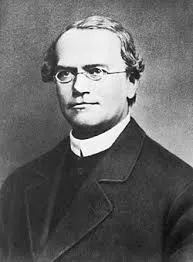
Gregor Mendel, widely known as the “Father of Genetics,” established the fundamental principles of heredity through carefully designed experiments on pea plants.
Monohybrid Cross (Single Trait)
Example: Tall (TT) × Short (tt)
F₁ Generation: All Tall (Tt)
F₂ Generation ratio:
\[ \text{Phenotypic Ratio} = 3 : 1 \]
\[ \text{Genotypic Ratio} = 1 : 2 : 1 \]
Dihybrid Cross (Two Traits)
Example: Seed shape (R/r) and seed colour (Y/y)
\[ \text{Phenotypic Ratio} = 9 : 3 : 3 : 1 \]
This demonstrates independent assortment of traits.
A cross between two heterozygous tall plants (Tt × Tt):
Possible gametes: T, t
Offspring: TT, Tt, Tt, tt
Conclusion: 3 tall : 1 short
- Confusing genotype with phenotype.
- Incorrect ratios in dihybrid crosses.
- Not mentioning laws explicitly in answers.
Why do recessive traits reappear in the F₂ generation?
Answer:
Because alleles segregate during gamete formation, allowing recessive alleles to pair again in offspring.
- Cross pure tall (TT) with pure short (tt).
- F₁: All heterozygous (Tt).
- Self-cross F₁: Tt × Tt.
- Genotypes: TT, Tt, Tt, tt.
- Phenotypes: 3 Tall, 1 Short.
- Gene (DNA) → mRNA: Transcription occurs in the nucleus.
- mRNA → Protein: Translation occurs in ribosomes.
- Protein Action: Proteins form structures or regulate biochemical reactions.
- Phenotype Formation: Observable traits appear.
Conceptual Flow Representation
Types of Allelic Interactions
Genotype vs Phenotype
| Feature | Genotype | Phenotype |
|---|---|---|
| Definition | Genetic makeup (TT, Tt, tt) | Observable traits (tall, short) |
| Nature | Inherited | Expressed |
| Influence | Only genes | Genes + environment |
- Eye Colour: Determined by pigment-producing proteins.
- Height: Controlled by multiple genes and nutrition.
- Blood Group: Example of codominance.
- Confusing genotype with phenotype.
- Ignoring role of proteins.
- Not explaining gene expression steps.
A plant has genotype Tt but shows tall phenotype. Explain why the short trait is not visible.
Solution:
Because the allele T (tall) is dominant and masks the expression of recessive allele t.
Logical Derivation of Trait Expression
- Genes contain DNA instructions.
- DNA is transcribed into RNA.
- RNA is translated into proteins.
- Proteins control traits.
- Traits appear as phenotype.
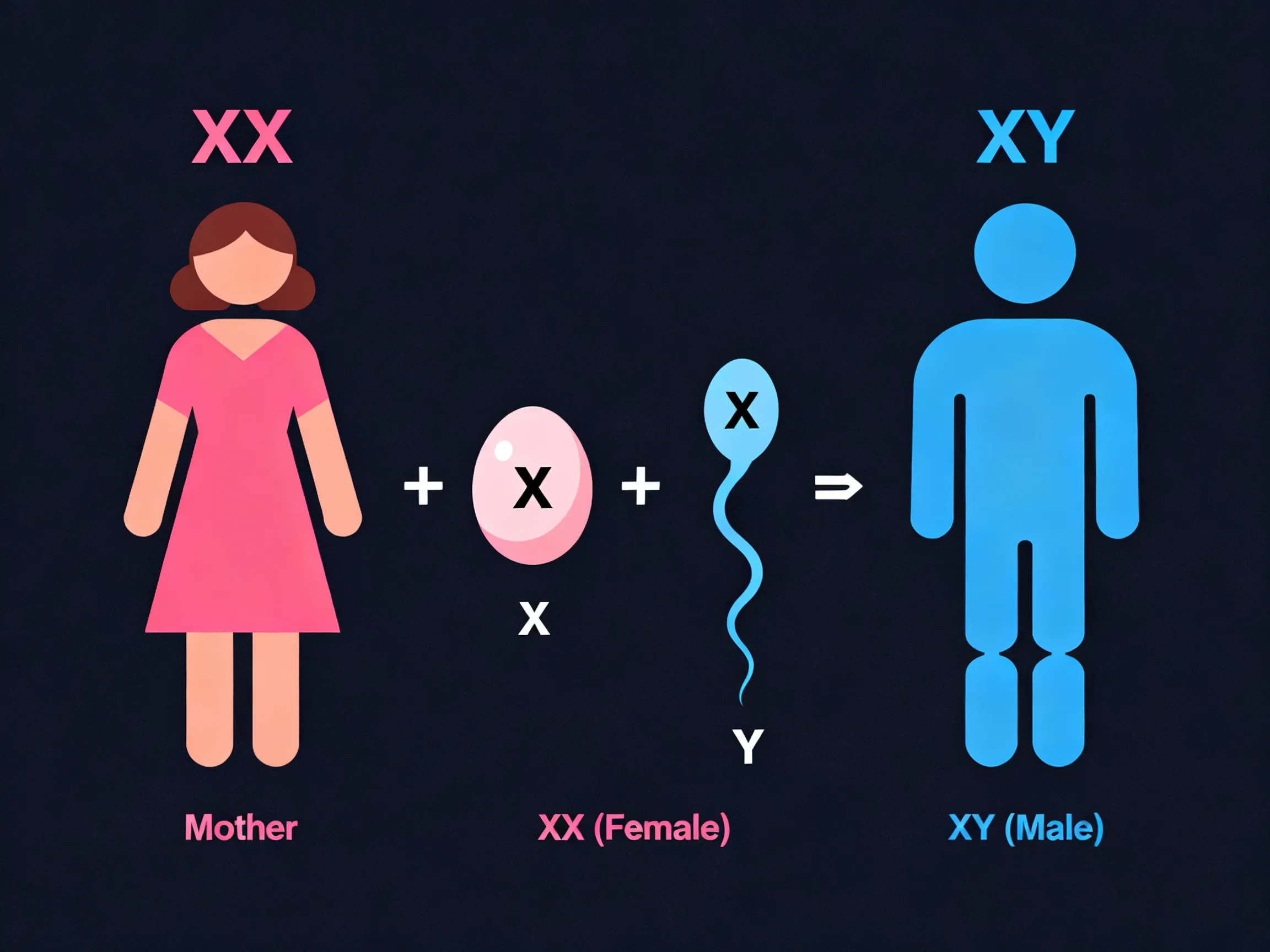
Sex Chromosomes in Humans
| Parent | Chromosomes | Gametes Produced |
|---|---|---|
| Female | XX | Only X |
| Male | XY | X or Y |
Genetic Representation
Probability Concept
Punnett Square Explanation
- Blaming females for child’s sex (scientifically incorrect).
- Not explaining role of sperm.
- Ignoring probability concept.
A couple has three daughters. Is the probability of the next child being a son lower? Explain.
Solution:
No. Each fertilization event is independent. The probability remains 50% regardless of previous outcomes.
Logical Derivation
- Female produces only X gametes.
- Male produces X and Y gametes.
- Fertilization combines gametes randomly.
- XX → Female, XY → Male.
Ultra Quick Revision (30-Second Recall)
- Variation → essential for survival and evolution.
- Genes → control traits.
- Dominant masks recessive.
- Sex determination → controlled by male (XY).
Concept Flow Map
Formula & Ratio Recall
Heredity & Evolution
AI Learning Engine
Master Mendel's Laws, Punnett Squares, Chromosomes, and Evolutionary concepts through interactive modules, deep-dive explanations, and AI-guided problem solving.
Eight foundational concept blocks — each with explanations, examples, tips, and common mistakes.
Heredity is the transmission of traits from parents to offspring through biological inheritance. It explains why children resemble their parents.
Variation refers to differences that arise between individuals of the same species. Variations can be heritable (passed to offspring) or non-heritable (acquired during lifetime).
Differences caused by genetic changes. Can be passed to next generation. E.g., attached vs free earlobes, blood group.
Differences due to environment or experience. Not passed on. E.g., body weight due to diet, muscle size due to exercise.
Gregor Johann Mendel (1822–1884) experimented on Pisum sativum (garden pea). He chose pea plants because they have distinct, contrasting traits, short life cycle, self-pollinating, and easy to cross-pollinate.
Mendel studied 7 pairs of contrasting characters and performed monohybrid and dihybrid crosses.
| Character | Dominant | Recessive |
|---|---|---|
| Seed Shape | Round | Wrinkled |
| Seed Colour | Yellow | Green |
| Pod Shape | Inflated | Constricted |
| Pod Colour | Green | Yellow |
| Flower Position | Axial | Terminal |
| Stem Height | Tall | Short/Dwarf |
| Flower Colour | Violet | White |
A cross between parents differing in one character. Let T = Tall (dominant), t = short (recessive).
Parent Cross: TT × tt
F₁: All Tall (Tt) — 4:0 phenotypic ratio
F₁ Self-Cross: Tt × Tt
F₂: 3 Tall : 1 short (phenotypic ratio)
A cross between parents differing in two characters simultaneously. E.g., Round Yellow (RRYY) × Wrinkled Green (rryy).
F₁ all Round Yellow (RrYy). When F₁ is self-crossed, 4 types of gametes (RY, Ry, rY, ry) are produced and combined in a 4×4 Punnett square giving 16 combinations.
Round + Yellow (both dominant expressed)
Round + Green (one dominant, one recessive)
Wrinkled + Yellow (one recessive, one dominant)
Wrinkled + Green (both recessive — new combination!)
| Term | Definition | Example |
|---|---|---|
| Gene | A segment of DNA that codes for a trait | Gene for seed colour |
| Allele | Alternate forms of the same gene | Y (yellow) and y (green) |
| Dominant | Allele that expresses itself even in hybrid state | Y — yellow |
| Recessive | Allele that is masked in the presence of dominant | y — green |
| Homozygous | Both alleles are identical (pure breeding) | TT or tt |
| Heterozygous | Two different alleles (hybrid) | Tt |
| Genotype | Genetic constitution of an organism | TT, Tt, tt |
| Phenotype | Observable physical expression | Tall or Short |
| F₁ Generation | First filial generation — offspring of P cross | All Tt in TT×tt |
| F₂ Generation | Second filial — offspring of F₁ self-cross | 3 Tall : 1 short |
Humans have 46 chromosomes (23 pairs). 22 pairs are autosomes; 1 pair are sex chromosomes.
Females: XX (homogametic — one type of gamete: X)
Males: XY (heterogametic — two types: X or Y)
The father's sperm determines the sex of the child. A sperm carrying X + egg (X) → XX = Girl. A sperm carrying Y + egg (X) → XY = Boy.
Evolution is the change in heritable characteristics of populations over successive generations. It results in new species over long time periods.
Charles Darwin proposed Natural Selection — organisms with favourable variations survive and reproduce more, passing traits to offspring.
Same structure, different function. Evidence of common ancestry (divergent evolution). E.g., forelimbs of whale, bat, horse, human.
Different structure, same function. Evidence of convergent evolution. E.g., wings of birds and insects.
Preserved remains of ancient organisms. Provide direct evidence of evolution. Older fossils are in deeper rock layers.
Organs that were functional in ancestors but reduced/non-functional now. E.g., human appendix, ear muscles, wisdom teeth.
Speciation is the formation of new species from existing ones. It occurs when two populations of the same species become reproductively isolated from each other.
Genetic Drift — random changes in allele frequency in small populations. Can fix or eliminate alleles by chance alone (not selection).
Geographic Isolation (allopatric speciation) — physical barriers (mountains, rivers) separate populations, leading to divergence.
Natural Selection — directional pressure based on environment favours certain traits. E.g., peppered moths in industrial England.
All critical ratios, rules, and expressions from Chapter 8 — your quick-reference formula sheet.
P(both dominant) = P(Aa×Aa gives dominant) = 3/4 = 75%
P(recessive) = 1/4 = 25%
P(dominant both traits) = 3/4 × 3/4 = 9/16
P(recessive both) = 1/4 × 1/4 = 1/16
Organism shows dominant trait → testcross with homozygous recessive to determine genotype.
Plants that, when self-pollinated, produce offspring identical to themselves. Always homozygous.
| Fact | Value |
|---|---|
| Human chromosomes | 46 (23 pairs) |
| Human autosomes | 44 (22 pairs) |
| Sex chromosomes | 1 pair (XX or XY) |
| Pea plant chromosomes | 14 (7 pairs) |
| Characters studied by Mendel | 7 pairs of contrasting characters |
| F₂ phenotypic ratio (Monohybrid) | 3 : 1 |
| F₂ phenotypic ratio (Dihybrid) | 9 : 3 : 3 : 1 |
| Mendel's experimental period | 1856–1863 |
| Mendel's paper published | 1866 |
| Mendel's work rediscovered | 1900 |
Select a problem type and follow the guided, step-by-step solution process — just like a human teacher.
In pea plants, round seed (R) is dominant over wrinkled seed (r). If a pure-breeding round-seeded plant is crossed with a pure-breeding wrinkled-seeded plant, find the phenotype and genotype of F₁ and F₂ generations. State the ratios obtained.
R (round) | Recessive allele: r (wrinkled)Pure-breeding round:
RR (homozygous dominant)Pure-breeding wrinkled:
rr (homozygous recessive)R gametes.rr produces only
r gametes.Both parents are homozygous → only one type of gamete each.
Rr → All Round (heterozygous)
R and r in equal proportions (1:1).1 RR : 2 Rr : 1 rrGenotypic ratio = 1 : 2 : 1
(1 homozygous dominant : 2 heterozygous : 1 homozygous recessive)
Round : Wrinkled = 3 : 1 ← Final Phenotypic Ratio
Answer: F₁ all Round (Rr); F₂ ratio = 3 Round : 1 Wrinkled
In pea plants, yellow seed (Y) is dominant over green (y) and round (R) is dominant over wrinkled (r). Two dihybrid plants (RrYy) are crossed. Find the phenotypic ratio in offspring.
RrYy (heterozygous for both genes)Number of heterozygous pairs (n) = 2
Number of gamete types = 2ⁿ = 2² = 4 types
RY, Ry, rY, ryRule: R pairs with Y or y; r pairs with Y or y. Law of Independent Assortment!
• R_Y_ (Round+Yellow): 9 boxes
• R_yy (Round+Green): 3 boxes
• rrY_ (Wrinkled+Yellow): 3 boxes
• rryy (Wrinkled+Green): 1 box
This famous 9:3:3:1 ratio confirms the Law of Independent Assortment.
Explain with a cross how sex is determined in humans. A couple already has two daughters. What is the probability that their next child will be a boy? Who is responsible for determining the sex of the baby?
XX (homogametic — produces only X gametes)Male genotype:
XY (heterogametic — produces X or Y gametes)Probability of a boy = 2/4 = 50%
✅ The father (male) determines the sex — his sperm carries either X or Y chromosome. The mother only contributes X chromosomes. Previous births do NOT affect future probability (each birth is independent event).
A tall pea plant (T_) is crossed with a short pea plant (tt). The offspring show 50% tall and 50% short plants. What is the genotype of the tall parent?
Expected: 100% tall, 0% short. This does NOT match the observed 50:50 ratio. ❌
Gametes from Tt: T or t | Gametes from tt: only t
Offspring: Tt (Tall) and tt (short) → 1:1 ratio = 50:50 ✓
The 1:1 ratio in testcross offspring always indicates the parent being tested was heterozygous.
In Mendel's F₂ generation, out of 7324 pea plants, 5474 were round-seeded and 1850 were wrinkled-seeded. (i) Calculate the ratio. (ii) What does this suggest? (iii) How many plants were homozygous dominant?
Divide both by 1850 → 2.96 : 1 ≈ 3 : 1
Total plants = 7324
RR = 1/4 × 7324 = 1831 plants
Round = 1831 + 3662 = 5493 ≈ 5474 (small statistical deviation expected)
Homozygous dominant (RR) ≈ 1831 plants
40+ rich, original questions with full step-by-step solutions. Organised by concept — no repetition of standard textbook questions.
Any four valid reasons earn full marks.
TT × tt: Gametes: T (from TT) and t (from tt) → All Tt → All TALL. Both crosses give all-tall phenotype but different genotypic ratios! TT×Tt gives 50% TT + 50% Tt; TT×tt gives 100% Tt.
Explanation: The parents must be heterozygous (Pp × Pp) where purple (P) is dominant. Wait — but we said parents are white-flowered...
Revised Answer: This is impossible in simple dominance if both parents show white flowers. The question may imply: (a) There is a case of recessive epistasis OR (b) More likely interpretation: One parent is Pp × pp and offspring are all Pp (purple). The parent showing white was pp; the other showing white was actually Pp (if purple was recessive to another gene). For NCERT level: If all F₁ are purple and both parents show white, both parents were homozygous recessive (pp × pp) is impossible. The scenario requires that purple is recessive and white is dominant — then both white parents (WW × Ww) are crossed giving Ww and ww, the ww showing purple. Marks for correct logical analysis.
For example, a heterozygous tall plant (Tt): during meiosis, T and t separate → 50% gametes carry T, 50% carry t. No gamete ever carries BOTH T and t.
This means every gamete is "pure" for that allele — it never contains a mixed/hybrid form of the gene. Hence the law is called the "Law of Purity of Gametes." This refuted the blending inheritance theory.
(b) Parents' Genotypes: Since ratio is 9:3:3:1 and both parents are round yellow (dominant phenotype), both parents must be dihybrid: RrYy × RrYy
R = round (dominant), r = wrinkled (recessive), Y = yellow (dominant), y = green (recessive)
(c) Law Demonstrated: This demonstrates Mendel's Law of Independent Assortment — alleles of different gene pairs (R/r and Y/y) assort independently during gamete formation, giving 4 types of gametes (RY, Ry, rY, ry) and 4 phenotypic classes in 9:3:3:1.
Sex determination: The father determines the sex. His sperm carries either X chromosome (→ daughter XX) or Y chromosome (→ son XY). The mother only produces X-carrying eggs. Since XY (father) × XX (mother) → 50% XX (daughters) + 50% XY (sons).
Normal Human Male: 44 autosomes + 2 sex chromosomes (XY) = 46 chromosomes total. Written as 44 + XY or 46,XY.
During gamete formation (meiosis): Females produce eggs with 22 autosomes + 1 X. Males produce sperm with 22 autosomes + 1 X or 22 autosomes + 1 Y. The Y-bearing sperm determines male offspring.
Gametes: Mother = X^N or X^c | Father = X^N or Y
Offspring:
• X^N X^N = Normal female (25%)
• X^c X^N = Carrier female (25%)
• X^N Y = Normal male (25%)
• X^c Y = Colour-blind male (25%)
Probabilities:
• Daughters: 0% colour-blind (all have at least one X^N)
• Sons: 50% colour-blind
• Overall: 25% children are colour-blind
Note: Colour blindness affects males more because they only have one X chromosome — a single recessive allele is enough to express the trait.
Examples: (1) Forelimbs of humans, whales, bats, and horses — same bone arrangement (humerus, radius, ulna, carpals, phalanges) but different functions (manipulation, swimming, flying, running). (2) Thorn of Bougainvillea and tendril of Cucurbita — both are modified stems.
Analogous Organs: Have different basic structures but perform the same function. Evidence of convergent evolution — unrelated organisms adapting similarly to similar environments.
Examples: (1) Wings of birds (modified forelimbs, bones present) and wings of insects (chitinous outgrowths, no bones). (2) Sweet potato (root modification) and potato (stem modification) — both store food.
Geological Strata Principle:
• Rock layers (strata) form over millions of years — older layers are deeper.
• Fossils found in deeper layers are older; fossils in shallower layers are more recent.
• By studying the sequence, scientists can see how organisms changed over time.
Evidence for Evolution:
(1) Fossils show progression from simpler to complex forms over geological time.
(2) Extinct organisms (e.g., Archaeopteryx — intermediate between reptiles and birds) show transitional forms.
(3) Relative and absolute dating of fossils establishes evolutionary timelines.
(4) Absence of human fossils in Cambrian rock (500 mya) is consistent with humans evolving much later.
Peppered Moth (Biston betularia) Example:
Before Industrialization (pre-1850): Tree barks were covered with light-coloured lichens. Light-coloured (peppered) moths were camouflaged → survived predation. Dark (melanic) moths were easily spotted and eaten → rare in population.
During Industrial Revolution: Factories released soot → killed lichens, coated bark black. Light moths now became visible → easy prey. Dark moths blended with dark bark → survived better.
Result: Within ~50 years, dark moth population increased dramatically in industrial areas. Light moths remained common in non-industrial areas.
Lesson: No individual changed colour. The environment changed the selection pressure. Dark moths always existed (pre-existing variation) but were selected for. This is micro-evolution driven by natural selection.
Three Factors Leading to Speciation:
(1) Geographic Isolation (Allopatric Speciation): Physical barriers (mountains, rivers, oceans) separate populations → each adapts to its own environment → accumulate different mutations → eventually unable to interbreed.
(2) Genetic Drift: Random changes in allele frequency, especially in small populations, can lead to significant genetic divergence from the original population.
(3) Natural Selection: Different environments exert different selection pressures → populations adapt differently → accumulate different traits → eventually become separate species.
(1) DNA Similarity: Humans and chimpanzees share approximately 98-99% of their DNA sequence — the highest similarity of any two species.
(2) Anatomical Homology: Many bones and organs are homologous — similar bone structures in hands/forelimbs, similar muscle arrangements.
(3) Common Ancestor: Fossil evidence suggests humans and chimps diverged from a common ancestor approximately 5–7 million years ago.
(4) Biochemical Similarity: Similar blood proteins, enzymes, and metabolic pathways.
Note: This does NOT mean "humans evolved from chimps" — rather, both share a common ancestor and diverged along separate evolutionary paths.
Step 1: Take a sample of the farmer's plants (showing dominant trait, genotype unknown — A_).
Step 2: Cross them with a known homozygous recessive plant (aa).
Step 3: Observe offspring for several generations.
Interpretation:
• If ALL offspring show dominant trait → parent was AA (true breeding) ✓ Farmer's claim verified.
• If 50% dominant + 50% recessive offspring appear → parent was Aa (hybrid) ✗ NOT true breeding.
Additionally: Allow self-pollination across multiple generations — true breeding plants produce identical offspring always. Hybrid plants produce 3:1 ratio in F₂.
This systematic testcross approach is exactly how breeders verify purity of lines.
Resolution — Natural Selection Acts as a Filter:
(1) Mutations generate random variation in a population.
(2) Most mutations are neutral or harmful → organisms with these die or reproduce less.
(3) Occasionally, a mutation is advantageous in the current environment → organism survives better, reproduces more.
(4) Over thousands of generations, advantageous mutations accumulate → population appears "designed."
Key Insight: The environment is the non-random "selector." Random variation + non-random selection = directed-looking outcome.
Analogy: Random variation is like shuffling cards randomly. Natural selection is like a specific rule that only keeps certain hands. The result appears structured even though the process started randomly.
This is why the same environment can independently produce similar "designs" (convergent evolution — e.g., dolphins and sharks both have streamlined bodies).
Test your knowledge. Instant feedback with explanations after each question.
Build your own Punnett square. Enter alleles and instantly see genotype and phenotype ratios.
Click any card to flip it and reveal the definition. Navigate through all terms.
Key milestones in the discovery of heredity and evolutionary theory — from Mendel to modern genetics.
Recent posts
How do Organisms Reproduce — Learning Resources
Get in Touch
Let's Connect
Questions, feedback, or suggestions?
We'd love to hear from you.