Ovary Stigma Asexual: Fission (Amoeba) Budding (Hydra, Yeast) Regeneration (Planaria) Spore formation (Rhizopus)
🌱
Chapter 7  ·  Class X Science

Asexual and Sexual Reproduction Across the Living World

How do Organisms Reproduce?

From Binary Fission to Flowers — Reproduction in All Its Forms

Chapter Snapshot

13Concepts
2Formulae / Reactions
8–10%Exam Weight
4–5Avg Q's
Easy-ModerateDifficulty

Why This Chapter Matters for Exams

CBSE BoardNTSEState Boards

How do Organisms Reproduce contributes 8–10 marks in CBSE Boards. The longitudinal section of a flower (diagram), types of asexual reproduction with examples, and the male/female reproductive system are guaranteed questions. Contraception and sexually transmitted diseases are standard 2-mark topics. NTSE includes reproduction-type identification MCQs.

Key Concept Highlights

Modes of Reproduction
Asexual Reproduction: Fission (Binary, Multiple)
Asexual Reproduction: Fragmentation, Regeneration
Asexual Reproduction: Budding, Vegetative Propagation
Asexual Reproduction: Spore Formation
Sexual Reproduction in Flowering Plants
Structure of a Flower
Pollination (Self and Cross)
Fertilisation and Seed Formation
Sexual Reproduction in Humans
Male Reproductive System
Female Reproductive System
Reproductive Health and Contraception

Important Formulae & Reactions

$\text{Sexual reproduction: DNA from two sources → genetic variation}$
$\text{Asexual reproduction: single parent → genetically identical offspring}$

What You Will Learn

Navigate to Chapter Resources

🏆 Exam Strategy & Preparation Tips

The flower diagram (sepals, petals, stamens, pistil, ovary, ovule) must be practised until automatic — it appears in every CBSE paper. Asexual reproduction examples: fission (Amoeba), budding (Hydra, yeast), regeneration (Planaria), vegetative propagation (potato). Fertilisation sequence (pollen → pollen tube → ovule → zygote → seed) is a standard 3-marker. Time investment: 3 days.

Chapter 7 · CBSE Class X
🌱
Do Organisms Create Exact Copies of Themselves?
How do Organisms Reproduce Reproduction Asexual Reproduction Sexual Reproduction Vegetative Propagation Human Reproductive System Pollination Fertilization Menstrual Cycle Reproductive Health
📖 Introduction
📘 Definition
💡 Concept
Concept Explanation
✏️ Example
  • Amoeba: Reproduces by binary fission. Offspring look identical but may have slight genetic differences.
  • Human siblings: Share the same parents but differ in height, skin tone, and intelligence due to variation.
  • Plants (Vegetative propagation): Potato tubers produce similar plants, but minor variations still occur.
Why do organisms not produce exact copies of themselves?

Answer (Step-wise Roadmap):

  1. DNA replication is highly accurate but not perfect.
  2. Small errors occur during copying, leading to variation.
  3. In sexual reproduction, mixing of genes increases variation.
  4. Hence, offspring are similar but not identical.
🗒️ Important
  • Forms the basis of evolution and natural selection.
  • Frequently asked in 2–3 mark conceptual questions.
  • Helps differentiate asexual vs sexual reproduction.
  • Important for case-study and assertion-reason questions.
⚡ Exam Tip
⚠️ Warning
Common Mistakes
📋 Case Study
A population of bacteria is exposed to antibiotics. Initially, most bacteria die, but a few survive and reproduce.
Why did some bacteria survive?
Some bacteria had variations that made them resistant to antibiotics.
What role did variation play?
These variations allowed survival and reproduction, leading to resistant populations.
🔎 Key Fact
Variation
📖 Introduction
📘 Definition
🗂️ Types / Category
Genetic Environmental Continuous Discontinuous

Types of Variation

Genetic (Heritable) Variation
Variation caused by differences in genes and passed from parents to offspring through DNA. It is inherited and forms the basis of many traits, such as blood group, eye colour, and natural resistance to certain diseases.
Environmental Variation
Variation caused by environmental factors such as nutrition, climate, lifestyle, exercise, and habitat. It is not inherited and can change during an individual’s lifetime, such as body weight, skin tanning, and muscle development.
Continuous Variation
Variation that shows a gradual range of differences with no clear boundaries between categories. It is usually influenced by many genes and the environment, for example human height, weight, and skin colour.
Discontinuous Variation
Variation that falls into distinct categories with no intermediate forms. It is usually controlled by one or a few genes and is less affected by the environment, for example blood groups, tongue rolling, and attached or free earlobes.
💡 Concept
Concept Explanation

Variation originates primarily during DNA replication. Although replication mechanisms include proofreading, occasional errors (mutations) occur. Additionally, in sexual reproduction, processes like recombination and fusion of gametes mix parental genes, creating new gene combinations.

In asexual reproduction, variation is minimal because offspring arise from a single parent. However, mutations still introduce slight differences. In contrast, sexual reproduction produces significant variation due to genetic recombination.

1
Example
Human Population: Differences in height, skin colour, eye colour, and fingerprints.
2
Example
Plants: Variations in leaf size, flower colour, and seed shape.
3
Example
Bacteria: Some bacteria develop antibiotic resistance due to variation.
✏️ Example
Why is variation important for the survival of a species?
  1. Environment changes continuously.
  2. Not all individuals can survive these changes.
  3. Some individuals possess beneficial variations.
  4. These individuals survive and reproduce.
  5. Thus, variation ensures survival and continuity of species.
🗒️ Important
  • Core concept for evolution and natural selection questions.
  • Frequently asked in 3–5 mark descriptive answers.
  • Essential for understanding reproduction and heredity.
  • Used in assertion-reason and case-based questions.
⚡ Exam Tip
⚠️ Warning
Common Mistakes
📋 Case Study

A farmer notices that some plants in his field survive drought conditions better than others.

Questions:

  1. What biological concept explains this observation?
  2. How does it help in agriculture?

Solution:

  • The concept is variation among plants.
  • Plants with beneficial variations survive and can be selected for breeding drought-resistant crops.
📐 Derivation
Concept Derivation

Variation arises through the following sequential process:

  1. DNA replication occurs during cell division.
  2. Minor copying errors introduce mutations.
  3. In sexual reproduction, gamete fusion mixes parental genes.
  4. Environmental factors further influence traits.
  5. Result: Individuals show differences → Variation.
🔎 Key Fact
🌱
Importance of Variation
📖 Introduction
📘 Definition
💡 Concept
Concept Explanation
🔎 Key Fact
✏️ Example
1
Example
Antibiotic Resistance in Bacteria: Some bacteria survive antibiotics due to variation and reproduce, forming resistant populations.
2
Example
Darwin’s Finches: Different beak shapes evolved due to variation and adaptation to food sources.
3
Example
Human Immunity: Some individuals are naturally more resistant to certain diseases.
✏️ Example
Explain why genetic variation is important for the survival of a species, with reference to natural selection.

Variation ensures species survival through natural selection:

  1. Environments change unpredictably (e.g., droughts, predators, temperature shifts).
  2. Not all individuals survive these changes; average traits may fail.
  3. Individuals with favorable variations (e.g., drought-resistant plants) thrive and reproduce.
  4. They pass these traits to offspring via genes.
  5. Over generations, favorable variations spread, ensuring species adaptation and continuity.

Example: Peppered moths in industrial England—dark variants survived better on soot-covered trees.

⚡ Exam Tip
⚠️ Warning
Common Mistakes
📋 Case Study

A sudden temperature drop occurs in a region. Most insects die, but a few survive and reproduce.

Questions:

  1. What enabled some insects to survive?
  2. What will happen to the population over time?

Solution:

  • Surviving insects had beneficial variations (cold resistance).
  • Over time, the population will consist mainly of cold-resistant insects due to natural selection.
📝 Summary
Quick Revision Points
🌱
Cellular Apparatus
📖 Introduction
📘 Definition
Cellular Apparatus
The integrated network of cell organelles, membranes, and structures working together like a "cellular factory" to sustain life processes such as metabolism, growth, reproduction, and response to stimuli.

  • Key Components: Nucleus (control center), mitochondria (energy), ER (Endoplasmic Reticulum) & Golgi (packaging), ribosomes (protein synthesis), lysosomes (digestion).
  • Importance: Enables division of labor; e.g., in muscle cells, abundant mitochondria power contraction.
  • Example: In Amoeba, pseudopodia (cytoskeleton part) + contractile vacuole maintain shape and osmoregulation.

Analogy: Like a city's infrastructure (roads=ER, power plants=mitochondria).

Organelle
Membrane-bound or non-membrane structures within eukaryotic cells, each specialized for a distinct function, absent or simpler in prokaryotes.

  • Types & Functions: Mitochondria (ATP production), Chloroplasts (photosynthesis in plants), Nucleus (genetic control), Vacuoles (storage).
  • Prokaryotic Equivalent: 70S ribosomes (no membrane-bound organelles).
  • Example: In human RBCs, no nucleus/organelles for max O₂ transport; in plant guard cells, chloroplasts drive stomatal opening.

Analogy: Cell's "departments"—each handles one job efficiently.

📊 Comparison Table

Major Components and Functions

Organelle Function Role in Reproduction
Nucleus Stores DNA and controls cell activities Ensures DNA replication and genetic continuity
Mitochondria Produces energy (ATP) Provides energy required for cell division
Ribosomes Protein synthesis Produces proteins required for growth and division
Endoplasmic Reticulum Protein and lipid transport Supports synthesis of new cellular components
Cell Membrane Regulates entry and exit of substances Maintains internal balance during division
Cytoplasm Medium for biochemical reactions Provides environment for organelle functioning
💡 Concept
Concept Explanation
✏️ Example
1
Example
Amoeba: Uses its cellular apparatus for binary fission, ensuring DNA duplication and division into two daughter cells.
2
Example
Human Cells: Undergo mitosis with coordinated functioning of nucleus, cytoplasm, and organelles.
3
Example
Plant Cells: Cellular apparatus supports growth and reproduction through cell division and differentiation.
✏️ Example
Explain the role of cellular apparatus in reproduction.
  1. Nucleus replicates DNA.
  2. Mitochondria provide energy.
  3. Ribosomes synthesize proteins.
  4. Cell membrane maintains internal balance.
  5. All organelles coordinate to ensure successful cell division.
🌟 Importance
⚡ Exam Tip
⚠️ Warning
Common Mistakes
📋 Case Study

A cell fails to produce sufficient energy due to malfunctioning mitochondria.

Questions:

  1. How will this affect reproduction?
  2. Which processes will be disrupted?

Solution:

  • Cell division requires energy; hence reproduction will be impaired.
  • DNA replication and protein synthesis processes will be affected due to lack of ATP.
🔎 Key Fact
Quick Revision Points
🌱
Fission
📖 Introduction
📘 Definition
💡 Concept
Concept Explanation
🔄 Process
Step-wise Process
  • 1
    Parent Cell Grows
    The parent cell first grows in size and becomes ready for division.
  • 2
    DNA Replication
    The DNA duplicates itself, forming two identical copies so that each new cell can receive one complete set of genetic material.
  • 3
    Nuclear Division
    The nucleus divides into two separate nuclei, each containing one copy of the DNA.
  • 4
    Cytoplasmic Division
    Finally, the cytoplasm splits and two daughter cells are formed.
📊 Comparison Table

Types of Fission

Type Description Examples
Binary Fission A form of asexual reproduction in which one parent cell divides into two equal and identical daughter cells. Amoeba, Bacteria, Paramecium
Multiple Fission A type of asexual reproduction in which the nucleus divides repeatedly first, followed by division of the cytoplasm to form many daughter cells at the same time. Plasmodium
Longitudinal Fission A type of binary fission in which the organism divides lengthwise along its longitudinal axis. Leishmania
✏️ Example
  • Amoeba: Undergoes binary fission in any plane.
  • Paramecium: Divides along transverse axis.
  • Leishmania: Shows longitudinal fission due to flagellum.
  • Plasmodium: Undergoes multiple fission inside host cells.
🌟 Importance
⚡ Exam Tip
⚠️ Warning
Common Mistakes
📋 Case Study

A culture of bacteria doubles its population every 20 minutes under ideal conditions.

Questions:

  1. Which type of reproduction is occurring?
  2. Why is this process advantageous?

Solution:

  • Binary fission is occurring.
  • It allows rapid population growth in favourable conditions.
🔎 Key Fact
Quick Revision
🌱 Fission in Amoeba
Fission in Amoeba
Fission in Amoeba
Fission in Amoeba Animation

Visualization of binary fission in Amoeba showing nuclear division followed by cytoplasmic division.

🌱
Fragmentation
📖 Introduction
📘 Definition
💡 Concept
Concept Explanation
🔄 Process
Step-wise Process
  • 1
    Parent organism forms a filamentous structure.
    The parent organism grows into a long, thread-like or filamentous body, which makes it easier to break into smaller parts.
  • 2
    External forces cause breakage into fragments.
    When the filament is disturbed by wind, water current, or any mechanical force, it breaks into smaller pieces called fragments.
  • 3
    Each fragment contains living cells.
    Every fragment has living cells capable of surviving and continuing growth, so each piece can act as a new starting point.
  • 4
    Cells divide and elongate under favourable conditions.
    When conditions such as water, sunlight, and nutrients are available, the cells in each fragment divide repeatedly and the fragment grows longer.
  • 5
    Each fragment develops into a complete organism.
    Each growing fragment develops into an independent new organism that is genetically similar to the parent.
  • 6
    Example of fragmentation.
    Spirogyra is a common example of fragmentation. In Spirogyra, the filament breaks into pieces, and each piece grows into a new individual.
✏️ Example

Spirogyra is a green filamentous alga found in freshwater bodies. It consists of long, thread-like chains of cells. When these filaments break due to disturbance, each fragment continues to grow independently by cell division and forms a new filament identical to the parent.

🗒️ FIG

Fragmentation in Spirogyra

Fragmentation in Spirogyra
Fragmentation in Spirogyra Animation

Visualization of filament breakage and regrowth in Spirogyra.

👁️ Observation

Favourable Conditions

✅ Advantages
Advantages of Fragmentation
  • Rapid multiplication without reproductive organs
  • Energy efficient process
  • Quick colonization of suitable habitats
  • Helps in recovery after physical damage
⚠️ Limitations
Limitations of Fragmentation
  • Produces genetically identical offspring (clones)
  • Low variation reduces adaptability
  • Vulnerable to environmental changes and diseases
🌟 Importance
⚡ Exam Tip
❌ Common Mistakes
  • Confusing fragmentation with regeneration.
  • Not giving proper example.
  • Ignoring limitations of low variation.
📋 Case Study

A pond shows rapid growth of green algae after a storm breaks existing filaments.

Questions:

  1. Which reproductive method is responsible?
  2. Why does growth increase rapidly?

Solution:

  • Fragmentation is responsible.
  • Broken fragments grow independently, increasing population quickly.
📝 Summary
Quick Revision Points
🌱
Regeneration
📖 Introduction
📘 Definition
Regeneration Blastema
Regeneration
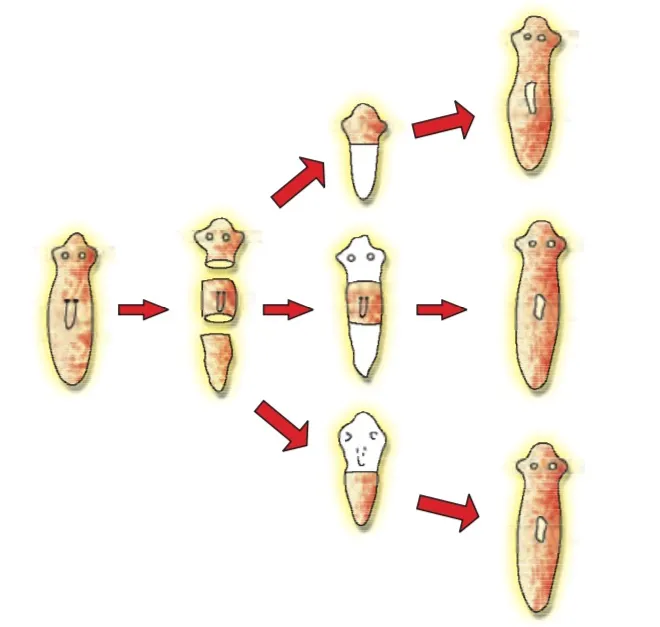
Regeneration is the biological process by which an organism repairs, replaces, or regrows lost or damaged body parts. In some simple organisms, a body fragment can grow into a complete new individual. Examples include Planaria, Hydra, and starfish.
Blastema
A blastema is a mass of undifferentiated, actively dividing cells that forms at the site of injury during regeneration. These cells multiply and later differentiate to rebuild the missing part. In animals such as salamanders, the blastema helps in regrowing limbs or tails.
💡 Concept
Concept Explanation
🔄 Process
Step-wise Process of Regeneration
  • 1
    Injury or cutting of body part occurs.
    Regeneration begins when a body part is injured, lost, or cut off. The organism detects the damage and activates repair mechanisms at the wound site. Example: A planaria cut into pieces can begin the regeneration process in each fragment.
  • 2
    Wound heals and blastema forms.
    The wound surface first gets covered by new cells. In many organisms, a mass of actively dividing cells called a blastema forms at the injured site. Example: In salamanders, a blastema forms at the stump of the lost limb.
  • 3
    Cells divide rapidly.
    The cells of the blastema multiply very quickly to produce a large number of new cells. These cells are undifferentiated at first and remain capable of forming different tissues. Example: In Hydra and planaria, repeated cell division helps rebuild the missing part.
  • 4
    Cells differentiate into tissues and organs.
    The newly formed cells gradually specialize into different tissues such as skin, muscle, nerve, or bone, depending on the part being restored. This step gives the new structure its proper form and function. Example: In a regenerating salamander limb, cells develop into muscles, bones, and other tissues.
  • 5
    Complete organism or body part is restored.
    Finally, the missing body part is fully rebuilt, or in some simple organisms, a complete new individual is formed from the fragment. The regenerated part is usually similar to the original one. Example: A starfish can regrow an arm, and planaria can form a whole new organism from a body fragment.
🖼️ Figure
Regeneration in Planaria
Regeneration in Planaria (Courtsey-NCERT)
✏️ Example
Planaria
Planaria is a freshwater flatworm with remarkable regenerative capacity. When its body is cut into pieces, each fragment regenerates missing parts through rapid cell division and differentiation, eventually forming a complete organism.
📊 Comparison Table

Regeneration vs Fragmentation

Regeneration Fragmentation
Involves regrowth of lost parts Body breaks into fragments naturally
Requires specialized cells No specialized cells required
Planaria Spirogyra
✅ Advantages
  • Helps organisms recover from injury.
  • Allows reproduction without gametes in simple organisms.
  • Ensures survival in hostile environments.
  • Maintains population without mating.
⚠️ Limitations
  • Limited to simple organisms for full regeneration.
  • Higher organisms show restricted regeneration.
  • Requires specific cellular conditions.
🌟 Importance
⚡ Exam Tip
❌ Common Mistakes
  • Confusing regeneration with fragmentation.
  • Not explaining stages clearly.
  • Ignoring role of specialized cells.
📋 Case Study

A lizard loses its tail when attacked but regrows it after some time.

Questions:

  1. What process is involved?
  2. Why is this regeneration limited compared to Planaria?

Solution:

  • The process is regeneration.
  • Higher organisms have specialized cells, limiting full-body regeneration.
📝 Summary
🌱
Budding
🗒️ Intoduction

Budding is a common asexual reproductive strategy in which a new organism develops from a localized outgrowth of the parent body. This process is highly efficient in simple multicellular organisms, allowing rapid multiplication under favourable environmental conditions.

Unlike fission or fragmentation, budding involves unequal division where the parent remains intact while a smaller new individual (bud) grows and eventually separates.

📘 Definition
Budding Bud
Budding
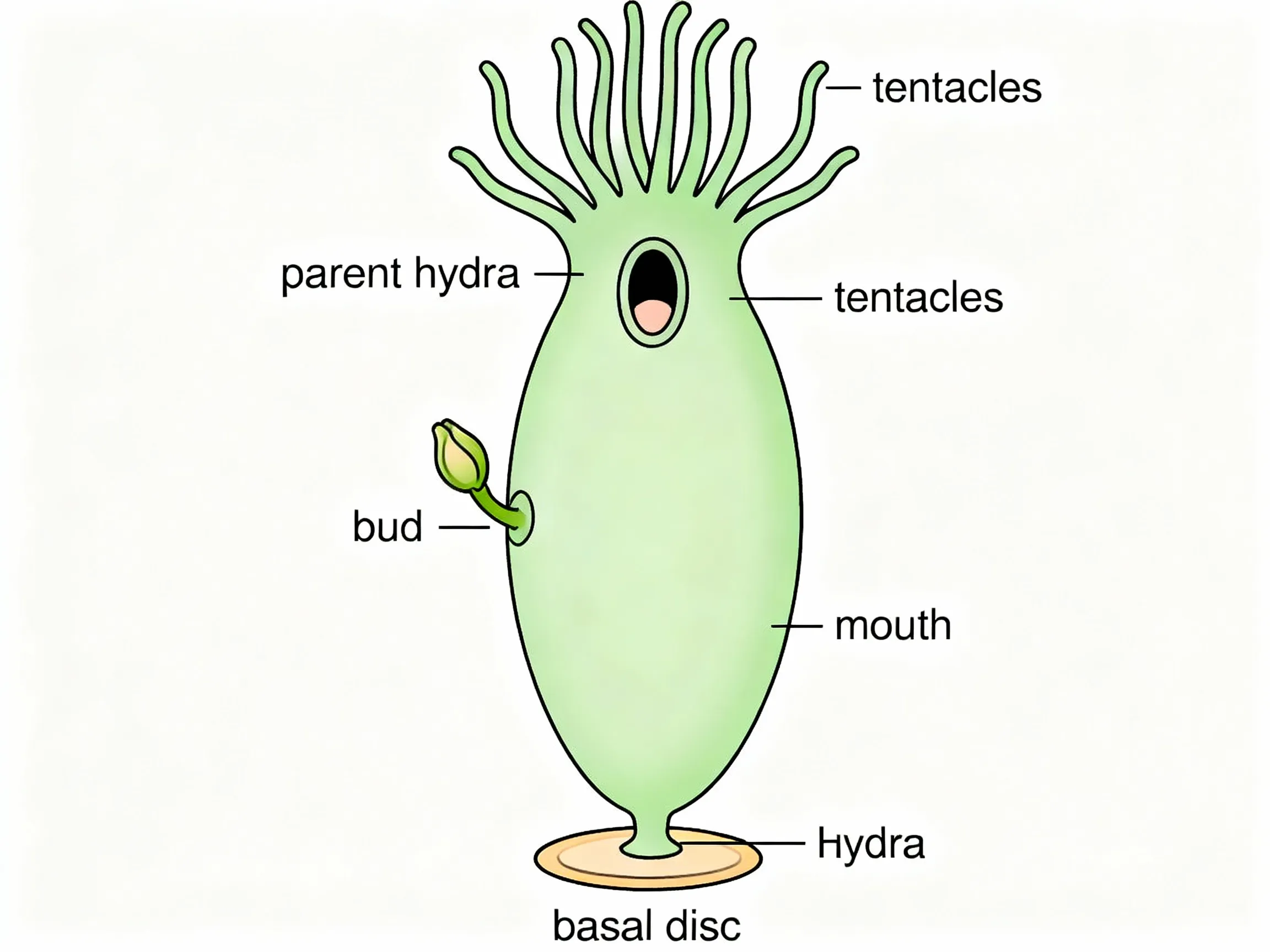
Budding is an asexual mode of reproduction in which a new organism develops as a small outgrowth on the parent body. The bud grows by cell division, remains attached for some time, and finally separates to live independently. Examples include Hydra and yeast.
Bud
A bud is a small outgrowth or swelling that develops on the body of the parent organism during budding. It contains actively dividing cells and gradually grows into a new individual. In yeast, the bud appears as a tiny projection on the parent cell.
💡 Concept
Concept Explanation
🔄 Process
Budding - Step-wise Process
  • 1
    Initiation of bud due to localized cell division
    A small outgrowth starts forming at one specific point on the parent organism because cells divide rapidly at that site. Example: In Hydra, the bud appears as a tiny projection on the body wall.
  • 2
    Growth of bud by continuous cell division
    The bud enlarges as more cells are produced by repeated mitotic division. At this stage, the bud remains attached to the parent and receives nutrients from it. Example: In yeast, the bud keeps increasing in size while still connected to the mother cell.
  • 3
    Differentiation into structures like tentacles and mouth
    The newly formed cells begin to specialize into different body parts and tissues. In multicellular organisms like Hydra, this includes the formation of structures such as tentacles and mouth. Example: A young Hydra bud gradually develops tentacles and a mouth-like opening.
  • 4
    Maturation while attached to parent
    The bud continues to grow and becomes fully developed while still attached to the parent organism. During this period, it functions as a developing young individual. Example: In Hydra, the bud matures on the parent body before separating.
  • 5
    Detachment to form an independent organism
    Once the bud has reached maturity, it detaches from the parent body and lives independently as a new organism. Example: A mature Hydra bud breaks away and becomes a separate, free-living Hydra.
🖼️ Figure
Budding in Hydra
Budding in Hydra
Budding in Hydra
✏️ Example
Hydra Yeast
1
Example
Hydra, a freshwater organism, reproduces by budding. A small bud develops on its body wall, grows by cell division, and forms structures such as tentacles. After complete development, it detaches and lives independently.
2
Example
In yeast, budding occurs at the cellular level. A small bud forms on the parent cell, enlarges, and eventually separates. Sometimes buds remain attached, forming chains of cells.
✅ Advantages
  • Rapid multiplication under favourable conditions.
  • No need for gametes or mating.
  • Energy efficient and simple process.
  • Parent organism remains alive and continues reproduction.
⚠️ Limitations
  • Produces genetically identical offspring (clones).
  • Limited genetic variation reduces adaptability.
  • Population may be vulnerable to environmental changes.
📊 Comparison Table

Budding vs Fission

Budding Fission
Unequal division Equal division
Parent remains intact Parent divides completely
A new organism grows as a bud on the parent body The parent cell splits into two or more daughter cells
New individual usually remains attached for some time Daughter cells separate immediately after division
Common in Hydra and yeast Common in Amoeba, bacteria, and Paramecium
Occurs by outgrowth formation at one specific point Occurs by direct splitting of the whole parent cell
Offspring may be smaller at first and later grow to full size Daughter cells are usually formed with nearly equal size
Seen in both unicellular and some multicellular organisms Mostly seen in unicellular organisms
🌟 Importance
⚡ Exam Tip
❌ Common Mistakes
  • Confusing budding with fission.
  • Not mentioning detachment stage.
  • Ignoring example of yeast.
📋 Case Study

A Hydra kept in nutrient-rich water shows rapid increase in number.

Questions:

  1. Which reproductive method is responsible?
  2. Why does reproduction increase under these conditions?

Solution:

  • Budding is responsible.
  • Favourable conditions promote rapid cell division and bud formation.
📝 Summary
🌱
Vegetative Propagation
📖 Introduction
📘 Definition
Vegetative Propagation Clone
Vegetative Propagation
Vegetative propagation is an asexual method of reproduction in plants in which a new plant develops from vegetative parts such as roots, stems, leaves, or buds. The new plant grows without seeds and usually carries the same hereditary traits as the parent plant. Examples include potato, sugarcane, Bryophyllum, and ginger.
Clone
A clone is a genetically identical copy of the parent plant produced by asexual reproduction. Since no fusion of gametes occurs, the offspring receives the same genetic material as the parent. Plants produced by cuttings, layering, or tissue culture are all examples of clones.
📊 Comparison Table
Natural Propagation Artificial Propagation

Types of Vegetative Propagation

Type Description Examples
Natural Occurs naturally through plant structures Potato (tuber), Ginger (rhizome), Bryophyllum (leaf buds)
Artificial Induced by humans for cultivation Cutting (Rose), Layering, Grafting
💡 Concept
Concept Explanation
🔄 Process

Vegetation Steps

  • 1
    Selection of a vegetative part
    A suitable vegetative part such as a stem, root, or leaf is selected for propagation. This part should be healthy and capable of producing a new plant. Example: A potato tuber, ginger rhizome, or Bryophyllum leaf.
  • 2
    Cell division at growth points
    Cells at the growth points, such as nodes or meristems, begin to divide actively. These cells produce new tissues needed for growth. Example: In stem cuttings, the node helps in the formation of new roots and shoots.
  • 3
    Formation of roots and shoots
    The dividing cells develop into roots and shoots. Roots absorb water and minerals, while shoots grow upward and form leaves and stems. Example: A stem cutting of rose or sugarcane develops roots and new shoots under proper conditions.
  • 4
    Development into a complete plant
    The young plant continues to grow, becoming independent and capable of carrying out all life processes. It gradually develops into a complete new plant genetically similar to the parent. Example: A potato eye grows into a full potato plant.
🖼️ Figure
Vegetative Propagation
✏️ Example
1
Example
Sugarcane: Stem cuttings with nodes are planted; buds grow into new plants.
2
Example
Rose: Stem cuttings develop roots and grow into new plants.
3
Example
Potato: Eyes (buds) on tubers grow into new plants.
4
Example
Bryophyllum: Leaf margins produce buds that grow into new plants.
✅ Advantages
  • Produces genetically identical plants (uniformity).
  • Faster reproduction compared to seeds.
  • Useful for seedless or sterile plants.
  • Preserves desirable traits like taste, colour, and yield.
⚠️ Limitations
  • Lack of genetic variation.
  • Increased vulnerability to diseases.
  • Limited adaptability to environmental changes.
🌟 Importance
⚡ Exam Tip
❌ Common Mistakes
  • Confusing vegetative propagation with sexual reproduction.
  • Not giving correct examples.
  • Ignoring advantages and limitations.
📋 Case Study

Farmers prefer growing sugarcane using stem cuttings instead of seeds.

Questions:

  1. Which method of reproduction is used?
  2. Why is this method preferred?

Solution:

  • Vegetative propagation is used.
  • It ensures uniform crops and faster growth.
📝 Summary
🌱
Spore Formation
📖 Introduction
📘 Definition
Spore Formation Spore Sporangium
Spore Formation
Spore formation is an asexual mode of reproduction in which an organism produces numerous tiny reproductive bodies called spores. These spores are usually formed inside special structures called sporangia and, under favourable conditions, each spore can germinate to form a new individual. This method helps in rapid multiplication, wide dispersal, and survival during unfavourable conditions. Examples include Rhizopus, Mucor, and many fungi.
Spore
A spore is a microscopic, usually single-celled reproductive unit that can develop into a new organism without fusing with another cell. Spores are light, resistant, and easily dispersed by air, water, or other agents. They also help organisms survive adverse conditions because of their protective covering. Examples are the spores of bread mould and some algae, fungi, and plants.
Sporangium
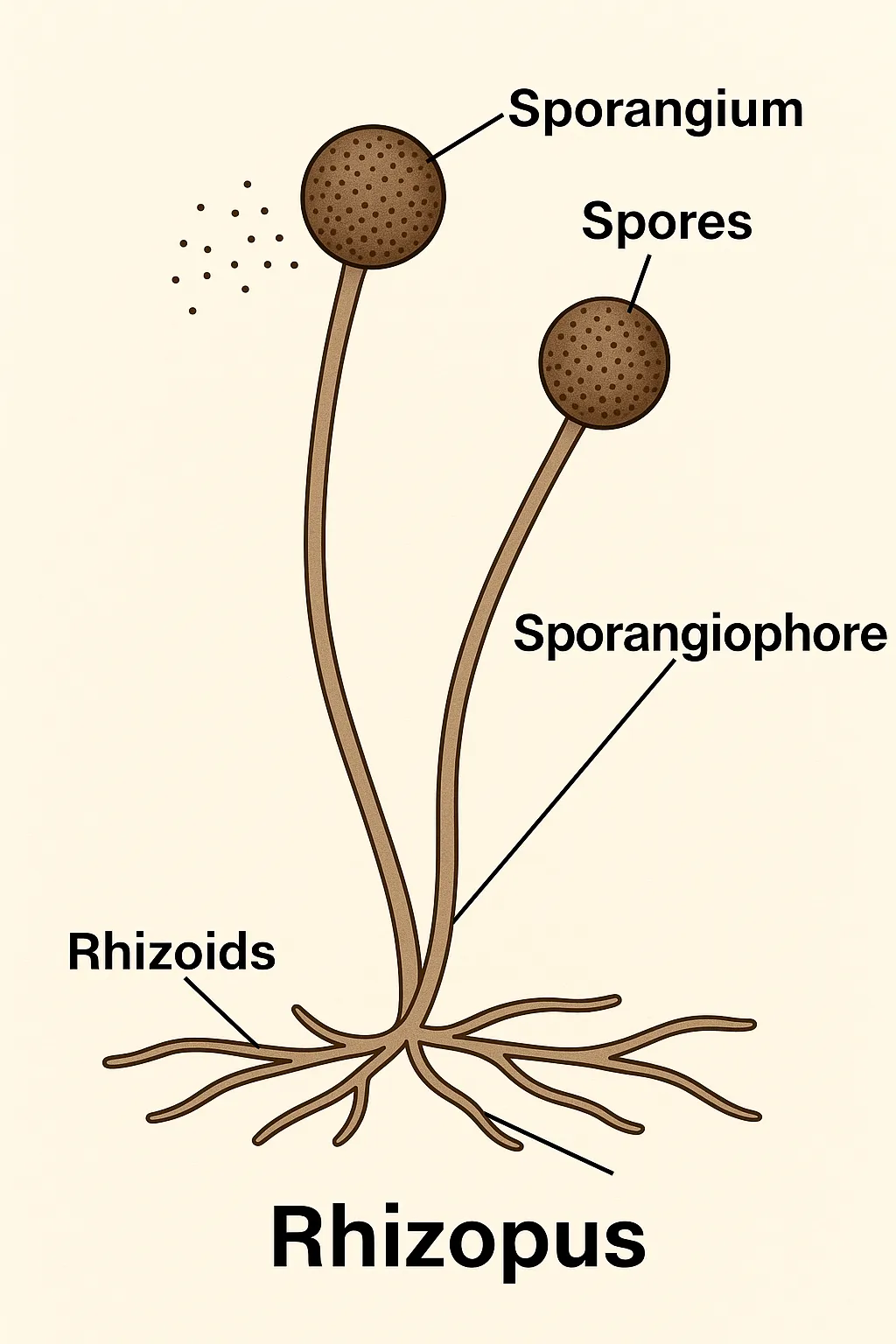
A sporangium is a sac-like spore-producing structure in which spores are formed, stored, and protected until they mature. When fully developed, the sporangium may burst open to release the spores into the surroundings. In fungi such as Rhizopus, sporangia are present at the tips of upright hyphae called sporangiophores.
💡 Concept
Concept Explanation
🔄 Process
Step-wise Process
  • 1
    Formation of sporangium at the tip of hyphae
    A sporangium develops at the tip of a specialized fungal structure called a hypha or sporangiophore. This sac-like structure protects the spores while they are forming. Example: In Rhizopus, sporangia appear on upright hyphae.
  • 2
    Development of numerous spores inside the sporangium
    Inside the sporangium, the nucleus and cytoplasm divide repeatedly to form many tiny spores. Each spore contains the material needed to grow into a new organism. Example: Bread mould produces a large number of spores inside each sporangium.
  • 3
    Bursting of sporangium under suitable conditions
    When the spores mature, the sporangium dries up and bursts open. This releases the spores into the surrounding environment. Example: In fungi, mature sporangia rupture and free the spores.
  • 4
    Dispersal of spores by air or water
    The released spores are light and small, so they can be carried away easily by wind, water, or other agents. This helps them spread to new places. Example: Rhizopus spores spread through air to reach food sources.
  • 5
    Germination into new organism
    When a spore lands on a favourable surface with proper moisture, temperature, and nutrients, it germinates and grows into a new individual. Example: A Rhizopus spore grows into a new mould colony on moist bread.
🖼️ Figure
Spore Formation in Rhizopus
✏️ Example

Rhizopus is a common fungus found on moist bread. It forms thread-like structures called hyphae. Upright hyphae known as sporangiophores bear sporangia at their tips, which contain numerous spores.

When the sporangium matures and bursts, spores are released and dispersed by air. Upon landing on a moist and nutrient-rich surface, they germinate to form a new fungal network (mycelium).

🔎 Key Fact
✅ Advantages
  • Rapid reproduction due to large number of spores.
  • High survival rate in harsh conditions.
  • Wide dispersal ensures colonization of new habitats.
  • No need for mating or gametes.
⚠️ Limitations
  • Produces genetically identical offspring.
  • Limited genetic variation.
  • Dependence on favourable conditions for germination.
🗒️ Imporatnce
  • Commonly asked 2–3 mark question.
  • Important example of asexual reproduction in fungi.
  • Used in case-based and diagram questions.
  • Often compared with vegetative propagation.
⚡ Exam Tip
❌ Common Mistakes
  • Confusing spores with seeds.
  • Not mentioning sporangium.
  • Ignoring dispersal mechanism.
📋 Case Study

Bread kept in a moist environment develops black patches after a few days.

Questions:

  1. Which organism is responsible?
  2. Which reproductive method is involved?

Solution:

  • Rhizopus fungus is responsible.
  • It reproduces through spore formation.
📝 Summary
🌱
Why the Sexual Mode of Reproduction?
📖 Introduction
📘 Definition
Sexual Reproduction Gametes Fertilization
Sexual Reproduction
Sexual reproduction is a mode of reproduction in which male and female gametes fuse to form a zygote. The offspring produced is genetically different from both parents, which increases variation in the population. This process is common in humans, flowering plants, birds, and many animals.
Gametes
Gametes are specialized reproductive cells that carry half the number of chromosomes of the parent organism. The male gamete is called sperm and the female gamete is called egg or ovum. Examples include human sperm and ovum, and pollen grain and egg cell in flowering plants.
Fertilization
Fertilization is the process in which male and female gametes fuse to form a zygote. It marks the beginning of a new organism and restores the full chromosome number. In humans, fertilization usually occurs in the fallopian tube; in flowering plants, it occurs in the ovule.
💡 Concept
📌 Note

Why Sexual Reproduction is Important

✏️ Example
Humans Flowering Plants Animals
1
Example
Humans: Offspring show variation in physical and genetic traits.
2
Example
Flowering Plants: Pollination and fertilization produce genetically diverse seeds.
3
Example
Animals: Variation helps species survive environmental stress.
⚡ Exam Tip
❌ Common Mistakes
  • Writing only definition without explaining importance.
  • Ignoring role of variation.
  • Confusing sexual reproduction with reproduction in general.
📋 Case Study

A population of organisms reproducing sexually survives a sudden disease outbreak, while a similar asexual population is wiped out.

Questions:

  1. Why did the sexual population survive?
  2. What biological principle is demonstrated?

Solution:

  • Genetic variation allowed some individuals to resist the disease.
  • This demonstrates natural selection and survival of the fittest.
📊 Comparison Table

Asexual vs Sexual Reproduction

Basis Asexual Reproduction Sexual Reproduction
Number of Parents One Two
Genetic Variation Absent (clones formed) Present (variation produced)
Gametes Not involved Formed and fused
Speed Fast Slow
Energy Requirement Low High
Adaptability Low High
Examples Amoeba, Hydra, Spirogyra Humans, Animals, Plants
📝 Summary
🌱
Sexual Reproduction in Organisms
🗒️ Intorduction
Sexual reproduction is a coordinated, multi-stage biological process that ensures the formation of a genetically unique organism. Each step—from gamete formation to development—plays a precise role in maintaining genetic stability, introducing variation, and ensuring survival of species.
🔄 Process

Detailed Steps in Sexual Reproduction

  • 1
    Gamete Formation

    Gametes are specialized reproductive cells formed through a reduction division process called meiosis, which halves the chromosome number.

    • Male gametes: Sperm (animals) / pollen grains (plants)
    • Female gametes: Ovum (egg)
    • Ensures chromosome number remains constant after fertilisation
    • Introduces genetic variation through recombination
  • 2
    Gamete Transfer

    Transfer of male gametes to female gametes is essential for fertilisation.

    • Animals: Internal or external fertilisation depending on species
    • Plants: Pollination (transfer of pollen to stigma)
    • Agents of pollination: wind, water, insects, animals
  • 3
    Fertilisation

    Fertilisation is the fusion of male and female gametes, restoring the diploid chromosome number.

    • Fusion of nuclei (karyogamy)
    • Formation of diploid zygote
    • Combines genetic traits from both parents
    • Can be internal (humans) or external (fish, frogs)
  • 4
    Formation of Zygote

    The zygote is the first cell of the new organism formed after fertilisation.

    • Contains full genetic information (diploid)
    • Acts as a blueprint for development
    • Undergoes rapid mitotic divisions
  • 5
    Development of Zygote into Embryo

    The zygote divides repeatedly and differentiates to form an embryo with distinct tissues and organs.

    • Cell division (mitosis) increases cell number
    • Cell differentiation forms specialized tissues
    • Embryo receives nutrition (placenta in animals / stored food in seeds)
  • 6
    Growth and Development into New Organism
    • Continuous cell division and enlargement
    • Organs mature and become functional
    • Embryo develops into a complete organism
    • New organism grows, reproduces, and continues lifecycle
💡 Concept
Key Concepts
⚡ Exam Tip
❌ Common Mistakes
  • Confusing meiosis with mitosis
  • Skipping gamete transfer step
  • Not mentioning zygote formation
📝 Summary
🌱
Sexual Reproduction in Flowering Plants
📖 Introduction
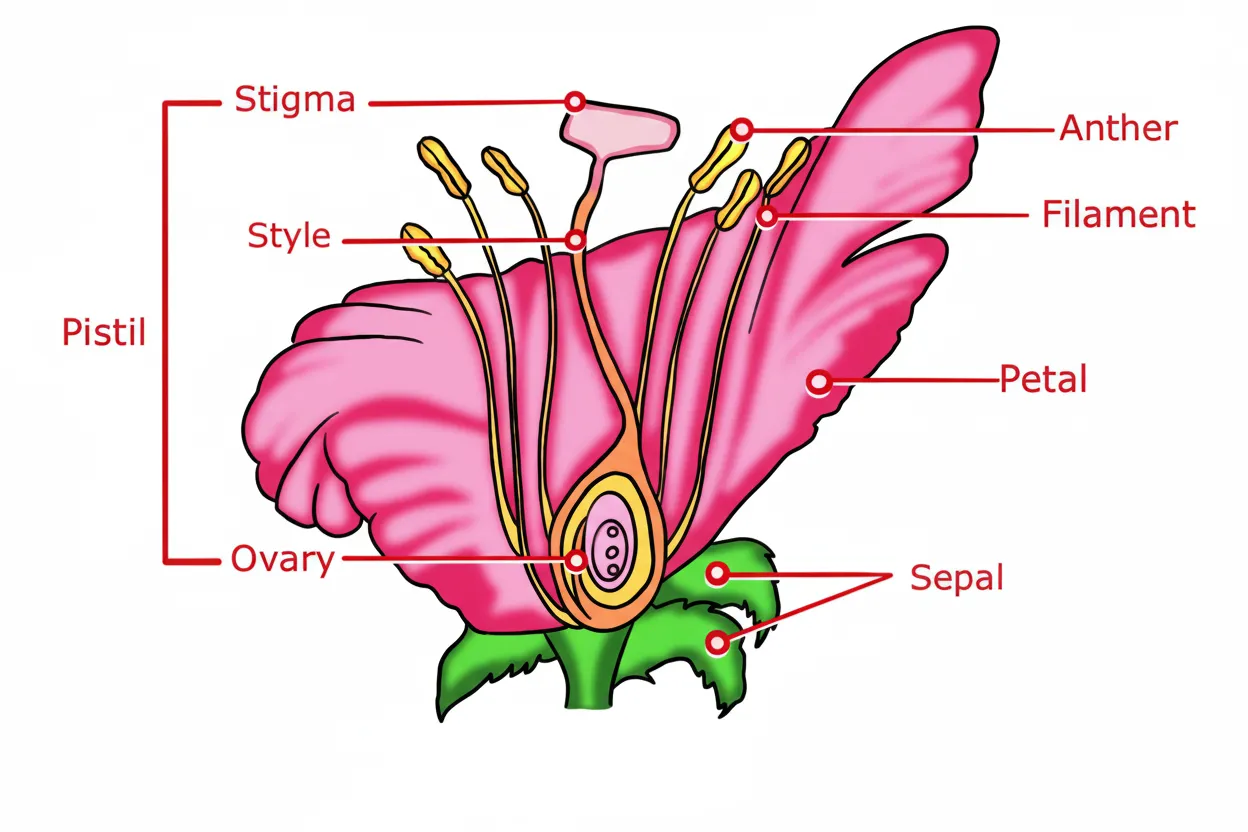
🌱 Reproductive Structures Of A Flower
  • 1
    Anther
    Produces pollen grains inside pollen sacs. Each pollen grain carries male gametes. It is the functional part of the stamen.
  • 2
    Filament
    Supports the anther and positions it for effective pollen transfer.
  • 3
    Stigma
    Sticky surface that receives pollen grains during pollination. It ensures compatibility of pollen.
  • 4
    Style
    Connects stigma to ovary and provides a pathway for pollen tube growth.
  • 5
    Ovary
    Contains ovules and protects them. After fertilisation, it develops into fruit.
  • 6
    Ovule
    Contains the egg cell (female gamete). After fertilisation, it develops into a seed.
🖼️ Figure
Longitudinal section of flower
🔄 Process

Process of Sexual Reproduction in Plants

  • 1
    Pollination
    Pollination is the transfer of pollen grains from the anther to the stigma of a flower. It may occur by self-pollination or cross-pollination and is the first step that brings the male gamete close to the female reproductive part. Example: In hibiscus and pea plants, pollen is transferred from anther to stigma by insects or by self-pollination.
  • 2
    Pollen Tube Formation
    After landing on a compatible stigma, the pollen grain germinates and forms a pollen tube. The tube grows through the style toward the ovary and carries the male gamete to the ovule. Example: In flowering plants, the pollen tube guides the male gamete to the embryo sac.
  • 3
    Fertilisation
    Fertilisation is the fusion of the male gamete with the egg cell inside the ovule to form a zygote. In angiosperms, this event is part of double fertilisation, where another male gamete fuses with the polar nuclei to form endosperm. Example: In flowering plants such as lily and pea, fertilisation occurs inside the ovule.
  • 4
    Seed Formation
    After fertilisation, the ovule develops into a seed. The zygote develops into the embryo, while the endosperm provides nourishment during early growth. Example: In a bean seed, the embryo inside the seed develops from the fertilised ovule.
  • 5
    Fruit Formation
    The ovary enlarges and develops into a fruit after fertilisation. The fruit protects the developing seeds and helps in their dispersal when mature. Example: In mango and tomato, the ovary becomes the fruit after fertilisation.
📊 Comparison Table

Types of Pollination

Type Description Advantage
Self Pollination Pollen transferred within same flower/plant Ensures reproduction without external agents
Cross Pollination Pollen transferred between different plants Increases genetic variation
⭐ Special Case

Double Fertilisation

🌟 Importance
⚡ Exam Tip
❌ Common Mistakes
  • Confusing pollination with fertilisation
  • Not mentioning pollen tube formation
  • Ignoring role of ovule and ovary
📝 Summary
🌱
Reproduction in Human Beings
📖 Introduction
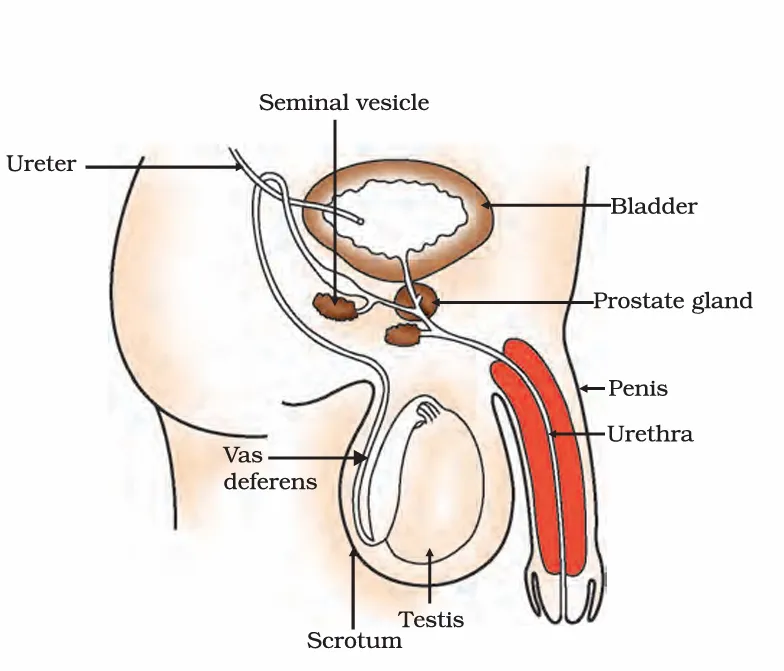
♂️ Male Reproductive System
Humans have separate male and female reproductive systems, each specialized for producing gametes, secreting sex hormones, and supporting fertilisation and the development of offspring. The male reproductive system mainly produces and delivers sperm, while the female reproductive system produces ova, receives sperm, and supports fertilisation, pregnancy, and childbirth.
  • Testes: The paired male gonads that produce sperm and secrete testosterone. They are the main sites of spermatogenesis and require a temperature slightly lower than body temperature for proper sperm formation.
  • Scrotum: A muscular sac that holds the testes outside the body and helps maintain the lower temperature needed for sperm production. It also protects the testes from injury.
  • Epididymis: A long coiled tube where sperm mature, gain motility, and are stored temporarily before ejaculation. It connects the testes to the vas deferens.
  • Vas Deferens: A muscular tube that transports mature sperm from the epididymis to the urethra. During ejaculation, it pushes sperm forward by rhythmic contractions.
  • Seminal Vesicles & Prostate Gland: These accessory glands add nourishing and protective fluids to sperm, forming semen. The seminal vesicles supply fructose for energy, while the prostate adds alkaline fluid that helps sperm survive.
  • Urethra: The common passage that carries semen out of the body during ejaculation and also carries urine at another time. It runs through the penis.
  • Penis: The external organ that deposits semen into the female reproductive tract during mating. It also serves as the passage for urine.

Functional Summary

The male reproductive system produces sperm in the testes, stores and matures them in the epididymis, and transports them through the vas deferens. Secretions from the seminal vesicles and prostate gland mix with sperm to form semen, which is expelled through the urethra during ejaculation. The penis helps deliver sperm into the female reproductive tract, where fertilisation may occur.

🖼️ Figure
Human male reproductive system
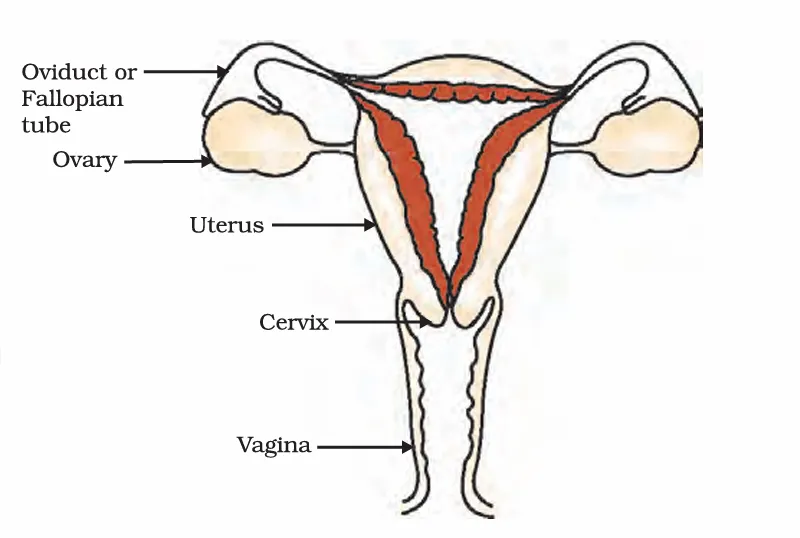
♀️ Female Reproductive System
The female reproductive system produces eggs (ova), receives sperm, provides the site for fertilisation, and supports the growth and development of the embryo and foetus until birth. It also secretes important hormones such as oestrogen and progesterone, which regulate the menstrual cycle and prepare the body for pregnancy.
  • Ovaries: The paired female gonads that produce ova and secrete the hormones oestrogen and progesterone. They release one mature egg during each menstrual cycle in a process called ovulation.
  • Fallopian Tubes: Thin tubes that carry the ovum from the ovary to the uterus. Fertilisation usually takes place in the fallopian tube when a sperm fuses with the egg to form a zygote.
  • Uterus: A thick, muscular organ where the fertilised egg implants and develops into an embryo and later a foetus. Its lining becomes rich in blood vessels to nourish the developing baby.
  • Cervix: The narrow lower part of the uterus that opens into the vagina. It acts as a gateway, allowing menstrual flow out and, during childbirth, widening to let the baby pass through.
  • Vagina: A muscular canal that receives sperm during reproduction and also serves as the birth canal during delivery. It connects the cervix to the outside of the body.

Functional Summary

An ovum released from an ovary enters the fallopian tube, where fertilisation may occur if sperm is present. The resulting zygote moves to the uterus, where it implants in the thickened lining and develops into an embryo, then a foetus. The uterus nourishes and protects the developing baby until birth.

🖼️ Figure
Human female reproductive system
🧬 Fertilisation In Humans
Fertilisation is internal and occurs in the fallopian tube where sperm fuses with ovum to form a diploid zygote. This ensures genetic mixing and variation.

Development of Embryo

  • Zygote undergoes mitotic divisions
  • Forms embryo and implants in uterus
  • Placenta provides nourishment and oxygen
  • Embryo develops into foetus
🧑‍🦱 Puberty And Hormonal Control
Puberty is the stage when reproductive organs mature and secondary sexual characteristics develop due to hormonal changes.
Males
  • In males, testosterone is the main hormone responsible for sperm production and the development of secondary sexual characters during puberty.
  • It helps in the growth of facial hair, deepening of the voice, increase in muscle mass, and maturation of the reproductive organs.
  • Testosterone is produced mainly by the testes and continues to regulate reproductive function in adult males.
  • Example: During puberty, boys develop a deeper voice and facial hair because of rising testosterone levels.
Females
  • In females, oestrogen and progesterone are the main hormones that regulate the menstrual cycle and control the development of secondary sexual characters.
  • Oestrogen helps in the development of breasts, widening of hips, and maturation of the reproductive system, while progesterone prepares the uterus for pregnancy and helps maintain it.
  • These hormones are produced mainly by the ovaries.
  • Example: The menstrual cycle and monthly release of an ovum are controlled by these hormones.
🩸 Menstrual Cycle
The menstrual cycle is a regular cyclic process in females that usually lasts about 28 days, though it may vary from person to person. During this cycle, the ovaries release an egg and the uterus prepares itself for a possible pregnancy by thickening its lining. It is controlled by hormones such as oestrogen and progesterone and begins at puberty, continuing until menopause.
  • Ovulation: A mature egg is released from one of the ovaries and enters the fallopian tube.
  • If fertilisation occurs: The egg fuses with sperm to form a zygote, which may implant in the uterus and lead to pregnancy.
  • If fertilisation does not occur: The thickened lining of the uterus breaks down and is shed from the body as menstrual flow or menstruation.
🌟 Importance
⚡ Exam Tip
❌ Common Mistakes
  • Confusing ovulation with fertilisation
  • Ignoring role of hormones
  • Missing stages of development
📝 Summary
🌱
Process of Fertilization
📖 Introduction
🔄 Process

Process Overview

  • 1
    Release of Gametes (Ovulation & Ejaculation)
    In females, a mature ovum is released from the ovary during ovulation and is picked up by the fimbriae of the fallopian tube. In males, millions of sperms are produced in the testes and released into the female reproductive tract during ejaculation. This creates the chance for the male and female gametes to meet and begin the process of fertilisation.
  • 2
    Movement of Sperm
    After ejaculation, sperms travel from the vagina through the cervix and uterus towards the fallopian tube. During this journey, most sperms die or are destroyed by the acidic environment of the vagina, mucus barriers, and immune defenses, so only a small number reach the upper reproductive tract. Example: Out of millions of sperms, only a few hundred may reach the fallopian tube.
  • 3
    Meeting of Sperm and Egg
    In the fallopian tube, the sperms surround the ovum and try to penetrate its outer layers. Enzymes released from the sperm help break the egg coverings, but only one sperm enters the egg, ensuring monospermy. Example: The fallopian tube is the usual site where the sperm and egg meet in humans.
  • 4
    Fertilization (Fusion of Nuclei)
    Fertilisation occurs when the nucleus of the sperm fuses with the nucleus of the ovum. This restores the diploid chromosome number and combines genetic material from both parents, forming a unique combination of traits in the offspring.
  • 5
    Formation of Zygote
    The fused cell is called a zygote, which is the first cell of a new individual. It contains a complete set of chromosomes and begins rapid mitotic divisions as it moves through the fallopian tube toward the uterus.
  • 6
    Early Development and Implantation
    The zygote divides repeatedly to form an embryo while travelling to the uterus. After reaching the uterus, it implants into the thickened uterine wall, where it receives nourishment and continues development into a foetus. Example: Successful implantation is necessary for pregnancy to continue.
💡 Concept
Key Biological Concepts
🌟 Importance
⚡ Exam Tip
❌ Common Mistakes
  • Confusing fertilization with implantation
  • Incorrect location (not uterus initially)
  • Ignoring role of sperm journey
📋 Case Study

Despite millions of sperms being released, only one fertilizes the egg.

Questions:

  1. Why do most sperms fail to reach the egg?
  2. Why is only one sperm allowed to fuse?

Solution:

  • Due to physical barriers and unfavorable conditions.
  • To maintain correct chromosome number (prevent polyspermy).
📝 Summary
Quick Revision Points
🌱
Development and Birth
📖 Introduction
👶 Embryo Formation And Early Growth

After fertilization, the zygote undergoes rapid mitotic divisions forming a multicellular structure called the embryo. It travels to the uterus and implants into the uterine lining, which provides protection and nourishment.

  • Zygote divides repeatedly (cleavage)
  • Implantation occurs in uterine wall
  • Basic body plan begins to form
🤰 Nourishment And Support: Placenta

The placenta is a temporary organ that connects the developing embryo to the mother’s body. It plays a critical role in exchange of materials and protection.

  • Supplies oxygen and nutrients
  • Removes carbon dioxide and waste
  • Connected via umbilical cord
  • Prevents mixing of maternal and fetal blood
👶 Foetal Development

After approximately 8 weeks, the embryo is termed a foetus. During this stage, organs grow, mature, and become functional.

  • Development of limbs, organs, and nervous system
  • Heartbeat becomes detectable
  • Growth in size and complexity
  • Gestation period ≈ 9 months
🤱 Process Of Birth (parturition)

Birth is the process by which the fully developed baby is delivered from the mother’s body.

  • Uterine contractions initiate labor
  • Cervix dilates to allow passage
  • Baby is pushed out through birth canal
  • Placenta is expelled after birth
🌟 Importance
🧑 Puberty And Growth

Puberty is the stage when reproductive organs mature and secondary sexual characteristics appear due to hormonal changes. It marks the beginning of reproductive capability.

  • Occurs between ages 10–16 (approx.)
  • Controlled by hormones
  • Leads to physical and emotional changes
⚡ Exam Tip
❌ Common Mistakes
  • Confusing embryo and foetus stages
  • Ignoring role of placenta
  • Not mentioning implantation
📝 Summary
🌱
What Happens During Puberty?
🗒️ Intorduction
Puberty is a crucial stage of human development during which the body undergoes physical, hormonal, emotional, and psychological changes. It marks the transition from childhood to adulthood and enables reproductive capability. These changes are regulated by hormones secreted by endocrine glands such as the pituitary gland, testes, and ovaries.
🧬 Hormonal Control Of Puberty
  • Pituitary gland: Releases hormones that initiate puberty
  • Testosterone: Controls male secondary sexual characters
  • Estrogen & Progesterone: Regulate female development and menstrual cycle

Physical Changes

Physical Changes in Boys
  • Voice deepens due to enlargement of larynx
  • Shoulders broaden; muscle mass increases
  • Growth of facial hair (beard, moustache) and body hair
  • Testes and penis enlarge; sperm production begins
  • Increased height due to growth spurt
Physical Changes in Girls
  • Breast development (mammary glands mature)
  • Hips widen for childbirth adaptation
  • Growth of pubic and underarm hair
  • Ovaries and uterus mature
  • Menstruation begins (menarche)
🧑‍🤝‍🧑 Emotional And Social Changes

Puberty is not only a physical transformation but also a period of emotional and social development.

  • Mood swings due to hormonal changes
  • Development of self-identity
  • Increased independence and decision-making ability
  • Interest in social relationships and peer interactions
🌟 Importance
Significance of Puberty
🌟 Importance
Significance of Sexual Reproduction
⚡ Exam Tip
❌ Common Mistakes
  • Ignoring hormonal control
  • Mixing male and female changes
  • Not mentioning emotional development
🗒️ Conclusion
Conclusion
Puberty is a vital phase that prepares the human body for reproduction and adulthood. It involves a combination of physical, hormonal, and emotional changes that ensure healthy development. Along with sexual reproduction, it contributes to the continuity and diversity of human life.
📝 Summary

Quick Revision Points

🌱
What Happens When the Egg is Not Fertilised?
📖 Introduction
🔄 Process
Process Overview
🗒️ Overview
When fertilisation does not take place, the unfertilised egg survives for only about 24 hours and then disintegrates. At the same time, the hormone levels that supported the uterine lining start to fall. As a result, the lining of the uterus breaks down and is shed through the vagina as menstrual flow.
  • 1
    No Fertilisation
    If sperm does not fuse with the egg, the ovum remains unfertilised and cannot develop into a zygote. Therefore, pregnancy cannot begin. Example: In a normal cycle, if no sperm reaches the egg in the fallopian tube, fertilisation does not occur.
  • 2
    Hormonal Changes
    When fertilisation does not occur, the levels of oestrogen and progesterone begin to decrease. These hormones normally maintain the thickened uterine lining. Their fall signals that pregnancy has not taken place and prepares the body for the next menstrual cycle.
  • 3
    Breakdown of Uterine Lining
    Before ovulation, the uterus builds a thick, blood-rich lining called the endometrium to support a possible pregnancy. If there is no embryo, this lining is no longer needed and starts to break down. The broken tissue mixes with blood and mucus and is removed from the body.
  • 4
    Menstruation Begins
    The shedding of the uterine lining is called menstruation. The menstrual flow contains blood, pieces of the endometrium, mucus, and the unfertilised egg. This marks day 1 of a new menstrual cycle.

    • Usually occurs once every 28 days, though the cycle may vary.
    • Lasts about 3–5 days in many females.
    • It is a normal physiological process, not a disease.
  • 5
    Monthly Cycle
    The menstrual cycle continues from puberty until menopause, unless pregnancy occurs. It is controlled by hormones and helps the reproductive system prepare every month for a possible pregnancy. Example: If fertilisation does not occur in one month, a new cycle begins after menstruation.
🌟 Importance
💡 Concept
Key Concepts
⚡ Exam Tip
❌ Common Mistakes
  • Confusing ovulation with menstruation
  • Not mentioning hormone changes
  • Skipping uterine lining explanation
📝 Summary
Quick Revision Points
🌱
Reproductive Health
📖 Introduction
📘 Definition
🌟 Importance
⚕️ Key Aspects Of Reproductive Health
  • Personal Hygiene: Cleanliness of reproductive organs prevents infections and maintains health.
  • Balanced Diet: Proper nutrition supports hormonal balance and organ development.
  • Safe Practices: Use of protection helps prevent STIs and unwanted pregnancies.
  • Vaccination: Protects against infections like HPV that may lead to serious diseases.
  • Regular Check-ups: Early detection and treatment of reproductive disorders.
  • Knowledge and Awareness: Education about puberty, reproduction, and health practices.
🩺 Common Reproductive Health Issues
  • Sexually Transmitted Infections (STIs) like HIV/AIDS, gonorrhea
  • Hormonal imbalances
  • Infertility problems
  • Menstrual disorders
🫂 Social And Emotional Well Being
Reproductive health also involves emotional stability, respect for oneself and others, and awareness of healthy relationships. Good communication and informed decisions are essential.
📢 Awareness And Responsibility
  • Sex education promotes informed choices
  • Public awareness programs reduce spread of diseases
  • Responsible behavior ensures healthy society
⚡ Exam Tip
❌ Common Mistakes
  • Limiting answer to physical health only
  • Ignoring social and emotional aspects
  • Not giving examples
🗒️ Conclusion
Conclusion
Reproductive health is essential for a healthy life and a balanced society. Maintaining hygiene, awareness, and proper healthcare ensures safe reproduction and prevents diseases, contributing to a better future for individuals and communities.
📝 Summary
🌱
Important Points
📖 Introduction
📝 Summary
Key Points for Revision
?>
NCERT Science Class X · Chapter 7

How do Organisms Reproduce?

A complete learning engine with concept maps, step-by-step solvers, interactive quizzes, flashcards, and diagrams — all in one place.

8 Core Concepts
12 Solved Problems
20 Quiz Questions
18 Flashcards
5 Diagrams
📚

Core Concepts

Click any concept to expand the full explanation

🌱
Why Do Organisms Reproduce?
Survival of species, DNA continuity, and the non-essential nature of reproduction at the individual level.
🔄
DNA Copying & Variation
Faithful vs. variable copying, role of errors, evolution, and body design.
Asexual Reproduction
Fission, fragmentation, regeneration, budding, vegetative propagation, spore formation.
🌸
Sexual Reproduction in Plants
Flower structure, pollination, fertilisation, seed and fruit formation.
🧬
Sexual Reproduction in Animals
Gametes, fertilisation (internal/external), embryo development.
👶
Human Reproduction
Male & female reproductive systems, puberty, menstrual cycle, fertilisation, pregnancy.
🛡️
Reproductive Health
STDs, contraception methods, safe sex, family planning.
⚖️
Sexual vs. Asexual Comparison
Advantages, disadvantages, and when each strategy is favoured in nature.
Concept 1
Why Do Organisms Reproduce?
Reproduction is not essential for the survival of an individual organism — an organism can live without reproducing. However, it is essential for the survival of the species over time. Without reproduction, a species would become extinct when its individuals die.

The fundamental purpose of reproduction is the transfer of genetic information (DNA) from one generation to the next. This ensures:
  • Continuity of species characteristics
  • Adaptation to changing environments through variation
  • The raw material for evolution
Reproduction is driven by the need to propagate genes, not just individuals. The organism is, in a sense, a vehicle for its DNA.
Think of reproduction as a photocopier for DNA — sometimes a small copying error (mutation) creates a new "edition" that may be better suited to the environment.
Concept 2
DNA Copying & Variation
During reproduction, the cell copies its DNA using biochemical reactions. This copying is largely faithful, but not perfect — small errors occur.

Consequences of variations:
  • Useful variation: Helps the organism survive environmental changes → selected by nature → evolution
  • Neutral variation: No immediate advantage or disadvantage → accumulated over time
  • Harmful variation: Reduces survival → eliminated by natural selection
Variation is the raw material of evolution. Asexual reproduction produces less variation; sexual reproduction maximises variation through genetic recombination.
Students confuse "variation" with "mutation." Mutation is a sudden large change; variation is the gradual accumulation of small differences over generations.
Concept 3
Asexual Reproduction — Modes & Examples
In asexual reproduction, a single parent gives rise to offspring without involvement of gametes. Offspring are genetically identical to parent (clones).
ModeDescriptionExample
Binary FissionParent divides into two equal halvesAmoeba, Leishmania (longitudinal), Plasmodium (multiple fission)
Multiple FissionParent divides into many daughter cells simultaneouslyPlasmodium (malarial parasite)
FragmentationBody breaks into fragments, each grows into new organismSpirogyra
RegenerationSpecialised cells (undifferentiated) rebuild entire organismPlanaria, Hydra
BuddingSmall bud grows on parent, detaches as new organismHydra, Yeast
Vegetative PropagationNew plant from vegetative parts (stem, root, leaf)Potato (stem), Bryophyllum (leaf), Rose (stem cutting)
Spore FormationSporangia produce spores that germinate into new organismsRhizopus (bread mould)
Remember "FFRBBVS" — Fission, Fragmentation, Regeneration, Budding, Budding(yeast), Vegetative propagation, Spore formation.
Regeneration ≠ Reproduction as a primary strategy. It is an ability to regrow lost parts. Planaria reproduce primarily by fragmentation, but regeneration allows each fragment to become whole.
Concept 4
Sexual Reproduction in Flowering Plants
The flower is the reproductive organ of a plant.
  • Stamens (male) → Filament + Anther → produce pollen grains (male gametes)
  • Pistil/Carpel (female) → Stigma + Style + Ovary → contains ovules (female gametes)

Pollination: Transfer of pollen from anther to stigma.
  • Self-pollination: same flower or same plant
  • Cross-pollination: different plants of same species, by wind, insects, water, birds

Fertilisation: Pollen tube grows through style → releases male gamete → fuses with female gamete in ovule → zygote.

Post-fertilisation: Ovary → Fruit; Ovule → Seed; Zygote → Embryo inside seed.
In angiosperms, double fertilisation occurs: one sperm fertilises the egg (→embryo), another fuses with polar nuclei (→endosperm, the food store).
Students often say "pollen is the male gamete." Pollen grain is NOT the gamete — it contains the male gamete inside it.
Concept 5
Sexual Reproduction in Animals
Animals produce specialised sex cells called gametes:
  • Male gamete: Sperm (small, motile)
  • Female gamete: Ovum/Egg (large, non-motile)

Fertilisation types:
  • External fertilisation: Outside the body, in water (fish, amphibia) — many eggs produced
  • Internal fertilisation: Inside female body (reptiles, birds, mammals) — fewer eggs, better care

After fertilisation, zygote develops into embryo → organism, either inside or outside the mother's body.
External fertilisation needs water to prevent gametes drying out — that's why it's found in aquatic animals.
Concept 6
Human Reproductive System
Male Reproductive System:
  • Testes: Produce sperms & testosterone; located in scrotum (below body temp for sperm production)
  • Vas deferens: Carries sperm from testes to urethra
  • Seminal vesicles + Prostate gland: Provide fluids that nourish sperm → semen
  • Urethra: Common passage for urine and semen (not simultaneously)
  • Penis: Delivers semen into vagina during copulation
Female Reproductive System:
  • Ovaries: Produce eggs and oestrogen
  • Fallopian tubes (Oviducts): Carry egg from ovary to uterus; fertilisation occurs here
  • Uterus: Where embryo implants and develops; lined by endometrium
  • Vagina: Receives penis; birth canal
  • Placenta: Connects embryo to mother's blood supply — exchanges nutrients, O₂, CO₂, waste
Menstrual Cycle (~28 days):
  • Day 1–5: Menstruation (endometrium sheds if no fertilisation)
  • Day 6–13: Follicular phase — egg matures
  • Day 14: Ovulation — egg released
  • Day 15–28: Luteal phase — endometrium thickens (for implantation)
Testes are outside the body because sperm production requires ~2–2.5°C below body temperature. The scrotum acts as a temperature regulator.
Students confuse "fertilisation" (union of sperm and egg in fallopian tube) with "implantation" (embedding of blastocyst in uterine wall). These are different events!
Concept 7
Reproductive Health
STDs (Sexually Transmitted Diseases): Gonorrhoea, syphilis (bacterial); AIDS (viral, HIV), warts (viral). Transmitted through sexual contact, blood transfusion, or mother to child.

Contraception Methods:
TypeMethodHow it works
BarrierCondom, diaphragmPrevents sperm from reaching egg; also protects against STDs
ChemicalOral pills, vaginal creamHormones prevent ovulation or alter uterine lining
IntrauterineIUD, copper-TPrevents implantation inside uterus
SurgicalVasectomy (M), Tubectomy (F)Permanent; cuts/blocks vas deferens or fallopian tubes
NaturalAbstinence, safe periodAvoiding intercourse during fertile days
Condom is the ONLY contraceptive method that also provides protection against STDs.
Contraceptives do not cause infertility (except surgical methods). Pills, IUDs etc. are reversible methods.
Concept 8
Sexual vs. Asexual Reproduction
FeatureAsexualSexual
Parents involvedOneTwo (usually)
Gametes requiredNoYes
Genetic variationAbsent (clones)Present (recombination)
SpeedFastSlower
Energy costLowHigh
AdaptabilityLow (no variation)High (genetic diversity)
Example organismsBacteria, Hydra, AmoebaMost animals, flowering plants
Asexual reproduction is advantageous in stable, unchanging environments. Sexual reproduction is favoured when the environment changes — diversity helps some individuals survive.
🔬

Key Points, Definitions & Processes

Essential facts and process equations for this chapter

Critical Definitions to Know
Reproduction
Parent Organism → Offspring (DNA transfer)
Process of producing offspring similar to parents; ensures continuity of species
Fertilisation
♂ Gamete + ♀ Gamete → Zygote (2n)
Fusion of male and female gametes to form diploid zygote
Binary Fission
1 Parent Cell → 2 Daughter Cells
DNA replication → elongation → septum formation → division
Seed Formation
Ovule + Zygote → Seed (contains embryo + food store)
Ovule develops into seed; ovary develops into fruit after fertilisation
Pollen Tube Growth
Stigma → Style → Ovary → Ovule
Pollen germinates on stigma; tube carries male gamete to ovule for fertilisation
Menstrual Cycle
Avg. period = 28 days; Ovulation ≈ Day 14
Cyclic hormonal changes preparing uterus for potential implantation
Placenta Function
Mother ↔ Placenta ↔ Embryo: O₂, Glucose, CO₂, Waste
Disc-shaped structure embedded in uterine wall; bridge for nutrient/gas exchange
Vegetative Propagation
Vegetative part → New plant (Mitosis only)
No gametes; new plant genetically identical to parent; fast method
Process Sequences — Must Memorise
🌸

Pollination → Fertilisation → Fruit/Seed

Pollen lands on stigma → pollen tube grows through style → enters ovule → male gamete fuses with egg → zygote → embryo (ovule→seed; ovary→fruit)

🧬

Sperm Journey in Male Body

Testes → Epididymis → Vas Deferens → (joins seminal vesicle fluid) → Urethra → Penis

🥚

Egg Journey in Female Body

Ovary → Fallopian Tube (fertilisation here) → Uterus (implantation) → 9 months gestation → birth via vagina

📅

Menstrual Cycle Events

Day 1–5: Menstruation → Day 6–13: Follicular phase/endometrium rebuilds → Day 14: Ovulation → Day 15–28: Luteal phase → Day 28: Menstruation (if no fertilisation)

🔬

Amoeba Binary Fission Steps

DNA replication → nucleus elongates and divides (karyokinesis) → cytoplasm divides (cytokinesis) → two daughter Amoebae formed

🧠

Step-by-Step AI Solver

Select a question to see the full worked solution

Choose a Question
Select a question above to begin.
✏️

Interactive Quiz

20 concept-based questions — tap an option to check your answer

Score
0 / 20
🃏

Flashcards

Click the card to flip — use arrows to navigate

Click to reveal definition
🌱
Loading...
Definition
Loading...
1 / 18
🖼️

Interactive Diagrams

Labelled visual representations of key biological structures

Nucleus Step 1: Normal Cell DNA replicates Step 2: Elongation & Cleavage Cell divides Step 3: Two Daughter Cells
Amoeba shows irregular binary fission — the plane of division is not fixed. Leishmania (a flagellated protozoan) shows longitudinal binary fission along the length of the flagellum.
Sepal Petal Anther (pollen) ← Stamen Ovary Style Stigma Ovule Filament Structure of a Flower (Longitudinal Section)
The pistil = stigma + style + ovary. The stamen = anther + filament. A flower with both is called a bisexual/hermaphrodite flower.
Abdominal cavity Urinary Bladder Prostate Gland Seminal Vesicle Vas Deferens Penis Urethra Testis Testis Scrotum Male Reproductive System
Testes are outside the body because sperm require temperatures ~2–3°C lower than core body temperature. The scrotum is positioned outside the abdomen to achieve this.
Uterus Cervix Vagina Fallopian Tube Ovary Fallopian Tube Ovary Endometrium Placenta Female Reproductive System (Frontal View)
Fertilisation occurs in the fallopian tube (oviduct), NOT in the uterus. The fertilised egg (zygote) then travels to the uterus for implantation.
Basal disc Hypostome ← Tentacles Parent Hydra Bud (developing) Detaches New Hydra Budding in Hydra
In budding, the bud is formed by mitotic division of cells on the parent body. The bud grows, develops tentacles, and eventually detaches to form a genetically identical new individual.
💡

Tips & Common Mistakes

Exam-focused insights that separate average from excellent answers

Smart Study Tips
💡

Use the "WHO-WHAT-HOW" framework

For every mode of reproduction: WHO is the organism? WHAT type is it (sexual/asexual)? HOW does the process work (steps)?

🧩

Link structure to function always

E.g., testes outside → low temp needed → sperm viability. Style long → pollen tube needs to travel far → ensures only strong pollen fertilises.

🏷️

For diagram questions: label everything

Even if only 3 labels are asked, show 5-6. Examiners award bonus marks for extra correct labels and a clean diagram with a title.

🔁

Memorise the menstrual cycle as a story

"The lining builds up (Days 6–13) waiting for a fertilised egg. On Day 14 the egg is released. If no egg arrives by Day 28, the lining sheds (menstruation). Repeat."

📊

Use tables for comparison questions

When asked to "differentiate" or "compare," a 3-column table (Feature | A | B) scores higher than paragraph answers — clearer, faster, and complete.

🎯

Condom = ONLY contraceptive for STD protection

Examiners love this. Copper-T, pills, and vasectomy do NOT protect against STDs. Only barrier methods (especially condoms) do both.

Most Common Mistakes (Avoid These!)

Pollen grain = male gamete (WRONG)

Pollen grain is the structure that CONTAINS the male gamete. The male gamete is inside. This is a very common error in 3-mark answers.

Fertilisation happens in the uterus (WRONG)

Fertilisation occurs in the fallopian tube (oviduct). The uterus is where implantation and development occur.

Regeneration = Mode of reproduction (WRONG)

Regeneration is an ability, not a primary reproductive strategy. Planaria use fragmentation to reproduce; regeneration makes each fragment whole. Don't say "regeneration is a mode of asexual reproduction" in an exam without qualification.

Variation = Mutation (WRONG)

Variations are small heritable differences accumulated over generations. Mutations are sudden, large changes. They are related concepts but not identical.

Asexual reproduction produces genetically varied offspring (WRONG)

Asexual reproduction produces clones — genetically identical offspring. Only sexual reproduction generates variation through meiosis and gamete fusion.

Sperm is produced in the scrotum (WRONG)

Sperm is produced in the testes (seminiferous tubules). The scrotum is just the external sac that houses the testes and maintains their temperature.

📝

Question Bank

Concept-organised, non-repetitive questions with full solutions

Interactive Activity — Match the Following
Organism ↔ Mode of Reproduction
Organisms
Modes
Click an organism, then its mode to match.
Structured Questions with Full Answers
📚
ACADEMIA AETERNUM तमसो मा ज्योतिर्गमय · Est. 2025
Sharing this chapter
How do Organisms Reproduce Class 10 Notes | Revision
How do Organisms Reproduce Class 10 Notes | Revision — Complete Notes & Solutions · academia-aeternum.com
Reproduction is a defining characteristic of living organisms, ensuring the continuity of life on Earth. NCERT Science Class X Chapter 7, “How do Organisms Reproduce?” explores the fascinating processes by which plants, animals, and humans bring forth the next generation. Students discover the difference between asexual and sexual reproduction, the biological structures involved, and the underlying principles governing heredity and variation. This chapter also delves into human reproduction,…
🎓 Class 10 📐 Science 📖 NCERT ✅ Free Access 🏆 CBSE · JEE
Share on
academia-aeternum.com/class-10/science/how-do-organisms-reproduce/notes/ Copy link
💡
Exam tip: Sharing chapter notes with your study group creates a reinforcement loop. Teaching a concept is the fastest path to mastering it.

Recent posts

    Get in Touch

    Let's Connect

    Questions, feedback, or suggestions?
    We'd love to hear from you.