The Human Eye and the Colourful World — NCERT Solutions | Class 10 Science | Academia Aeternum
Ch 10  ·  Q–
0%
Class 10 Science Exercise NCERT Solutions Olympiad Board Exam
Chapter 10

The Human Eye and the Colourful World

Step-by-step NCERT solutions with stress–strain analysis and exam-oriented hints for Boards, JEE & NEET.

12 Questions
40-50 min Ideal time
Q1 Now at
Q1
NUMERIC3 marks

The human eye can focus on objects at different distances by adjusting the focal length of the eye lens. This is due to:

  1. presbyopia
  2. accommodation
  3. near-sightedness
  4. far-sightedness
Concept Theory

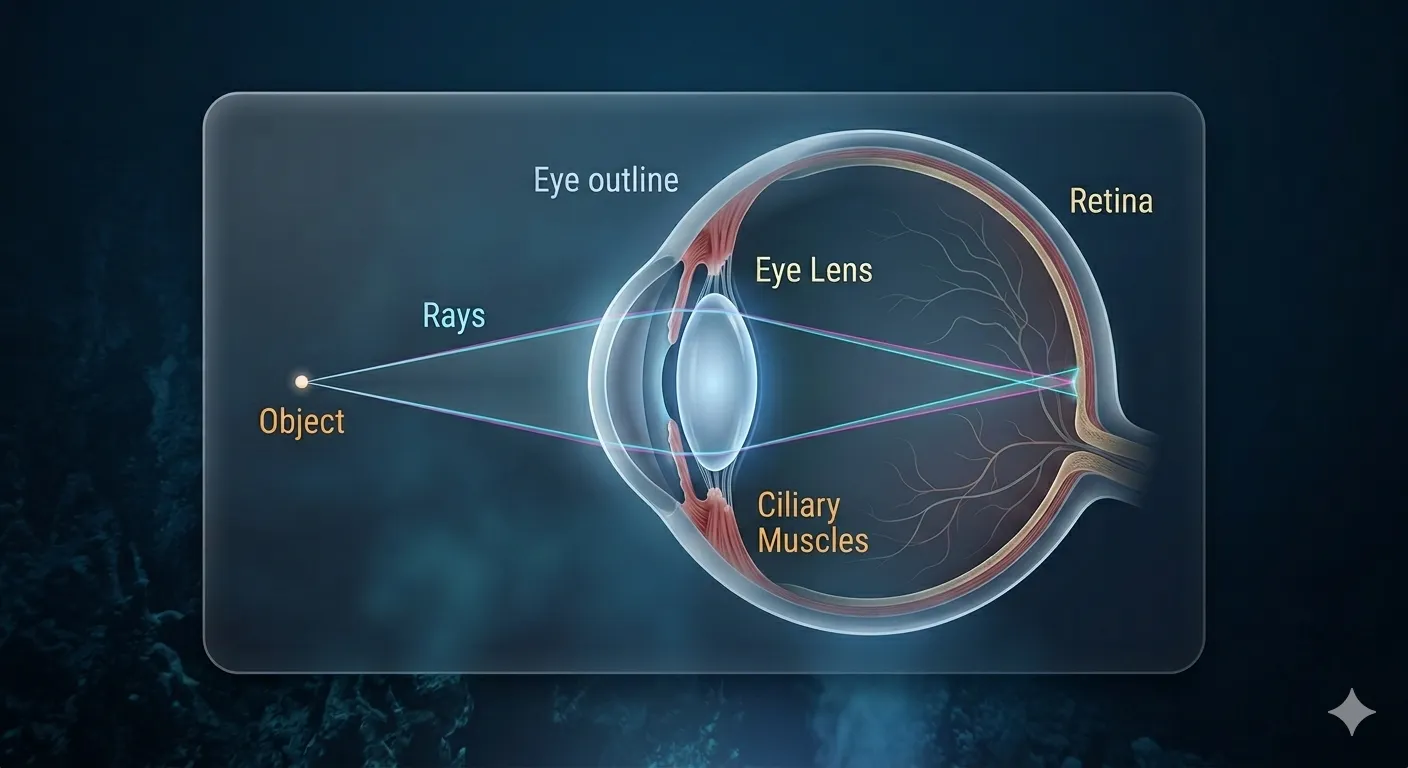
The human eye works like a camera where the eye lens forms images on the retina. To clearly see objects at different distances, the eye must adjust its focal length.

This adjustment is achieved by ciliary muscles, which can:

  • Contract → lens becomes thicker → focal length decreases (near objects)
  • Relax → lens becomes thinner → focal length increases (distant objects)

This ability of the eye is called accommodation.

Solution Roadmap
  1. Identify what the question is asking → ability to focus at different distances
  2. Recall the concept related to change in focal length
  3. Check given options one by one
  4. Select the correct physiological process
Step-by-Step Solution

Step 1: The question refers to changing focal length of the eye lens.

Step 2: This change is controlled by ciliary muscles.

Step 3: The process of changing focal length is called:

\[ \text{Accommodation} \]

Step 4: Now eliminate incorrect options:

  • Presbyopia: Age-related defect → not correct
  • Near-sightedness (Myopia): Defect → not correct
  • Far-sightedness (Hypermetropia): Defect → not correct

Final Answer: b. accommodation

Ray Diagram (Accommodation Process)
Near Object Eye Lens Retina
Exam Significance
  • Board Exams: Frequently asked MCQ and theory-based question
  • Conceptual Weightage: Forms base for defects of vision
  • Competitive Exams: Important for NEET, NDA, and Olympiads
  • Application: Helps understand myopia, hypermetropia, presbyopia corrections
↑ Top
1 / 12  ·  8%
Q2 →
Q2
NUMERIC3 marks

The human eye forms the image of an object at its:

  1. cornea
  2. iris
  3. pupil
  4. retina
Concept Theory

The human eye functions as an optical system where light from an object enters through the cornea, passes through the pupil, and is focused by the eye lens.

The final image is formed on the retina, which is a light-sensitive layer containing photoreceptor cells (rods and cones).

These cells convert light into electrical signals, which are then sent to the brain via the optic nerve.

Solution Roadmap
  1. Understand where image formation actually occurs in the eye
  2. Differentiate between parts that control light entry and focusing
  3. Identify the light-sensitive screen of the eye
  4. Select the correct option
Step-by-Step Solution

Step 1: Light enters the eye through the cornea and pupil.

Step 2: The eye lens converges the incoming rays.

Step 3: The converging rays meet at a point where the image is formed.

Step 4: This point lies on the light-sensitive surface called:

\[ \text{Retina} \]

Step 5: Eliminate incorrect options:

  • Cornea: Only refracts light → does not form final image
  • Iris: Controls amount of light → not image formation
  • Pupil: Opening for light → not image formation

Final Answer: d. retina

Ray Diagram (Image Formation on Retina)
Eye Lens Retina Incident Light
Exam Significance
  • Board Exams: Very common MCQ and 1-mark question
  • Concept Link: Basis for understanding image defects
  • Competitive Exams: Frequently asked in NEET and NTSE
  • Diagram-Based Questions: Retina labeling is often tested
← Q1
2 / 12  ·  17%
Q3 →
Q3
NUMERIC3 marks

The least distance of distinct vision for a young adult with normal vision is about:

  1. 25 m
  2. 2.5 cm
  3. 25 cm
  4. 2.5 m
Concept Theory

The least distance of distinct vision (also called the near point) is the minimum distance at which a normal human eye can see an object clearly without strain.

For a young adult with normal vision, this distance is:

\[ D = 25 \text{ cm} \]

At distances smaller than this, the eye lens cannot increase its curvature sufficiently, and the image becomes blurred.

Solution Roadmap
  1. Recall the definition of least distance of distinct vision
  2. Remember the standard value for a normal eye
  3. Compare options with the known value
  4. Select the correct numerical answer
Step-by-Step Solution

Step 1: The least distance of distinct vision is also called the near point.

Step 2: For a normal human eye, this standard value is:

\[ D = 25 \text{ cm} \]

Step 3: Compare all options with this known value.

  • 25 m → too large → incorrect
  • 2.5 cm → too small → not possible for relaxed vision
  • 25 cm → matches standard value → correct
  • 2.5 m → incorrect

Final Answer: c. 25 cm

Concept Diagram (Near Point of Eye)
Retina Incident Light 25 cm (D)
Exam Significance
  • Board Exams: Direct MCQ or 1-mark factual question
  • Numerical Base: Used in lens formula problems
  • Competitive Exams: Frequently asked concept in NEET and NTSE
  • Concept Link: Important for understanding presbyopia and accommodation limits
← Q2
3 / 12  ·  25%
Q4 →
Q4
NUMERIC3 marks

The change in focal length of an eye lens is caused by the action of the:

  1. pupil
  2. retina
  3. ciliary muscles
  4. iris
Concept Theory

The focal length of the eye lens is not fixed. It changes dynamically to focus light from objects at different distances on the retina.

This adjustment is controlled by the ciliary muscles, which modify the curvature of the lens:

  • When ciliary muscles contract → lens becomes thicker → focal length decreases
  • When ciliary muscles relax → lens becomes thinner → focal length increases

This process is known as accommodation.

Solution Roadmap
  1. Understand what causes change in focal length
  2. Identify the structure responsible for lens shape change
  3. Eliminate parts that only control light entry or detection
  4. Choose the correct physiological component
Step-by-Step Solution

Step 1: Focal length depends on curvature of the eye lens.

Step 2: The structure that can change lens curvature must be identified.

Step 3: Ciliary muscles are attached to the lens and control its shape.

Step 4: Thus, the focal length changes due to:

\[ \text{Action of ciliary muscles} \]

Step 5: Eliminate incorrect options:

  • Pupil: Controls light entry only
  • Retina: Forms image, does not adjust focus
  • Iris: Controls size of pupil

Final Answer: c. ciliary muscles

Concept Diagram (Role of Ciliary Muscles)
ciliary muscles
Exam Significance
  • Board Exams: Frequently asked conceptual MCQ
  • Core Concept: Foundation of accommodation mechanism
  • Competitive Exams: Important for NEET, NDA, and Olympiads
  • Application: Helps explain focusing defects and their correction
← Q3
4 / 12  ·  33%
Q5 →
Q5
NUMERIC3 marks
A person needs a lens of power –5.5 dioptres for correcting his distant vision. For correcting his near vision he needs a lens of power +1.5 dioptre. What is the focal length of the lens required for correcting
(i) distant vision, and
(ii) near vision?
Concept Theory

The power of a lens is related to its focal length by:

\[ P = \frac{1}{f} \]

where:

  • \(P\) = Power (in dioptres, D)
  • \(f\) = Focal length (in metres)

Sign convention:

  • Negative power → Concave lens → used for myopia (near-sightedness)
  • Positive power → Convex lens → used for hypermetropia (far-sightedness)
Solution Roadmap
  1. Write the given powers for both cases
  2. Use the relation \( P = \frac{1}{f} \)
  3. Rearrange to \( f = \frac{1}{P} \)
  4. Calculate focal length in metres
  5. Convert into centimetres
  6. Interpret sign of focal length
Given

Power for distant vision: \[ P_1 = -5.5\, \text{D} \] Power for near vision: \[ P_2 = +1.5\, \text{D} \]

Step-by-Step Solution

Formula used:

\[ f = \frac{1}{P} \]

  1. For distant vision:

    Step 1: Substitute value of power

    \[ f_1 = \frac{1}{-5.5} \]

    Step 2: Perform division

    \[ f_1 = -0.182\, \text{m} \]

    Step 3: Convert into centimetres

    \[ f_1 = -0.182 \times 100 = -18.2\, \text{cm} \]

    \[ \boxed{f_1 = -18.2\, \text{cm}} \]

  2. For near vision:

    Step 1: Substitute value of power

    \[ f_2 = \frac{1}{1.5} \]

    Step 2: Perform division

    \[ f_2 = 0.667\, \text{m} \]

    Step 3: Convert into centimetres

    \[ f_2 = 0.667 \times 100 = 66.7\, \text{cm} \]

    \[ \boxed{f_2 = 66.7\, \text{cm}} \]

Interpretation of Results
  • \(f_1 = -18.2\, \text{cm}\) → Negative → Concave lens → corrects myopia
  • \(f_2 = 66.7\, \text{cm}\) → Positive → Convex lens → corrects hypermetropia
  • Hence, the person requires bifocal lenses
Exam Significance
  • Board Exams: Very important 3–5 mark numerical question
  • Formula Application: Direct use of \(P = \frac{1}{f}\)
  • Competitive Exams: Frequently asked in NEET, NDA, SSC
  • Common Mistake: Forgetting sign convention and unit conversion
  • High-Value Concept: Identifying lens type from sign of power
← Q4
5 / 12  ·  42%
Q6 →
Q6
NUMERIC3 marks
The far point of a myopic person is 80 cm in front of the eye. What is the nature and power of the lens required to correct the problem?
Concept Theory

In myopia (near-sightedness), a person can see nearby objects clearly but distant objects appear blurred. This happens because the image of distant objects is formed in front of the retina.

To correct this defect, a concave (diverging) lens is used. It diverges incoming parallel rays so that they appear to originate from the far point and are then properly focused on the retina.

Relation between power and focal length:

\[ P = \frac{1}{f} \]

where \(P\) is in dioptres and \(f\) is in metres.

Solution Roadmap
  1. Identify the defect → myopia
  2. Determine nature of correcting lens
  3. Use far point as image position
  4. Apply lens formula simplification for distant object
  5. Calculate focal length
  6. Find power using \(P = \frac{1}{f}\)
Given

Far point of the myopic person: \[ v = -80 \text{ cm} = -0.8 \text{ m} \]

Step-by-Step Solution

Step 1: For distant objects, object distance is taken as infinity:

\[ u = -\infty \]

Step 2: Use lens formula:

\[ \frac{1}{f} = \frac{1}{v} - \frac{1}{u} \]

Step 3: Substitute values:

\[ \frac{1}{f} = \frac{1}{-0.8} - \frac{1}{-\infty} \]

Step 4: Since \(\frac{1}{\infty} = 0\),

\[ \frac{1}{f} = \frac{1}{-0.8} \]

Step 5: Therefore,

\[ f = -0.8 \text{ m} \]

Step 6: Calculate power:

\[ P = \frac{1}{f} = \frac{1}{-0.8} \]

\[ P = -1.25 \text{ D} \]

\[ \boxed{P = -1.25 \text{ D}} \]

Final Result
  • Nature of lens: Concave (diverging)
  • Power of lens: \(-1.25\, \text{D}\)
Exam Significance
  • Board Exams: Very common 3-mark numerical
  • Concept Tested: Sign convention + lens formula
  • Competitive Exams: High-frequency in NEET and NTSE
  • Common Errors: Wrong sign for far point and skipping infinity step
  • Key Skill: Identifying defect + selecting correct lens type
← Q5
6 / 12  ·  50%
Q7 →
Q7
NUMERIC3 marks
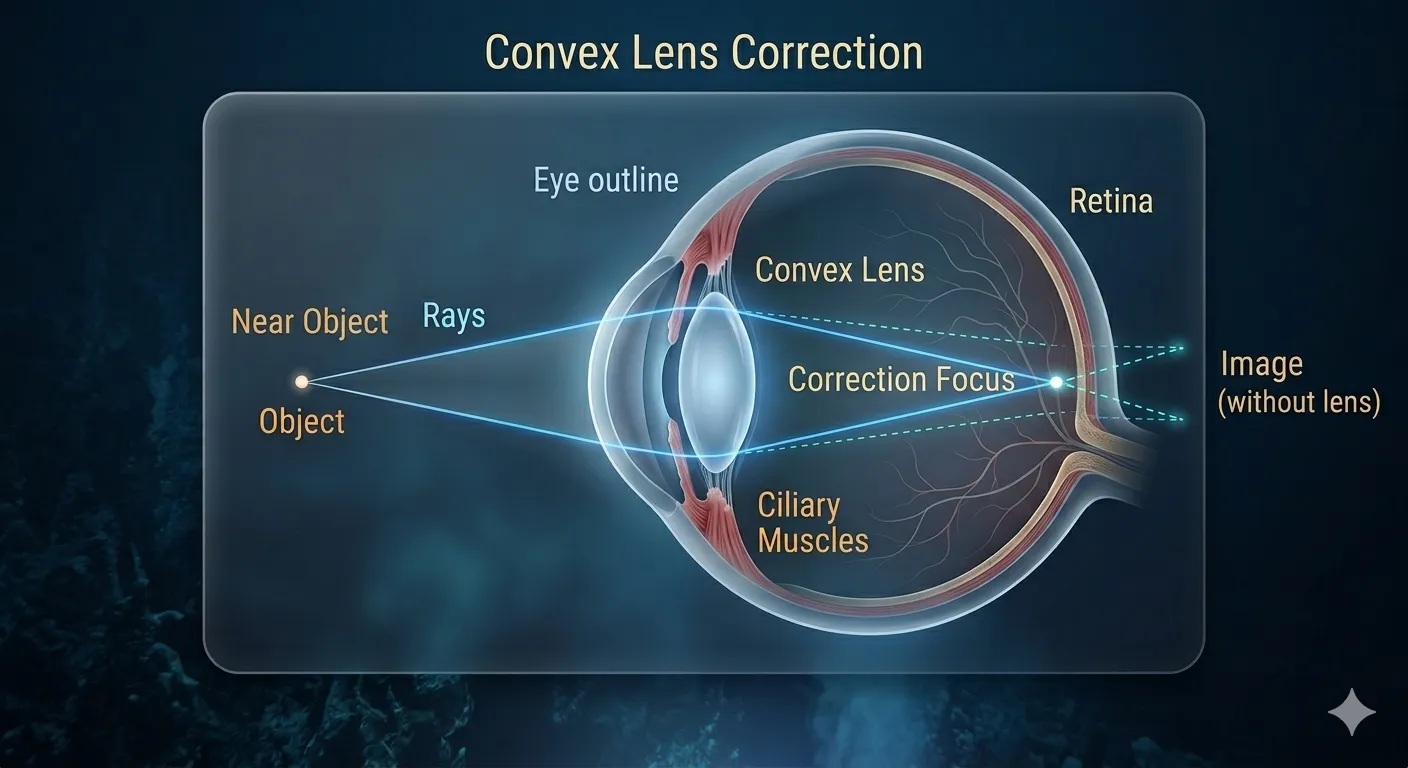
Make a diagram to show how hypermetropia is corrected. The near point of a hypermetropic eye is 1 m. What is the power of the lens required to correct this defect? Assume that the near point of the normal eye is 25 cm.
Concept Theory

Hypermetropia (far-sightedness) is a defect in which a person can see distant objects clearly but cannot see nearby objects distinctly.

Cause: Image of a near object forms behind the retina due to insufficient converging power of the eye lens.

Correction: A convex (converging) lens is used to converge rays before they enter the eye so that the image forms on the retina.

Solution Roadmap
  1. Identify defect → hypermetropia
  2. Determine required lens → convex
  3. Use near point data
  4. Apply lens formula
  5. Follow sign convention carefully
  6. Compute focal length and power
Given

Near point of defective eye: \[ v = -1 \text{ m} \]

Desired near point (normal eye): \[ u = -0.25 \text{ m} \]

Step-by-Step Solution

Step 1: Use lens formula:

\[ \frac{1}{f} = \frac{1}{v} - \frac{1}{u} \]

Step 2: Substitute values:

\[ \frac{1}{f} = \frac{1}{-1} - \frac{1}{-0.25} \]

Step 3: Simplify each term:

\[ \frac{1}{-1} = -1, \quad \frac{1}{-0.25} = -4 \]

Step 4: Perform calculation:

\[ \frac{1}{f} = -1 - (-4) \]

\[ \frac{1}{f} = -1 + 4 = 3 \]

Step 5: Find focal length:

\[ f = \frac{1}{3} = 0.333 \text{ m} \]

Step 6: Calculate power:

\[ P = \frac{1}{f} = 3.0 \text{ D} \]

\[ \boxed{P = +3.0 \text{ D}} \]

Final Result
  • Nature of lens: Convex (converging)
  • Power of lens: +3.0 D
Convex Lens Correction
Exam Significance
  • Board Exams: Very important 3–5 mark question (diagram + numerical)
  • Concept Tested: Lens formula + sign convention
  • Competitive Exams: Frequently asked in NEET and NTSE
  • Common Mistake: Taking wrong sign for near point
  • High-Scoring Tip: Always show substitution step clearly
← Q6
7 / 12  ·  58%
Q8 →
Q8
NUMERIC3 marks

Why is a normal eye not able to see clearly the objects placed closer than 25 cm?

Concept Theory

The least distance of distinct vision (near point) is the minimum distance at which a normal eye can see objects clearly without strain.

For a normal adult eye:

\[ D = 25 \text{ cm} \]

The eye focuses on nearby objects by increasing the curvature of the lens through the action of ciliary muscles. This reduces the focal length so that the image forms on the retina.

Solution Roadmap
  1. Understand focusing mechanism of the eye
  2. Identify the limitation of ciliary muscles
  3. Relate curvature change to focal length
  4. Explain why image cannot form on retina for very close objects
Step-by-Step Explanation

Step 1: To see a nearby object clearly, the eye lens must become more curved.

Step 2: Increased curvature leads to a decrease in focal length:

\[ f \downarrow \quad \Rightarrow \quad \text{image forms on retina} \]

Step 3: This change in curvature is controlled by ciliary muscles.

Step 4: However, these muscles have a maximum contraction limit.

Step 5: When an object is placed closer than 25 cm:

  • Required focal length becomes very small
  • Lens cannot become sufficiently thick

Step 6: As a result, the image forms:

\[ \text{Behind the retina} \]

Step 7: Therefore, the object appears blurred.

Final Answer

A normal eye cannot see objects closer than 25 cm clearly because the ciliary muscles cannot increase the curvature of the eye lens beyond a certain limit. As a result, the focal length cannot decrease sufficiently, and the image is not formed on the retina, leading to blurred vision.

Exam Significance
  • Board Exams: Frequently asked 2–3 mark conceptual question
  • Concept Tested: Accommodation and its limitation
  • Competitive Exams: Important for NEET conceptual clarity
  • Common Mistake: Students forget to mention "limit of ciliary muscles"
  • Link Concept: Basis for presbyopia and vision defects
← Q7
8 / 12  ·  67%
Q9 →
Q9
NUMERIC3 marks

What happens to the image distance in the eye when we increase the distance of an object from the eye?

Concept Theory

In the human eye, the retina acts as a fixed screen where images must be formed for clear vision.

The distance between the eye lens and the retina is approximately constant. Therefore:

\[ \text{Image distance } (v) = \text{constant} \]

To focus objects at different distances, the eye changes the focal length of the lens using ciliary muscles. This process is called accommodation.

Solution Roadmap
  1. Recall that retina position is fixed
  2. Understand lens formula relationship
  3. Analyze what changes when object distance varies
  4. Conclude which parameter remains constant
Step-by-Step Explanation

Step 1: The image in the eye must always form on the retina.

Step 2: The retina is fixed, so the image distance \(v\) remains constant.

Step 3: Lens formula for the eye:

\[ \frac{1}{f} = \frac{1}{v} - \frac{1}{u} \]

Step 4: When object distance increases:

  • \(u\) becomes more negative (moves towards infinity)

Step 5: Since \(v\) is constant, the focal length must adjust:

\[ f \text{ changes to maintain focus} \]

Step 6: This adjustment is done by ciliary muscles (accommodation).

Final Answer

When the distance of an object from the eye increases, the image distance remains constant because the image must always form on the retina. The eye lens adjusts its focal length through accommodation to maintain a clear image.

Concept Diagram (Constant Image Distance)
Retina Near Object Far Object Image always on Retina
Exam Significance
  • Board Exams: Common conceptual 2-mark question
  • Core Concept: Retina as fixed image plane
  • Competitive Exams: Frequently tested in NEET theory
  • Common Mistake: Students wrongly assume image distance changes
  • Key Insight: Only focal length changes, not image distance
← Q8
9 / 12  ·  75%
Q10 →
Q10
NUMERIC3 marks
Why do stars twinkle?
Concept Theory

Twinkling of stars is caused by atmospheric refraction.

The Earth's atmosphere consists of multiple layers of air with continuously changing temperature and density. These variations cause the refractive index of air to change continuously.

When light from a distant star passes through these layers, it bends repeatedly:

\[ \text{Refraction} \Rightarrow \text{continuous change in apparent position and brightness} \]

Solution Roadmap
  1. Identify the phenomenon → atmospheric refraction
  2. Understand variation in refractive index of air
  3. Explain continuous bending of light
  4. Relate it to fluctuation in brightness
  5. Explain why stars (not planets) twinkle
Step-by-Step Explanation

Step 1: Light from stars travels through Earth's atmosphere.

Step 2: Atmospheric layers have varying refractive indices due to temperature and density differences.

Step 3: This causes continuous refraction (bending) of light rays.

Step 4: The path of light keeps changing randomly.

Step 5: As a result:

  • Apparent position of the star changes
  • Amount of light reaching the eye fluctuates

Step 6: This rapid variation produces the effect:

\[ \text{Twinkling of stars} \]

Step 7: Stars twinkle more because they behave as:

\[ \text{Point sources of light} \]

Final Answer

Stars twinkle due to atmospheric refraction. The continuously changing layers of air bend the light from stars in different directions, causing fluctuations in brightness and apparent position. Since stars are very distant and act as point sources of light, this effect becomes prominent, making them appear to twinkle.

Exam Significance
  • Board Exams: Very common 2–3 mark explanation question
  • Core Concept: Atmospheric refraction
  • Competitive Exams: Frequently asked conceptual MCQ in NEET/NTSE
  • Common Mistake: Confusing with scattering of light
  • Extension: Planets do not twinkle because they appear as extended sources
← Q9
10 / 12  ·  83%
Q11 →
Q11
NUMERIC3 marks
Explain why the planets do not twinkle
Concept Theory

Twinkling is caused by atmospheric refraction, where light bends continuously due to changing refractive index of air.

The key difference between stars and planets lies in their apparent size:

  • Stars → behave as point sources
  • Planets → behave as extended sources (small discs)
Solution Roadmap
  1. Recall cause of twinkling → atmospheric refraction
  2. Compare stars and planets
  3. Understand point vs extended source
  4. Explain averaging of intensity fluctuations
Step-by-Step Explanation

Step 1: Light from planets passes through Earth's atmosphere.

Step 2: Atmospheric refraction causes slight fluctuations in light intensity.

Step 3: However, planets appear as extended sources:

\[ \text{Planet} \rightarrow \text{small disc (not a point)} \]

Step 4: Light from different parts of the disc travels through slightly different paths.

Step 5: These variations:

  • Cancel each other
  • Average out the intensity fluctuations

Step 6: Therefore, brightness remains steady.

Final Answer

Planets do not twinkle because they are much closer to Earth and appear as extended sources of light. The atmospheric refraction causes fluctuations in different parts of the planet’s light, which average out, resulting in a steady brightness instead of twinkling.

Exam Significance
  • Board Exams: Very common 2–3 mark explanation question
  • Concept Link: Directly related to twinkling of stars
  • Competitive Exams: Frequently asked MCQ concept
  • Common Mistake: Saying planets do not refract (they do, but effect averages out)
  • High-Scoring Tip: Always mention "extended source" in answer
← Q10
11 / 12  ·  92%
Q12 →
Q12
NUMERIC3 marks
Why does the sky appear dark instead of blue to an astronaut?
Concept Theory

The blue colour of the sky on Earth is due to Rayleigh scattering of sunlight by air molecules in the atmosphere.

Shorter wavelengths (blue light) scatter more strongly:

\[ \text{Scattering} \propto \frac{1}{\lambda^4} \]

This scattered blue light reaches our eyes from all directions, making the sky appear blue.

Solution Roadmap
  1. Identify cause of blue sky → scattering of light
  2. Understand dependence on wavelength
  3. Compare Earth vs space conditions
  4. Explain absence of scattering in space
Step-by-Step Explanation

Step 1: On Earth, sunlight enters the atmosphere.

Step 2: Air molecules scatter shorter wavelengths (blue light) more effectively.

Step 3: This scattered light reaches our eyes from all directions, so the sky appears blue.

Step 4: In outer space, there is:

  • No atmosphere
  • No air molecules

Step 5: Therefore, no scattering occurs:

\[ \text{No scattering} \Rightarrow \text{no diffused light} \]

Step 6: As a result, the sky appears:

\[ \text{Dark (black)} \]

Final Answer

The sky appears dark to an astronaut because there is no atmosphere in space to scatter sunlight. On Earth, the sky appears blue due to Rayleigh scattering of shorter wavelengths of light by air molecules. In the absence of this scattering, the sky appears black in space.

Exam Significance
  • Board Exams: Very common 2–3 mark explanation question
  • Concept Tested: Rayleigh scattering
  • Competitive Exams: Frequently asked conceptual MCQ
  • Common Mistake: Saying "no sunlight in space" (incorrect)
  • High-Scoring Tip: Always mention "absence of atmosphere"
← Q11
12 / 12  ·  100%
↑ Back to top
🎓

Chapter Complete!

All 12 solutions for The Human Eye and the Colourful World covered.

↑ Review from the top
📚
ACADEMIA AETERNUM तमसो मा ज्योतिर्गमय · Est. 2025
Sharing this chapter
Class 10 Human Eye NCERT Solutions (Exercises Explained Simply)
Class 10 Human Eye NCERT Solutions (Exercises Explained Simply) — Complete Notes & Solutions · academia-aeternum.com
Here you will find detailed, step-by-step solutions to the Text Book exercises from NCERT Class 10 Science Chapter 10, 'The Human Eye and the Colourful World'. These answers are crafted to help you thoroughly understand key concepts such as the structure and function of the human eye, vision defects and their corrections, nature of light, and fascinating phenomena like twinkling stars, atmospheric refraction, and formation of rainbows. The solutions are explained in a simple and clear manner…
🎓 Class 10 📐 Science 📖 NCERT ✅ Free Access 🏆 CBSE · JEE
Share on
academia-aeternum.com/class-10/science/the-human-eye-and-the-colourful-world/exercises/ Copy link
💡
Exam tip: Sharing chapter notes with your study group creates a reinforcement loop. Teaching a concept is the fastest path to mastering it.

Recent posts

    The Human Eye and the Colourful World — Learning Resources

    📝 Exercises

    Get in Touch

    Let's Connect

    Questions, feedback, or suggestions?
    We'd love to hear from you.