
Academia Aeternum
तमसो मा ज्योतिर्गमय
Work through every question with crystal‑clear steps, stress–strain visuals and exam‑oriented hints – all in a sleek deep‑space layout.
Q1
Give the magnitude and direction of the net force acting on
(a) a drop of rain falling down with a constant speed,
(b) a cork of mass 10 g floating on water,
(c) a kite skillfully held stationary in the sky,
(d) a car moving with a constant velocity of 30 km/h on a rough road,
(e) a high-speed electron in space far from all material objects, and free of electric and magnetic fields.
According to Newton’s First Law of Motion, a body continues in its state of rest or uniform straight-line motion unless acted upon by a net external force.
Mathematically,
\( \vec{F}_{net}=m\vec{a} \)
If velocity is constant (including zero), acceleration is zero. Therefore,
\( \vec{F}_{net}=0 \)
Thus whenever an object moves with constant velocity or remains at rest, all forces acting on it must balance each other.
Step-1 Identify the motion of the object.
Step-2 Determine whether acceleration exists.
Step-3 Apply Newton’s Second Law \(F_{net}=ma\).
Step-4 If acceleration is zero → Net force must be zero.
A raindrop falling with constant speed has reached terminal velocity. At terminal velocity, the upward air resistance balances the downward weight.
Thus,
\( F_{drag}=mg \)
Therefore the net force is zero.
Magnitude of net force: 0 N
Direction: None (net force is zero)
A floating body experiences two forces:
When the cork floats at rest,
\( F_{buoyant}=mg \)
Thus the forces balance.
Magnitude of net force: 0 N
Direction: None
When the kite remains fixed in the sky, the forces acting on it balance each other:
Since the kite does not accelerate,
\( \sum \vec{F}=0 \)
Magnitude of net force: 0 N
Direction: None
Although friction acts on the car, the engine provides an equal forward driving force.
Thus,
Driving force = frictional resistance
Because velocity is constant, acceleration is zero.
Therefore,
\( F_{net}=0 \)
Magnitude of net force: 0 N
Direction: None
The electron is far from gravitational sources and there are no electric or magnetic fields acting on it.
Thus no external force acts on the electron.
According to Newton’s First Law, it continues moving with constant velocity.
Hence,
\( F_{net}=0 \)
Q2
Give the magnitude and direction of the net force acting on
(a) a drop of rain falling down with a constant speed,
(b) a cork of mass 10 g floating on water,
(c) a kite skillfully held stationary in the sky,
(d) a car moving with a constant velocity of 30 km/h on a rough road,
(e) a high-speed electron in space far from all material objects, and free of electric and magnetic fields.
According to Newton’s First Law of Motion, a body continues in its state of rest or uniform straight-line motion unless acted upon by a net external force.
Mathematically,
\( \vec{F}_{net}=m\vec{a} \)
If velocity is constant (including zero), acceleration is zero. Therefore,
\( \vec{F}_{net}=0 \)
Thus whenever an object moves with constant velocity or remains at rest, all forces acting on it must balance each other.
Step-1 Identify the motion of the object.
Step-2 Determine whether acceleration exists.
Step-3 Apply Newton’s Second Law \(F_{net}=ma\).
Step-4 If acceleration is zero → Net force must be zero.
A raindrop falling with constant speed has reached terminal velocity. At terminal velocity, the upward air resistance balances the downward weight.
Thus,
\( F_{drag}=mg \)
Therefore the net force is zero.
Magnitude of net force: 0 N
Direction: None (net force is zero)
A floating body experiences two forces:
When the cork floats at rest,
\( F_{buoyant}=mg \)
Thus the forces balance.
Magnitude of net force: 0 N
Direction: None
When the kite remains fixed in the sky, the forces acting on it balance each other:
Since the kite does not accelerate,
\( \sum \vec{F}=0 \)
Magnitude of net force: 0 N
Direction: None
Although friction acts on the car, the engine provides an equal forward driving force.
Thus,
Driving force = frictional resistance
Because velocity is constant, acceleration is zero.
Therefore,
\( F_{net}=0 \)
Magnitude of net force: 0 N
Direction: None
The electron is far from gravitational sources and there are no electric or magnetic fields acting on it.
Thus no external force acts on the electron.
According to Newton’s First Law, it continues moving with constant velocity.
Hence,
\( F_{net}=0 \)
Q3
Give the magnitude and direction of the net force acting on a stone of mass
0.1 kg,
(a) just after it is dropped from the window of a stationary train,
(b) just after it is dropped from the window of a train running at a constant
velocity of 36 km/h,
(c) just after it is dropped from the window of a train accelerating with 1 m s-2,
(d) lying on the floor of a train which is accelerating with 1 m s-2, the stone
being at rest relative to the train.
If a body is in free fall (no contact forces), the only force acting on it is its weight.
\(F = mg\)
If the body remains in contact with a surface inside an accelerating system, additional forces like normal reaction and friction may act.
Step 1: Identify whether the stone is in free fall or in contact with the train.
Step 2: Determine all forces acting on the stone.
Step 3: Apply Newton’s Second Law \(F = ma\).
Step 4: Calculate magnitude and direction of the net force.
Immediately after release, the stone is in free fall. Only gravitational force acts on it.
\( F = mg = 0.1 \times 9.8 = 0.98 \, \text{N} \)
Direction: Vertically downward.
A train moving with constant velocity forms an inertial frame.
After release, the stone retains the horizontal velocity of the train but no horizontal force acts on it.
Thus only gravity acts.
\( F = mg = 0.98 \, \text{N} \)
Direction: Vertically downward.
When released, the stone no longer remains in contact with the train.
Thus the horizontal acceleration of the train does not act on the stone.
The only force acting is gravity.
\( F = mg = 0.98 \, \text{N} \)
Direction: Vertically downward.
The stone remains in contact with the floor and moves with the train.
Vertical forces balance:
\(N = mg\)
Thus vertical net force is zero.
However the stone must accelerate horizontally with the train.
Therefore static friction provides the horizontal force.
\( F = ma = 0.1 \times 1 = 0.1 \, \text{N} \)
Direction: Horizontally in the direction of train acceleration.
Thus the net force on the stone is 0.1 N horizontally.
Q4
One end of a string of length l is connected to a particle of mass m and the
other to a small peg on a smooth horizontal table. If the particle moves in a
circle with speed v the net force on the particle (directed towards the centre)
is :
When a particle moves in a circular path, its velocity direction continuously changes. Therefore the particle experiences an inward acceleration called centripetal acceleration.
\[ a_c=\frac{v^2}{r} \]
The corresponding inward force is called centripetal force.
\[ F_c = m\frac{v^2}{r} \]
This is not an additional force; it is simply the net inward force acting on the body.
Step 1: Identify forces acting on the particle.
Step 2: Because the table is smooth, there is no friction.
Step 3: The only horizontal force acting is tension \(T\).
Step 4: This tension provides the required centripetal force.
The only horizontal force acting on the particle is the tension \(T\) directed towards the centre.
Since tension is the only horizontal force, the net force toward the centre equals the tension.
\[ F_{\text{net}} = T \]
This tension provides the centripetal force required for circular motion:
\[ T = \frac{mv^2}{l} \]
Thus the magnitude of the net inward force is T.
(i) \(T\)
(ii) \(T-\frac{mv^2}{l}\) → incorrect because centripetal force is not separate from tension.
(iii) \(T+\frac{mv^2}{l}\) → incorrect because no additional inward force exists.
(iv) 0 → incorrect because circular motion requires a non-zero inward force.
Q5 A constant retarding force of 50 N is applied to a body of mass 20 kg moving initially with a speed of 15 m s-1. How long does the body take to stop?
A retarding force acts opposite to the direction of motion and therefore produces a negative acceleration (deceleration).
According to Newton’s Second Law,
\[ a = \frac{F}{m} \]
If the force is constant, the acceleration is constant and the motion follows the kinematic equation
\[ v = u + at \]
Step 1: Use Newton’s second law to find acceleration.
Step 2: Since the force is retarding, acceleration is negative.
Step 3: Apply the first equation of motion.
Step 4: Solve for time when the final velocity becomes zero.
The retarding force acts opposite to the velocity, causing the body to slow down.
Given:
Mass of body, \(m = 20\,\text{kg}\)
Retarding force, \(F = 50\,\text{N}\)
Initial velocity, \(u = 15\,\text{m s}^{-1}\)
Final velocity, \(v = 0\)
\[ a = \frac{F}{m} \]
\[ a = \frac{50}{20} \]
\[ a = 2.5 \,\text{m s}^{-2} \]
Since the force is retarding, acceleration acts opposite to motion:
\[ a = -2.5 \,\text{m s}^{-2} \]
\[ v = u + at \]
Substituting the values:
\[ 0 = 15 - 2.5t \]
\[ 2.5t = 15 \]
\[ t = 6\,\text{s} \]
The body comes to rest after
\[ t = 6\,\text{s} \]
Q6 A constant force acting on a body of mass 3.0 kg changes its speed from \(2.0\,\text{m s}^{-1}\) to \(3.5\,\text{m s}^{-1}\) in \(25\,\text{s}\). The direction of motion of the body remains unchanged. What is the magnitude and direction of the force?
When a constant force acts on a body, it produces a constant acceleration according to Newton’s Second Law.
\[ F = ma \]
If the direction of motion does not change and the speed increases, the acceleration and force must act in the direction of motion.
Step 1: Determine the acceleration using the equation of motion.
Step 2: Apply Newton’s Second Law \(F=ma\).
Step 3: Identify the direction of the force.
The applied force acts in the same direction as the motion, increasing the speed of the body.
Given:
Mass of body, \(m = 3.0\,\text{kg}\)
Initial velocity, \(u = 2.0\,\text{m s}^{-1}\)
Final velocity, \(v = 3.5\,\text{m s}^{-1}\)
Time interval, \(t = 25\,\text{s}\)
Using the first equation of motion:
\[ v = u + at \]
\[ 3.5 = 2.0 + 25a \]
\[ 1.5 = 25a \]
\[ a = \frac{1.5}{25} \]
\[ a = 0.06\,\text{m s}^{-2} \]
\[ F = ma \]
\[ F = 3.0 \times 0.06 \]
\[ F = 0.18\,\text{N} \]
Magnitude of the force:
\[ F = 0.18\,\text{N} \]
Direction: Along the direction of motion.
Q7 A body of mass 5 kg is acted upon by two perpendicular forces 8 N and 6 N. Give the magnitude and direction of the acceleration of the body.
When two forces act perpendicular to each other, the resultant force is obtained using the Pythagorean theorem.
\[ F_R = \sqrt{F_1^2 + F_2^2} \]
The direction of the resultant force is obtained using
\[ \theta = \tan^{-1}\left(\frac{F_2}{F_1}\right) \]
The acceleration of the body is then obtained using Newton’s Second Law.
Step 1: Find the resultant of the perpendicular forces.
Step 2: Use Newton’s second law to calculate acceleration.
Step 3: Determine the direction of acceleration from the force triangle.
Given:
Mass of body \( m = 5 \, \text{kg} \)
Forces \( F_1 = 8 \, \text{N} \) and \( F_2 = 6 \, \text{N} \)
\[ F_R = \sqrt{F_1^2 + F_2^2} \]
\[ F_R = \sqrt{8^2 + 6^2} \]
\[ F_R = \sqrt{64 + 36} \]
\[ F_R = \sqrt{100} \]
\[ F_R = 10 \, \text{N} \]
\[ a = \frac{F_R}{m} \]
\[ a = \frac{10}{5} \]
\[ a = 2 \, \text{m s}^{-2} \]
\[ \theta = \tan^{-1}\left(\frac{F_2}{F_1}\right) \]
\[ \theta = \tan^{-1}\left(\frac{6}{8}\right) \]
\[ \theta = \tan^{-1}\left(\frac{3}{4}\right) \]
\[ \theta \approx 37^\circ \]
Magnitude of acceleration:
\[ a = 2 \, \text{m s}^{-2} \]
Direction: \(37^\circ\) to the 8 N force towards the 6 N force.
Q8 A body of mass 5 kg is acted upon by two perpendicular forces 8 N and 6 N. Give the magnitude and direction of the acceleration of the body.
When two forces act perpendicular to each other, the resultant force is obtained using the Pythagorean theorem.
\[ F_R = \sqrt{F_1^2 + F_2^2} \]
The direction of the resultant force is obtained using
\[ \theta = \tan^{-1}\left(\frac{F_2}{F_1}\right) \]
The acceleration of the body is then obtained using Newton’s Second Law.
Step 1: Find the resultant of the perpendicular forces.
Step 2: Use Newton’s second law to calculate acceleration.
Step 3: Determine the direction of acceleration from the force triangle.
Given:
Mass of body \( m = 5 \, \text{kg} \)
Forces \( F_1 = 8 \, \text{N} \) and \( F_2 = 6 \, \text{N} \)
\[ F_R = \sqrt{F_1^2 + F_2^2} \]
\[ F_R = \sqrt{8^2 + 6^2} \]
\[ F_R = \sqrt{64 + 36} \]
\[ F_R = \sqrt{100} \]
\[ F_R = 10 \, \text{N} \]
\[ a = \frac{F_R}{m} \]
\[ a = \frac{10}{5} \]
\[ a = 2 \, \text{m s}^{-2} \]
\[ \theta = \tan^{-1}\left(\frac{F_2}{F_1}\right) \]
\[ \theta = \tan^{-1}\left(\frac{6}{8}\right) \]
\[ \theta = \tan^{-1}\left(\frac{3}{4}\right) \]
\[ \theta \approx 37^\circ \]
Magnitude of acceleration:
\[ a = 2 \, \text{m s}^{-2} \]
Direction: \(37^\circ\) to the 8 N force towards the 6 N force.
Q9 The driver of a three-wheeler moving with a speed of 36 km/h sees a child standing in the middle of the road and brings his vehicle to rest in 4.0 s just in time to save the child. What is the average retarding force on the vehicle ? The mass of the three-wheeler is 400 kg and the mass of the driver is 65 kg.
When a vehicle slows down under braking, it experiences a retarding force which produces negative acceleration (deceleration).
If the force remains approximately constant during braking, the motion can be treated as uniformly accelerated motion.
The acceleration is obtained from
\[ v = u + at \]
and the braking force from Newton’s Second Law.
Step 1: Convert the speed into SI units.
Step 2: Calculate the total mass of the system.
Step 3: Find acceleration using the first equation of motion.
Step 4: Apply Newton’s second law to calculate the retarding force.
The braking force acts opposite to the direction of motion, bringing the vehicle to rest.
Initial speed:
\[ u = 36 \times \frac{5}{18} \]
\[ u = 10 \,\text{m s}^{-1} \]
Final velocity:
\[ v = 0 \]
Time taken to stop:
\[ t = 4\,\text{s} \]
\[ m = 400 + 65 \]
\[ m = 465\,\text{kg} \]
Using
\[ v = u + at \]
\[ 0 = 10 + 4a \]
\[ 4a = -10 \]
\[ a = -2.5 \,\text{m s}^{-2} \]
The negative sign indicates deceleration.
\[ F = ma \]
\[ F = 465 \times (-2.5) \]
\[ F = -1162.5\,\text{N} \]
Magnitude of the average retarding force:
\[ F \approx 1.16 \times 10^{3}\,\text{N} \]
Direction: opposite to the direction of motion.
Q10 A rocket with a lift-off mass 20,000 kg is blasted upwards with an initial acceleration of \(5.0\,\text{m s}^{-2}\). Calculate the initial thrust (force) of the blast.
During lift-off, a rocket experiences two main forces:
The upward acceleration occurs because the thrust exceeds the weight of the rocket.
Applying Newton’s Second Law to vertical motion gives
\[ F - mg = ma \]
Step 1: Identify forces acting on the rocket.
Step 2: Apply Newton’s second law.
Step 3: Solve for thrust.
The upward thrust must overcome gravity and produce upward acceleration.
Given:
Mass of rocket \(m = 20{,}000\,\text{kg}\)
Upward acceleration \(a = 5\,\text{m s}^{-2}\)
Acceleration due to gravity \(g \approx 10\,\text{m s}^{-2}\)
\[ F - mg = ma \]
\[ F = m(a+g) \]
\[ F = 20{,}000(5+10) \]
\[ F = 20{,}000 \times 15 \]
\[ F = 3.0 \times 10^{5}\,\text{N} \]
The initial thrust required for lift-off is
\[ F = 3.0 \times 10^{5}\,\text{N} \]
Direction: vertically upward.
Q11 A body of mass 0.40 kg moving initially with a constant speed of \(10\,\text{m s}^{-1}\) to the north is subject to a constant force of 8.0 N directed towards the south for 30 s. Take the instant the force is applied to be \(t=0\), the position of the body at that time to be \(x=0\). Predict its position at \(t=-5\) s, \(25\) s, and \(100\) s.
When a constant force acts on a body, it produces constant acceleration according to Newton’s Second Law.
In this problem the motion occurs in three phases:
Step 1: Calculate acceleration due to the force.
Step 2: Determine position before force is applied.
Step 3: Calculate position during accelerated motion.
Step 4: Calculate motion after the force stops acting.
\[ a = \frac{F}{m} \]
\[ a = \frac{8.0}{0.40} \]
\[ a = 20\,\text{m s}^{-2} \]
Since the force acts towards the south while motion is towards the north, taking north as positive:
\[ a = -20\,\text{m s}^{-2} \]
Before \(t=0\), the body moves with constant velocity \(u = 10\,\text{m s}^{-1}\).
\[ x = ut \]
\[ x(-5) = 10 \times (-5) \]
\[ x = -50\,\text{m} \]
Thus the body was 50 m south of the origin.
For \(0 \le t \le 30\) s the motion is uniformly accelerated.
\[ x = ut + \frac{1}{2}at^2 \]
\[ x(25) = 10(25) + \frac{1}{2}(-20)(25^2) \]
\[ x(25) = 250 - 6250 \]
\[ x(25) = -6000\,\text{m} \]
Thus the body is 6 km south of the origin.
First find motion during the first 30 s.
\[ S_1 = ut + \frac{1}{2}at^2 \]
\[ S_1 = 10(30) + \frac{1}{2}(-20)(30^2) \]
\[ S_1 = 300 - 9000 \]
\[ S_1 = -8700\,\text{m} \]
Velocity at \(t=30\) s:
\[ v = u + at \]
\[ v = 10 - 20(30) \]
\[ v = -590\,\text{m s}^{-1} \]
For the next \(70\) s the velocity remains constant:
\[ S_2 = vt \]
\[ S_2 = (-590)(70) \]
\[ S_2 = -41\,300\,\text{m} \]
Total displacement:
\[ S = S_1 + S_2 \]
\[ S = -8700 - 41\,300 \]
\[ S = -50\,000\,\text{m} \]
\[ x(-5\,s) = -50\,\text{m} \]
\[ x(25\,s) = -6000\,\text{m} \]
\[ x(100\,s) = -50\,000\,\text{m} \]
Negative sign indicates positions towards the south.
Q12
A truck starts from rest and accelerates uniformly at \(2.0\,\text{m s}^{-2}\).
At \(t = 10\) s, a stone is dropped by a person standing on the top of the truck
(6 m high from the ground). What are the
(a) velocity, and
(b) acceleration of the stone at \(t = 11\) s? (Neglect air resistance.)
When an object is dropped from a moving body, it retains the horizontal velocity of the body at the instant of release.
After release, the motion becomes projectile motion where:
These two components of motion are independent.
Step 1: Find the horizontal velocity of the truck at \(t=10\) s.
Step 2: Determine the horizontal velocity of the stone.
Step 3: Calculate the vertical velocity after 1 s of free fall.
Step 4: Combine the components to obtain resultant velocity.
Initial velocity \(u = 0\)
Acceleration \(a = 2.0\,\text{m s}^{-2}\)
\[ v_x = u + at \]
\[ v_x = 0 + 2 \times 10 \]
\[ v_x = 20\,\text{m s}^{-1} \]
Thus the stone has horizontal velocity \(20\,\text{m s}^{-1}\) at release.
Initial vertical velocity:
\[ u_y = 0 \]
Acceleration due to gravity:
\[ a_y = -10\,\text{m s}^{-2} \]
Time after release:
\[ \Delta t = 1\,\text{s} \]
\[ v_y = u_y + a_y t \]
\[ v_y = 0 - 10(1) \]
\[ v_y = -10\,\text{m s}^{-1} \]
Thus the vertical velocity is \(10\,\text{m s}^{-1}\) downward.
\[ v = \sqrt{v_x^2 + v_y^2} \]
\[ v = \sqrt{20^2 + 10^2} \]
\[ v = \sqrt{500} \]
\[ v = 10\sqrt{5} \approx 22.4\,\text{m s}^{-1} \]
Direction: forward (north) and downward.
After release, the only force acting on the stone is gravity.
Therefore the acceleration is
\[ a = g \approx 10\,\text{m s}^{-2} \]
Direction: vertically downward.
Velocity at \(t=11\) s:
\[ v = 10\sqrt{5} \approx 22.4\,\text{m s}^{-1} \]
Acceleration:
\[ a = 10\,\text{m s}^{-2}\ \text{downward} \]
Q13
A bob of mass 0.1 kg hung from the ceiling of a room by a string 2 m long is
set into oscillation. The speed of the bob at its mean position is \(1\,\text{m s}^{-1}\).
What is the trajectory of the bob if the string is cut when the bob is
(a) at one of its extreme positions,
(b) at its mean position.
When the string of a pendulum is cut, the bob is no longer constrained to move in a circular arc. From that instant onward, the only force acting on it is gravity.
Therefore the bob moves as a projectile, and its path depends on the velocity it has at the moment the string is cut.
Step 1: Identify the velocity of the bob at the instant the string is cut.
Step 2: Determine the direction of this velocity.
Step 3: Predict the motion of the bob under gravity.
At an extreme position of oscillation the bob is momentarily at rest.
Thus the velocity of the bob at that instant is
\[ v = 0 \]
After the string is cut, the only force acting is gravity, so the bob falls vertically downward.
Hence the trajectory is a straight vertical line.
At the mean position the bob has its maximum speed
\[ v = 1\,\text{m s}^{-1} \]
The velocity is directed horizontally along the tangent to the circular arc.
Once the string is cut, the bob behaves like a horizontally projected body.
Thus the bob follows a parabolic path, characteristic of projectile motion.
Q14
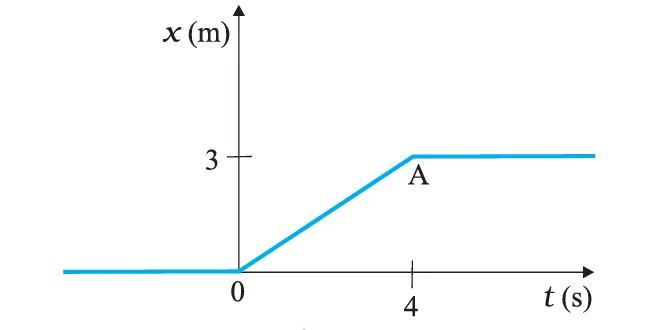
Figure 4.16 shows the position–time graph of a particle of mass 4 kg.
What is the
(a) force on the particle for \(t<0\), \(0
(b) impulse at \(t=0\) and \(t=4\,s\)?
(Consider one-dimensional motion only.)
For a position–time graph:
Impulse represents the instantaneous change in momentum.
Step 1: Determine velocity from the slope of the graph.
Step 2: Check whether velocity changes with time.
Step 3: Use \(F=ma\) to find force.
Step 4: Calculate impulse using change in momentum.
The graph is horizontal, meaning the position is constant.
\[ v = 0 \]
Since velocity is constant,
\[ a = 0 \]
\[ F = ma = 0 \]
Force = 0 N.
The graph is a straight sloping line from \(x=0\) at \(t=0\) to \(x=3\,m\) at \(t=4\,s\).
Velocity equals slope of the graph:
\[ v = \frac{\Delta x}{\Delta t} \]
\[ v = \frac{3-0}{4-0} \]
\[ v = \frac{3}{4}\,m\,s^{-1} \]
Velocity is constant ⇒ acceleration is zero.
\[ F = ma = 0 \]
Force = 0 N.
The graph again becomes horizontal.
Thus the particle is at rest.
\[ v = 0 \]
\[ a = 0 \]
\[ F = 0 \]
Force = 0 N.
Before \(t=0\):
\[ v_{before}=0 \]
After \(t=0\):
\[ v_{after}=\frac{3}{4}\,m\,s^{-1} \]
\[ J = m(v_{after}-v_{before}) \]
\[ J = 4\left(\frac{3}{4}-0\right) \]
\[ J = 3\,N\,s \]
Direction: positive \(x\)-direction.Just before \(t=4\):
\[ v_{before}=\frac{3}{4}\,m\,s^{-1} \]
After \(t=4\):
\[ v_{after}=0 \]
\[ J = 4\left(0-\frac{3}{4}\right) \]
\[ J = -3\,N\,s \]
Magnitude = \(3\,N\,s\) toward negative \(x\)-direction.
Q15 Two bodies of masses 10 kg and 20 kg respectively kept on a smooth, horizontal surface are tied to the ends of a light string. A horizontal force \(F=600\,N\) is applied to (i) A, (ii) B along the direction of the string. What is the tension in the string in each case?
When two bodies are connected by a light string and placed on a smooth surface, they move together with the same acceleration.
The acceleration of the system is determined by the total mass:
\[ a = \frac{F}{m_1 + m_2} \]
The tension in the string depends on which block the force is applied to.
Step 1: Calculate the common acceleration of the system.
Step 2: Apply Newton’s second law separately to each block.
Step 3: Determine the tension for each case.
\[ m_1 = 10\,kg, \quad m_2 = 20\,kg \]
\[ m_1 + m_2 = 30\,kg \]
\[ a = \frac{600}{30} \]
\[ a = 20\,m\,s^{-2} \]
For block A:
\[ F - T = m_1 a \]
\[ 600 - T = 10 \times 20 \]
\[ 600 - T = 200 \]
\[ T = 400\,N \]
For block B:
\[ F - T = m_2 a \]
\[ 600 - T = 20 \times 20 \]
\[ 600 - T = 400 \]
\[ T = 200\,N \]
Q16 Two masses 8 kg and 12 kg are connected at the two ends of a light inextensible string that goes over a frictionless pulley. Find the acceleration of the masses and the tension in the string when the masses are released.
When two masses are connected by a light string over a frictionless pulley, the heavier mass moves downward while the lighter mass moves upward.
Both masses have the same magnitude of acceleration, and the tension in the string is the same on both sides.
Step 1: Identify direction of motion.
Step 2: Apply Newton’s second law to each mass.
Step 3: Solve the equations simultaneously.
Let \(m_1 = 8\,kg\) and \(m_2 = 12\,kg\).
The heavier mass \(12\,kg\) moves downward and the lighter mass \(8\,kg\) moves upward.
Taking \(g = 10\,m\,s^{-2}\).
\[ T - m_1 g = m_1 a \]
\[ T - 80 = 8a \]
\[ m_2 g - T = m_2 a \]
\[ 120 - T = 12a \]
\[ T = 8a + 80 \]
\[ T = 120 - 12a \]
Equating,
\[ 8a + 80 = 120 - 12a \]
\[ 20a = 40 \]
\[ a = 2\,m\,s^{-2} \]
\[ T = 8a + 80 \]
\[ T = 8(2) + 80 \]
\[ T = 96\,N \]
Q17 A nucleus is at rest in the laboratory frame of reference. Show that if it disintegrates into two smaller nuclei, the products must move in opposite directions.
The total linear momentum of an isolated system remains constant. This is known as the law of conservation of linear momentum.
If the initial momentum of a system is zero, the vector sum of momenta of all products after interaction must also be zero.
Step 1: Determine the initial momentum of the nucleus.
Step 2: Apply conservation of linear momentum.
Step 3: Show that the resulting velocities must be opposite.
The nucleus is initially at rest.
\[ \vec{p}_{initial} = m\vec{v} \]
\[ \vec{p}_{initial} = 0 \]
Suppose the nucleus splits into two smaller nuclei of masses \(m_1\) and \(m_2\).
Let their velocities be \( \vec{v}_1 \) and \( \vec{v}_2 \).
Total momentum after disintegration:
\[ \vec{p}_{final} = m_1\vec{v}_1 + m_2\vec{v}_2 \]
By conservation of linear momentum:
\[ m_1\vec{v}_1 + m_2\vec{v}_2 = 0 \]
Rearranging:
\[ m_2\vec{v}_2 = -m_1\vec{v}_1 \]
\[ \vec{v}_2 = -\frac{m_1}{m_2}\vec{v}_1 \]
The negative sign indicates that the two velocities are in opposite directions.
The two momenta are equal in magnitude and opposite in direction, so the total momentum remains zero.
If a nucleus initially at rest disintegrates into two smaller nuclei, the two products must move in opposite directions so that their momenta cancel and total momentum remains zero.
Q18 Two billiard balls each of mass 0.05 kg moving in opposite directions with speed \(6\,\text{m s}^{-1}\) collide and rebound with the same speed. What is the impulse imparted to each ball due to the other?
Impulse is defined as the change in momentum of a body during a collision.
During a head-on collision, if a body reverses its velocity, its momentum changes significantly because the direction changes.
By Newton’s Third Law, the impulses on the two bodies are equal in magnitude and opposite in direction.
Step 1: Choose a sign convention for velocity.
Step 2: Determine initial and final velocities.
Step 3: Calculate change in momentum.
Step 4: Determine impulse magnitude.
Mass of each ball:
\[ m = 0.05\,kg \]
Initial velocity of one ball:
\[ u = +6\,m\,s^{-1} \]
After collision the ball rebounds with the same speed in the opposite direction:
\[ v = -6\,m\,s^{-1} \]
\[ \Delta p = m(v-u) \]
\[ \Delta p = 0.05(-6-6) \]
\[ \Delta p = 0.05(-12) \]
\[ \Delta p = -0.6\,kg\,m\,s^{-1} \]
Magnitude of impulse:
\[ J = |\Delta p| \]
\[ J = 0.6\,kg\,m\,s^{-1} \]
The impulse acts opposite to the initial direction of motion of the ball.
By Newton’s Third Law, the other ball receives an impulse of the same magnitude but in the opposite direction.
Impulse imparted to each ball:
\[ J = 0.6\,kg\,m\,s^{-1} \]
Equal in magnitude and opposite in direction for the two balls.
Q19 A shell of mass 0.020 kg is fired by a gun of mass 100 kg. If the muzzle speed of the shell is \(80\,\text{m s}^{-1}\), what is the recoil speed of the gun?
When a gun fires a shell, the shell moves forward and the gun recoils backward.
Since no external horizontal forces act on the system during firing, the total linear momentum of the gun–shell system is conserved.
If the system is initially at rest, the total momentum before firing is zero. Therefore the total momentum after firing must also remain zero.
Step 1: Determine the initial momentum of the system.
Step 2: Apply conservation of linear momentum.
Step 3: Solve for recoil velocity of the gun.
Mass of shell:
\[ m_s = 0.020\,kg \]
Mass of gun:
\[ m_g = 100\,kg \]
Velocity of shell:
\[ v_s = 80\,m\,s^{-1} \]
Let the recoil velocity of the gun be \(v_g\).
Initial momentum:
\[ p_{initial} = 0 \]
Final momentum:
\[ m_s v_s + m_g v_g = 0 \]
Substituting values:
\[ 0.020(80) + 100v_g = 0 \]
\[ 1.6 + 100v_g = 0 \]
\[ v_g = -\frac{1.6}{100} \]
\[ v_g = -0.016\,m\,s^{-1} \]
The recoil speed of the gun is
\[ 0.016\,m\,s^{-1} \]
The negative sign indicates that the gun moves in the direction opposite to the shell.
Q20 A batsman deflects a ball by an angle of \(45^\circ\) without changing its initial speed which is equal to \(54\,\text{km h}^{-1}\). What is the impulse imparted to the ball? (Mass of the ball is \(0.15\,kg\)).
Impulse equals the change in momentum of a body during a collision.
If the speed remains the same but the direction changes, the impulse depends on the change in velocity vector.
When two velocity vectors of equal magnitude \(v\) make an angle \(\theta\), the magnitude of their difference is
\[ |\Delta v|=\sqrt{v^2+v^2-2v^2\cos\theta} \]
Step 1: Convert the speed into SI units.
Step 2: Determine the change in velocity using vector geometry.
Step 3: Multiply by mass to obtain impulse.
Mass of the ball:
\[ m = 0.15\,kg \]
Initial speed:
\[ v = 54 \times \frac{5}{18} \]
\[ v = 15\,m\,s^{-1} \]
Since the ball is deflected by \(45^\circ\) but the speed remains the same,
\[ v_1 = v_2 = 15\,m\,s^{-1} \]
\[ |\Delta v|^2 = v_1^2 + v_2^2 - 2v_1v_2\cos45^\circ \]
\[ |\Delta v|^2 = 15^2 + 15^2 - 2(15)(15)\cos45^\circ \]
\[ |\Delta v|^2 = 450 - 450\cos45^\circ \]
\[ |\Delta v| = \sqrt{450\left(1-\frac{\sqrt2}{2}\right)} \]
\[ |\Delta v| \approx 11.5\,m\,s^{-1} \]
\[ J = m|\Delta v| \]
\[ J = 0.15 \times 11.5 \]
\[ J \approx 1.7\,kg\,m\,s^{-1} \]
Impulse imparted to the ball:
\[ J \approx 1.7\,kg\,m\,s^{-1} \]
The impulse acts in the direction of the change in velocity of the ball.
Q21 A stone of mass 0.25 kg tied to the end of a string is whirled round in a circle of radius 1.5 m with a speed of 40 rev/min in a horizontal plane. What is the tension in the string? What is the maximum speed with which the stone can be whirled around if the string can withstand a maximum tension of 200 N?
When a body moves in a circular path, a centripetal force is required towards the centre of the circle.
In this problem the tension in the string provides the required centripetal force.
Step 1: Convert rotational speed to angular velocity.
Step 2: Calculate linear speed of the stone.
Step 3: Use centripetal force formula to find tension.
Step 4: Use maximum allowable tension to find maximum speed.
Mass of the stone:
\[ m = 0.25\,kg \]
Radius of circular path:
\[ r = 1.5\,m \]
Rotational speed:
\[ n = 40\,rev/min \]
Convert to revolutions per second:
\[ n = \frac{40}{60} = \frac{2}{3}\,rev/s \]
\[ v = 2\pi r n \]
\[ v = 2\pi (1.5)\left(\frac{2}{3}\right) \]
\[ v = 2\pi \]
\[ v \approx 6.28\,m/s \]
\[ T = \frac{mv^2}{r} \]
\[ T = \frac{0.25(6.28)^2}{1.5} \]
\[ T \approx 6.6\,N \]
Maximum tension the string can withstand:
\[ T_{max} = 200\,N \]
Using
\[ T = \frac{mv^2}{r} \]
\[ 200 = \frac{0.25 v^2}{1.5} \]
\[ v^2 = 1200 \]
\[ v = \sqrt{1200} \]
\[ v \approx 34.6\,m/s \]
Q22
If, in Exercise 4.21, the speed of the stone is increased beyond the maximum
permissible value and the string breaks suddenly, which of the following
correctly describes the trajectory of the stone after the string breaks?
(a) the stone moves radially outwards,
(b) the stone flies off tangentially from the instant the string breaks,
(c) the stone flies off at an angle with the tangent whose magnitude depends
on the speed of the particle?
In circular motion the velocity of a particle is always directed along the tangent to the circular path, while the centripetal force acts towards the centre of the circle.
If the centripetal force suddenly disappears (for example when the string breaks), the particle continues moving with its instantaneous velocity according to Newton’s First Law of Motion.
Step 1: Identify the direction of velocity in circular motion.
Step 2: Identify the force maintaining circular motion.
Step 3: Determine what happens when that force suddenly disappears.
While the stone is tied to the string, the tension provides the centripetal force required for circular motion.
When the string suddenly breaks:
Since the instantaneous velocity is tangential to the circle, the stone moves in a straight line along the tangent.
(b) The stone flies off tangentially from the instant the string breaks.
Q23
Explain why
(a) a horse cannot pull a cart and run in empty space,
(b) passengers are thrown forward from their seats when a speeding bus stops suddenly,
(c) it is easier to pull a lawn mower than to push it,
(d) a cricketer moves his hands backwards while holding a catch.
These situations can be explained using Newton’s laws of motion:
Step 1: Identify the physical law involved.
Step 2: Analyze forces or momentum change.
Step 3: Explain the observed motion.
A horse pulls a cart by pushing the ground backward with its hooves. The ground exerts an equal and opposite reaction force that pushes the horse forward.
In empty space there is no ground to provide this reaction force. Therefore no external forward force acts on the horse–cart system, so it cannot accelerate or move forward.
This is a consequence of Newton’s Third Law.
Passengers in a moving bus have the same forward velocity as the bus.
When the bus stops suddenly, the lower part of the body in contact with the bus stops, but the upper body continues moving forward due to inertia.
Thus passengers are thrown forward.
This illustrates Newton’s First Law (inertia of motion).
When the mower is pushed, the applied force has a downward component, which increases the normal reaction.
Since friction depends on the normal reaction, the frictional force increases, making motion more difficult.
When the mower is pulled, the vertical component of the force acts upward, reducing the normal reaction and therefore reducing friction.
Hence pulling requires less effort than pushing.
A fast-moving ball has large momentum. Stopping it in a very short time would require a very large force.
By moving the hands backward, the cricketer increases the time over which the ball is brought to rest.
Since
\[ F\Delta t = \Delta p \]
increasing the stopping time reduces the average force on the hands.
This reduces the impact and prevents injury.
Before leaving this chapter, revise the most important ideas from Newton’s Laws of Motion in less than half a minute.
A body continues in its state of rest or uniform straight-line motion unless acted upon by a net external force.
The net force on a body equals the rate of change of its momentum.
\[ \vec{F} = m\vec{a} \]
For every action, there is an equal and opposite reaction.
\[ \vec{p} = m\vec{v} \]
\[ J = F\Delta t = \Delta p \]
\[ F_c = \frac{mv^2}{r} \]
In most mechanics problems, solving becomes easy if you:
Almost every problem in this chapter reduces to:
Identify forces → Apply \(F = ma\) → Solve for motion.
Many mistakes in mechanics occur not because students don't know the formulas, but because they apply them incorrectly. Avoid these common traps in exams.
Students often think action and reaction cancel each other. They do not cancel because they act on different bodies.
Constant velocity means the net force is zero, even though individual forces may still be acting.
A body moving with constant velocity requires no net force. This follows from Newton’s first law.
Momentum, force, velocity, and acceleration are vector quantities. Always consider their direction.
Most mistakes disappear if you first draw a free body diagram and identify all forces.
Centripetal force is not an additional force. It is the net inward force provided by tension, gravity, friction, etc.
Mass is constant, but weight depends on gravity:
\(W = mg\)
In collision problems, impulse equals change in momentum:
\(J = \Delta p\)
Many everyday phenomena (bus stopping, passengers moving forward) are explained by inertia of motion.
Before solving any mechanics question:
This simple method solves most problems in the Laws of Motion chapter.
This quick visual map connects the most important ideas from the Laws of Motion chapter. Use it for rapid revision before exams.
If you remember these connections, you can solve most problems from this chapter quickly in exams.
Many competitive exam questions follow recurring patterns. Master these five types and you will be able to solve a large portion of Laws of Motion problems quickly in exams.
Students are asked to identify forces acting on a body and apply Newton’s second law.
Key strategy: Draw the free body diagram first.
Questions involving connected masses over pulleys are extremely common.
Use Newton’s second law for each block separately.
Exams often test how acceleration affects apparent weight.
Apparent weight equals the normal reaction.
These questions involve change in momentum during impact.
\[ J = \Delta p \]
A common exam theme is finding tension or friction that provides centripetal force.
\[ F_c = \frac{mv^2}{r} \]
If you recognize the problem pattern first, the solution becomes much easier. Most questions reduce to:
Identify forces → Apply Newton’s laws → Solve equations.
Test your understanding of Newton’s Laws of Motion. Select an answer and click Check Answer to see the result instantly.
Drag the correct force arrows onto the block on the incline. Then click Check Diagram to see if your Free Body Diagram is correct.
A block rests on a rough inclined plane.
Get in Touch
Questions, feedback, or suggestions?
We'd love to hear from you.