In a linear equation, the rate of change between variables remains constant. Therefore, equal changes in one variable produce equal changes in another variable.
This constant rate creates a straight-line graph.

Every Line is an Equation — Every Equation is a Line
Infinite Solutions, One Graph — Master the Geometry of Linear Equations
Linear Equations in Two Variables contributes 5–7 marks in CBSE Class IX Boards. Graph of a linear equation and finding solutions (points on the line) are the most common question types. Real-world word problem conversion to linear equations is tested in 3-mark questions. NTSE uses linear equations in two variables as part of its algebra and reasoning sections.
Graphs must be neat, labelled, and drawn with at least two plotted points — CBSE deducts marks for sloppy diagrams. Always choose simple integer solutions (x = 0 gives y-intercept; y = 0 gives x-intercept). For word problems, define your variable clearly before writing the equation. Time investment: 2 days.
A linear equation is an algebraic equation in which the highest power of the variable is always 1. Such equations represent a straight line when plotted on a graph.
A linear equation may contain one variable, two variables, or more variables. However, in Class IX, we mainly study:
In a linear equation, the rate of change between variables remains constant. Therefore, equal changes in one variable produce equal changes in another variable.
This constant rate creates a straight-line graph.
Example: \(\small 2x + 5 = 11 \)
Example: \(\small x + y = 7 \)
Consider a relationship between two variables:
Move all terms to one side:
This becomes the standard form:
Therefore:
Given equation:
Highest power of \(x\) is 1.
Therefore, it is a linear equation.
| \(x\) | \(y\) | Verification |
|---|---|---|
| 1 | 4 | \(1+4=5\) |
| 2 | 3 | \(2+3=5\) |
| 5 | 0 | \(5+0=5\) |
| Mistake | Correct Approach |
|---|---|
| Writing \(x^2+y=5\) as linear equation | It is not linear because power of \(x\) is 2. |
| Interchanging coordinates | Always write coordinates as \((x,y)\). |
| Incorrect graph scale | Maintain equal spacing on axes. |
| Forgetting axis labels | Always label \(x\)-axis and \(y\)-axis. |
A cab service charges a fixed amount of ₹50 plus ₹12 per kilometre travelled.
Let distance travelled be \(x\) km and total fare be \(y\).
Form a linear equation representing the situation.
Fixed charge = ₹50
Charge per km = ₹12
Total fare:
Therefore, the required linear equation is:
where \( a \neq 0 \), \( b \) are real constants, \( x \) is variable
\( 2x + 5 = 11 \) → \( x = 3 \) (unique solution)
where \( a, b \) not both zero
\( x + y = 7 \) → Solutions: (1,6), (2,5), (3,4)...
Linear combination of \( n \) variables = constant
\( 2x + 3y - z = 5 \) (3 variables)
| Component | Description |
|---|---|
| Variable | A symbol representing an unknown quantity such as \(x,\;y,\;z\). |
| Coefficient | A numerical value multiplied with the variable, such as 5 in \(5x\). |
| Constant | A fixed numerical term without any variable. |
| Degree | The highest exponent of the variable, which is always 1 in a linear equation. |
| Equation | Reason |
|---|---|
\[x^2+3x+1=0\] |
Power of variable is 2. |
\[xy+5=0\] |
Product of variables is present. |
\[\sqrt{x}+2=0\] |
Variable is inside square root. |
\[\frac{1}{x}+4=0\] |
Variable appears in denominator. |
Every linear equation in two variables represents a straight line on the Cartesian plane. Each point lying on the line satisfies the equation.
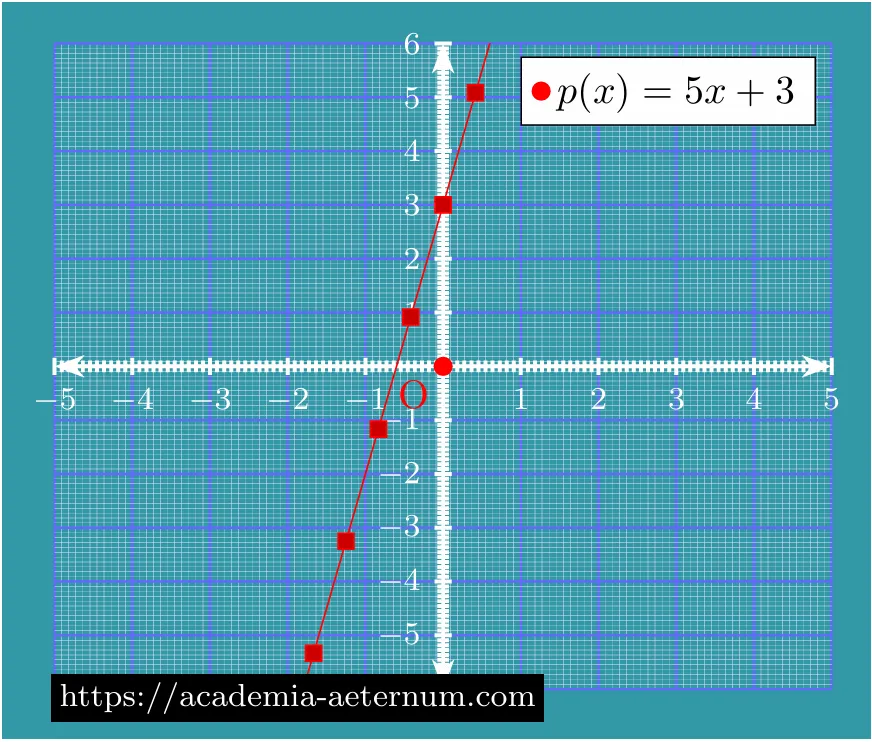
A linear equation must have variables raised only to power 1.
In the equation:
The variable \(x\) has exponent 2.
Therefore, the equation is not linear.
Linear equations are used to calculate profit, loss, cost, and revenue relationships.
Equations of motion and uniform speed relationships often use linear equations.
Businesses use linear models for budgeting and predicting expenses.
Taxi fare, mobile recharge, and shopping bills commonly follow linear relationships.
where \(\small a,\;b,\;c,\;d\) are constants and variables have degree 1.
Example
\(\small 2x+3y-6=0\)
The slope-intercept form is:
where:
The point-slope form is useful when:
The formula is:
where:
| Form | Equation | Main Use |
|---|---|---|
| Standard Form | \(\small ax+by+c=0\) | General representation |
| Slope-Intercept Form | \(\small y=mx+c\) | Easy graph plotting |
| Point-Slope Form | \(\small y-y_1=m(x-x_1)\) | When slope and one point are known |
Transposing terms:
Hence, slope:
and y-intercept:
Substitute \(x=3.5\) into the original equation:
Left-hand side:
Right-hand side:
To solve the equation:
subtract \(b\) from both sides:
divide both sides by \(a\):
Substitute:
into:
Since the equality is true, the substituted value satisfies the equation.
Linear equations are built using:
These operations follow the properties of equality. Therefore, every algebraic step preserves equality, making substitution mathematically valid.
Substitution confirms that the proposed value makes the equation balanced and true.
Since linear equations involve only first-degree terms, inverse operations always exist, ensuring that the substitution process remains valid and consistent.
Substitute:
into Equation (1):
into Equation (2):
Substitute:
into Equation (1):
into Equation (2):
When equal and opposite coefficients are added together, the variable cancels out:
This leaves only one variable in the equation, making it easier to solve.
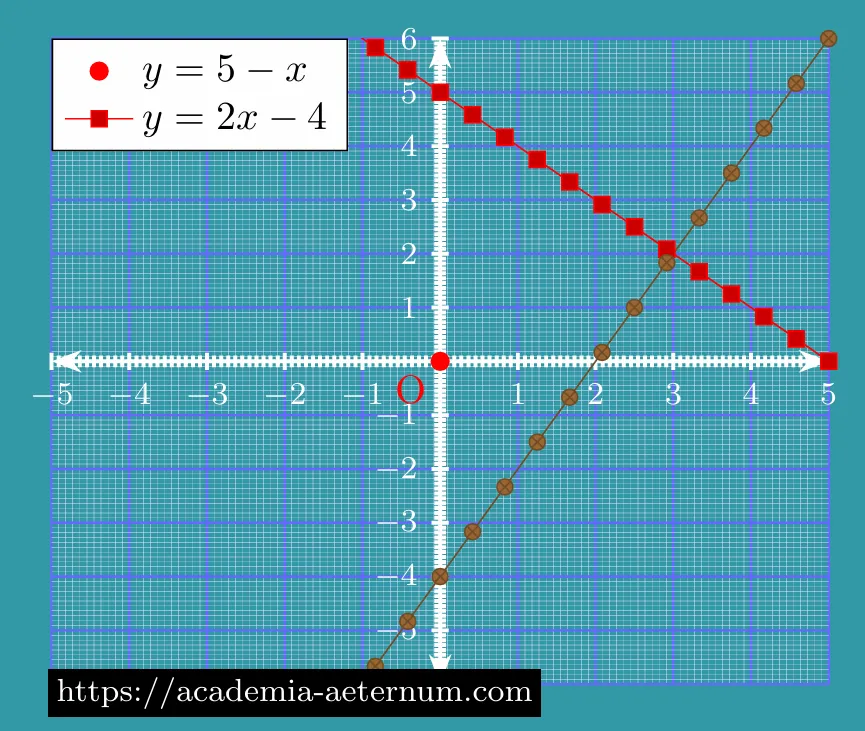
Simultaneous equations can be solved using different algebraic and graphical techniques. Each method has its own advantages depending on the structure of the equations.
Choosing the correct method helps simplify calculations and improves problem-solving speed.
| Method | Key Idea | When to Use | Example Result |
|---|---|---|---|
| Substitution Method | Replace one variable using another equation | Useful when one coefficient is 1 or easily isolated | \(\small x=4,\;y=3\) |
| Elimination Method | Add or subtract equations to eliminate one variable | Best when coefficients are equal or can be made equal | \(\small a=3,\;b=0\) |
| Graphical Method | Plot graphs and identify the intersection point | Useful for visual understanding | \(\small (3,2)\) |
| Cross-Multiplication Method | Apply direct determinant-like ratios | Fast for two-variable linear systems | Calculated algebraically |
Substitute:
into the first equation:
into the second equation:
Substitute:
into the first equation:
into the second equation:
Substitute:
into Equation (1):
into Equation (2):
| Coefficient | Equation 1 | Equation 2 |
|---|---|---|
| \(a\) | \(a_1=3\) | \(a_2=1\) |
| \(b\) | \(b_1=1\) | \(b_2=-3\) |
| \(c\) | \(c_1=-13\) | \(c_2=9\) |
Substitute:
into the first equation:
into the second equation:
A complete AI-powered learning engine — concepts, formulas, solver, practice, and interactive tools all in one place.
Eight foundational ideas from NCERT Class IX Chapter 4 — explained clearly with examples.
An equation of the form ax + by + c = 0, where a, b, c are real numbers and a, b are not both zero, is called a linear equation in two variables x and y.
Why "linear"? Because the highest power of each variable is 1. The graph of such an equation is always a straight line.
Examples: 2x + 3y = 6 ✓ | x – y = 0 ✓ | x² + y = 5 ✗ (not linear)
A pair of values (x₀, y₀) that satisfies ax + by + c = 0 is called a solution. A linear equation in two variables has infinitely many solutions.
For 2x + y = 5:
• x=1 → y=3 → (1,3) ✓
• x=0 → y=5 → (0,5) ✓
• x=2 → y=1 → (2,1) ✓
• x=½ → y=4 → (½,4) ✓
All are valid solutions — and there are infinitely many more!
Every point (x, y) on the graph of the line IS a solution, and every solution corresponds to a point on that line.
The set of all solutions forms the line itself — an infinite collection of ordered pairs.
The graph of ax + by + c = 0 is a straight line. To draw it, we need at least two points (we usually find three for accuracy).
The line y = k is horizontal, runs parallel to the x-axis at height k. Every point has y-coordinate = k regardless of x.
Example: y = 3 passes through (0,3), (1,3), (–2,3), etc.
The line x = h is vertical, runs parallel to the y-axis at h. Every point has x-coordinate = h regardless of y.
Example: x = –2 passes through (–2,0), (–2,1), (–2,5), etc.
If c = 0, the equation becomes ax + by = 0, which always passes through the origin (0, 0).
Such lines pass through origin and have slope m. Examples: y = 2x, y = –x, y = (3/2)x.
The x-intercept and y-intercept of such a line are both zero — the line passes through (0, 0).
Linear equations model real-world relationships. The key is identifying the two variables and expressing their relationship.
Example 1 (Cost problem):
A shopkeeper sells apples at ₹a each and oranges at ₹b each. If the total cost of x apples and y oranges is ₹100:
ax + by = 100
Example 2 (Age problem):
Sum of ages of father (x) and son (y) is 45 years:
x + y = 45
Example 3 (Distance-Speed):
A train travels at speed s km/h. Distance covered in t hours = d km:
s·t = d → s·t – d = 0
To find solutions systematically, create a table by assigning convenient values to one variable and computing the other.
For 3x + 2y = 12:
| x | y = (12 – 3x) / 2 | Point | Verify |
|---|---|---|---|
| 0 | 6 | (0, 6) | 3(0)+2(6)=12 ✓ |
| 2 | 3 | (2, 3) | 3(2)+2(3)=12 ✓ |
| 4 | 0 | (4, 0) | 3(4)+2(0)=12 ✓ |
| -2 | 9 | (-2, 9) | 3(-2)+2(9)=12 ✓ |
Convert ax + by + c = 0 to this form by isolating y:
y = (–a/b)x + (–c/b)
Slope m = –a/b | y-intercept = –c/b
If you know x-intercept p and y-intercept q:
Line passes through (p, 0) and (0, q).
Slope = –q/p
Every formula and relationship you need for this chapter — colour-coded and clearly labelled.
| Form | Equation | Slope | y-intercept | x-intercept |
|---|---|---|---|---|
| Standard | ax + by + c = 0 | –a/b | –c/b | –c/a |
| Slope-Intercept | y = mx + c | m | c | –c/m |
| Intercept | x/p + y/q = 1 | –q/p | q | p |
| Through Origin | y = mx | m | 0 | 0 |
| Horizontal | y = k | 0 | k | none (if k≠0) |
| Vertical | x = h | ∞ | none | h |
Enter any linear equation in two variables and get a complete, step-by-step solution with graph.
Enter the equation in the form ax + by + c = 0. Provide the coefficients a, b, c.
Given the equation above, check if a specific (x, y) pair is a solution, or find y for a given x.
Concept-wise practice questions with complete step-by-step solutions. All original — not from the textbook.
Smart shortcuts, memory aids, and exam strategies to boost your score.
Mistakes that students commonly make — know them, recognise them, and never lose marks on them.
Five hands-on tools to build deep intuition — explore, play, and understand.
Enter any equation ax + by + c = 0 and instantly see its graph with intercepts and slope labelled.
Adjust the slope slider and y-intercept to see how the line changes in real-time.
Enter an equation and a point — instantly find out if the point lies on the line.
Generate a full table of 8 solutions for any linear equation automatically.
Generate a fresh word problem from a random real-life scenario with full solution. Click to get a new problem each time!
10 multiple-choice questions covering the full chapter. Instant feedback after each answer.