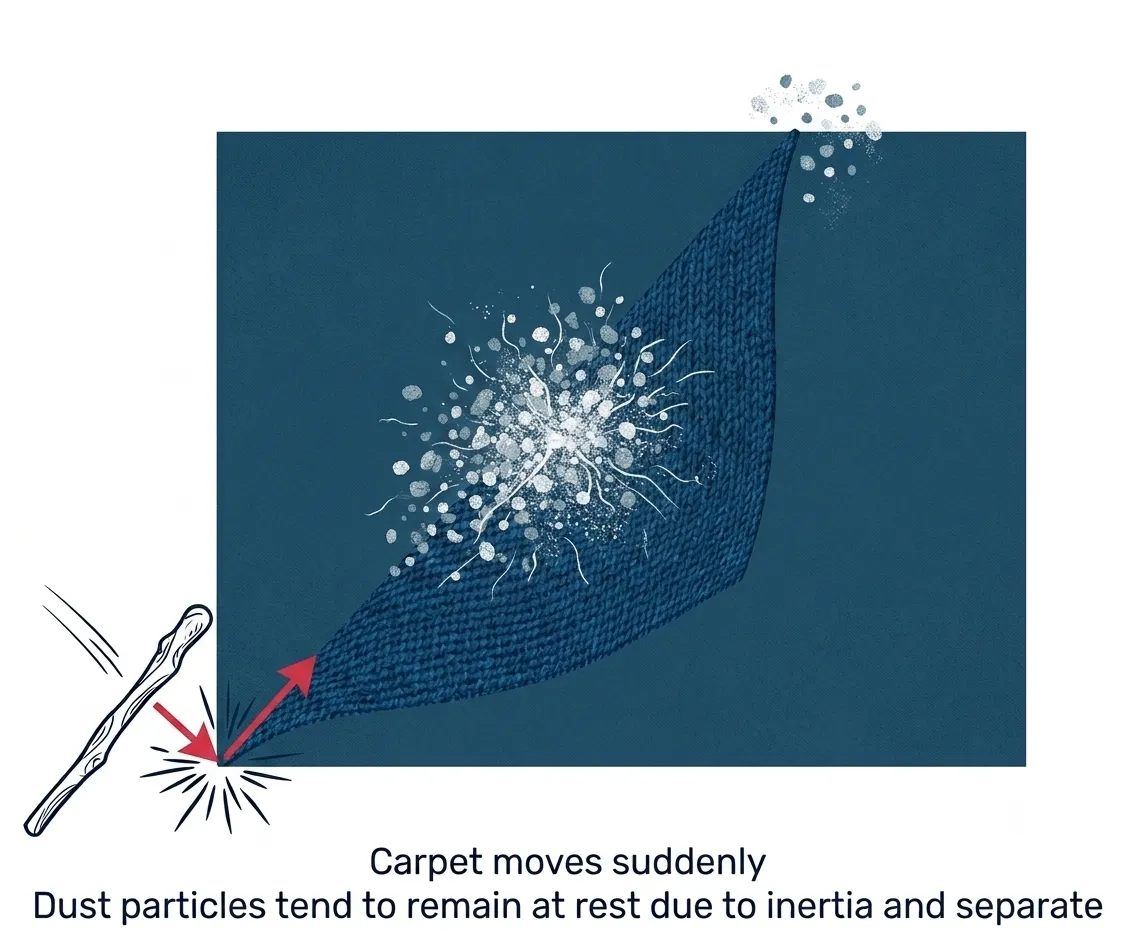
Concept Used
›
This question is based on Newton's First Law of Motion (Law of Inertia) and Newton's Second Law of Motion.
According to Newton's First Law, if the resultant (net) external force acting on an object is zero, the object does not change its state of motion. Therefore:
- If the object is initially at rest, it remains at rest.
- If the object is already moving, it continues to move with a constant velocity.
Newton's Second Law mathematically explains this relationship:
If the net external force is zero,
Therefore,
Since the mass of an object can never be zero,
Zero acceleration means that the object's velocity does not change with time. It does not imply that the velocity itself must be zero.
Step-by-step Plan
›
Use Newton's Second Law to relate force and acceleration.
Show that zero net force gives zero acceleration.
Interpret the physical meaning of zero acceleration.
Conclude the condition under which an object can move with non-zero velocity.
Graph / Figure
›
Complete Solution
›
- Yes. An object can travel with a non-zero velocity even when the net external unbalanced force acting on it is zero.
- According to Newton's Second Law of Motion,\[F=ma\]
- Since the net external force is zero,\[F=0\]
- Therefore,\[ \begin{aligned} F &= ma\\ 0 &= ma \end{aligned} \]
- As the mass of the object is non-zero,\[a=0\]
- Zero acceleration means that there is no change in velocity. Hence, the object can continue moving with the same velocity.
- Therefore, an object can have a non-zero velocity provided that:
- The magnitude of its velocity remains constant.
- The direction of its velocity also remains constant.
- In other words, the object must move with uniform velocity in a straight line. If either the magnitude or the direction of velocity changes, acceleration is produced, which requires a non-zero net external force.
- Thus, the object can keep moving with a constant non-zero velocity in the absence of any net external unbalanced force, as stated by Newton's First Law of Motion.
Exam Significance
›
- It tests the fundamental understanding of Newton's First and Second Laws of Motion.
- Students often confuse zero velocity with zero acceleration; this question removes that misconception.
- Frequently asked in CBSE board examinations as conceptual short-answer questions.
- Important for competitive examinations such as NTSE, Olympiads, JEE Foundation, and NEET Foundation where conceptual reasoning is tested.
Key Takeaways
›
-
Net external force is related to acceleration, not directly to velocity.
-
If the net force is zero, acceleration is zero.
-
Zero acceleration means velocity remains constant.
-
An object may have zero velocity or a constant non-zero velocity when the net force is zero.
-
For constant velocity, both the magnitude and the direction of velocity must remain unchanged.
-
Uniform straight-line motion is possible without any external unbalanced force.