
Control and Coordination — NCERT Solutions | Class 10 Science | Academia Aeternum
Ch 6  ·  Q–
0%
Class 10 Science Exercise NCERT Solutions Olympiad Board Exam
Chapter 6

Control and Coordination

Step-by-step NCERT solutions with stress–strain analysis and exam-oriented hints for Boards, JEE & NEET.

12 Questions
35-45 min Ideal time
Q1 Now at
Q1
NUMERIC3 marks
Which of the following is a plant hormone?
  1. Insulin
  2. Thyroxin
  3. Oestrogen
  4. Cytokinin
Relevant Theory

Hormones are chemical messengers that regulate growth, development, and responses in living organisms. In plants, these are called plant hormones (phytohormones).

Major plant hormones include:

  • Auxin – promotes cell elongation
  • Gibberellin – promotes stem growth
  • Cytokinin – promotes cell division
  • Abscisic acid – inhibits growth
  • Ethylene – promotes fruit ripening

Animal hormones such as insulin, thyroxine, and oestrogen are produced by endocrine glands and are not involved in plant growth processes.

Solution Roadmap
  • Step 1: Identify which options are hormones.
  • Step 2: Classify them into plant hormones and animal hormones.
  • Step 3: Select the hormone specifically found in plants.
Step-by-Step Solution:

Step 1: Identify the nature of each option:

  • Insulin → hormone regulating blood sugar in humans
  • Thyroxin → hormone controlling metabolism in humans
  • Oestrogen → female sex hormone in humans
  • Cytokinin → plant growth hormone

Step 2: Classify them:

  • Insulin → Animal hormone
  • Thyroxin → Animal hormone
  • Oestrogen → Animal hormone
  • Cytokinin → Plant hormone

Step 3: Select the correct option:

Only Cytokinin belongs to plant hormones.

Final Answer:

(d) Cytokinin

Cytokinin is responsible for cell division (cytokinesis) in plants. It plays a major role in growth of roots and shoots, delays ageing (senescence) of leaves, and helps in overall plant development.

Exam Significance
  • Board Exams: Frequently asked MCQ or 1-mark question from plant hormones.
  • Conceptual Clarity: Helps differentiate plant vs animal hormones (very important for theory questions).
  • Competitive Exams (NTSE, Olympiads, NEET Foundation): Basic hormone classification is commonly tested.
↑ Top
1 / 12  ·  8%
Q2 →
Q2
NUMERIC3 marks
The gap between two neurons is called a?
  1. Dendrite
  2. Synapse
  3. Axon
  4. Impulse
Relevant Theory

The nervous system transmits information through specialized cells called neurons. A neuron consists of dendrites, a cell body, and an axon.

Neurons do not touch each other directly. The small gap between two neurons is called a synapse. Communication across this gap occurs through chemical substances called neurotransmitters.

Solution Roadmap
  • Step 1: Understand the structure of a neuron.
  • Step 2: Identify the point where two neurons connect.
  • Step 3: Choose the correct term for the gap between neurons.
Step-by-Step Solution:

Step 1: Analyze each option:

  • Dendrite → receives signals within a neuron
  • Synapse → junction/gap between two neurons
  • Axon → carries impulse away from the cell body
  • Impulse → electrical signal, not a structure

Step 2: Identify the correct concept:

The question asks specifically for the gap between two neurons.

Step 3: Conclusion:

The correct term for this gap is synapse.

Final Answer:

(b) Synapse

At the synapse, the axon terminal of one neuron releases neurotransmitters into the synaptic gap. These chemicals diffuse across the gap and transmit the nerve impulse to the next neuron.

Exam Significance
  • Board Exams: Frequently asked MCQ or short-answer question on neuron structure.
  • Conceptual Importance: Helps in understanding how nerve impulses travel in one direction.
  • Competitive Exams: Synapse and neurotransmission are fundamental topics in biology-based entrance tests.
← Q1
2 / 12  ·  17%
Q3 →
Q3
NUMERIC3 marks
The brain is responsible for:
  1. Thinking
  2. Regulating the heartbeat
  3. Balancing the body
  4. All of the above
Relevant Theory

The brain is the main coordinating center of the body and is a part of the central nervous system. It controls both voluntary and involuntary activities.

The brain is divided into three major parts:

  • Cerebrum – responsible for thinking, memory, intelligence, and voluntary actions
  • Cerebellum – responsible for balance, posture, and coordination
  • Medulla oblongata – controls involuntary actions such as heartbeat, breathing, and blood pressure
Solution Roadmap
  • Step 1: Identify each function given in the options.
  • Step 2: Match each function with the correct part of the brain.
  • Step 3: Determine whether all functions are controlled by the brain.
Step-by-Step Solution:

Step 1: Analyze each function:

  • Thinking → a voluntary and intellectual function
  • Regulating heartbeat → an involuntary function
  • Balancing the body → coordination and posture function

Step 2: Match with brain parts:

  • Thinking → controlled by cerebrum
  • Heartbeat regulation → controlled by medulla oblongata
  • Balance → controlled by cerebellum

Step 3: Conclusion:

Since all the listed functions are controlled by different parts of the brain, the correct answer must include all of them.

Final Answer:

(d) All of the above

The brain performs multiple functions simultaneously by dividing work among its different regions. This division ensures efficient control of both voluntary actions (like thinking) and involuntary processes (like heartbeat), as well as coordination and balance.

Exam Significance
  • Board Exams: Frequently asked MCQs on functions of different brain parts.
  • Conceptual Clarity: Helps in distinguishing roles of cerebrum, cerebellum, and medulla.
  • Competitive Exams: Commonly tested in NTSE, Olympiads, and foundation-level medical exams.
← Q2
3 / 12  ·  25%
Q4 →
Q4
NUMERIC3 marks
Question: What is the function of receptors in our body? What happens if they fail?
Relevant Theory

The process of control and coordination in the body begins with detecting changes in the environment, called stimuli. Specialized cells known as receptors are responsible for detecting these stimuli.

Receptors are mainly located in sense organs such as the eyes, ears, skin, nose, and tongue. They convert external stimuli into electrical signals (nerve impulses), which are transmitted to the brain or spinal cord through neurons.

Solution Roadmap
  • Step 1: Define receptors and their role in the nervous system.
  • Step 2: Explain how receptors function.
  • Step 3: Give examples of different types of receptors.
  • Step 4: Describe consequences if receptors fail.
Step-by-Step Solution:

Step 1: Function of receptors:

Receptors are specialized sensory cells that detect various types of stimuli from the environment. After detecting a stimulus, they convert it into nerve impulses and send these signals to the central nervous system (brain or spinal cord) for processing.

Step 2: Types of receptors with examples:

  1. Photoreceptors → detect light (present in eyes)
  2. Thermoreceptors → detect temperature changes
  3. Chemoreceptors → detect smell and taste
  4. Mechanoreceptors → detect touch, pressure, and sound

Step 3: What happens if receptors fail:

If receptors do not function properly, the body cannot detect stimuli, which disrupts coordination and response.

  1. Damage to photoreceptors → leads to blindness
  2. Damage to auditory receptors → leads to deafness
  3. Damage to touch receptors → loss of sensation
  4. Damage to chemoreceptors → loss of smell and taste

Therefore, receptors play a crucial role in enabling the body to respond to environmental changes and maintain survival.

Exam Significance
  • Board Exams: Frequently asked 2–3 mark question requiring definition, examples, and failure consequences.
  • Answer Writing: Important to include both function and failure to score full marks.
  • Competitive Exams: Basic understanding of receptor types is commonly tested in biology MCQs.
← Q3
4 / 12  ·  33%
Q5 →
Q5
NUMERIC3 marks
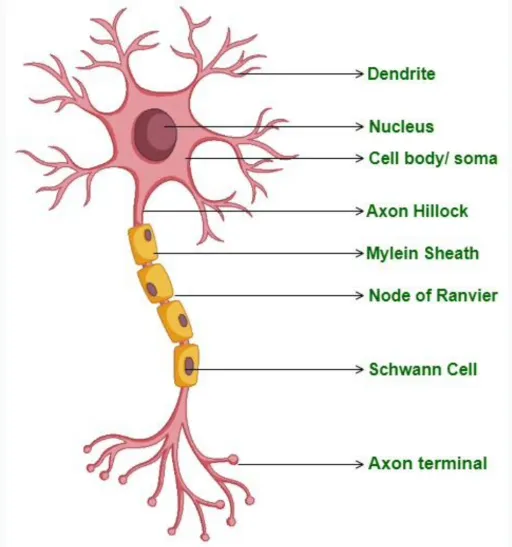
Draw the structure of a neuron and explain its function.
Relevant Theory

A neuron is the structural and functional unit of the nervous system. It is specialized to receive, process, and transmit information in the form of electrical impulses.

Neurons enable coordination by carrying messages between different parts of the body and the brain or spinal cord.

Solution Roadmap
  • Step 1: Identify the main structural parts of a neuron.
  • Step 2: Explain the function of each part.
  • Step 3: Describe how a nerve impulse travels through the neuron.
Structure of a neuron
Step-by-Step Explanation:

Step 1: Main parts of a neuron:

  • Dendrites → receive signals from receptors or other neurons
  • Cell Body (Soma) → contains nucleus and processes incoming signals
  • Axon → conducts nerve impulses away from the cell body
  • Axon Terminals → transmit signals to the next neuron through synapse

Step 2: Function of each part:

  • Dendrites collect information from surroundings or other neurons
  • Cell body integrates and interprets the received signals
  • Axon carries the electrical impulse over a long distance
  • Axon terminals release neurotransmitters to pass the signal forward

Step 3: Flow of nerve impulse:

The direction of impulse transmission is:

Dendrite → Cell Body → Axon → Axon Terminal → Synapse → Next Neuron

Thus, a neuron functions as a communication pathway that ensures rapid transmission of information throughout the body.

Exam Significance
  • Board Exams: Very important 3–5 mark question (diagram + explanation).
  • Answer Writing Tip: Always label diagram and explain impulse direction to score full marks.
  • Competitive Exams: Frequently tested concept in biology fundamentals and neural transmission.
← Q4
5 / 12  ·  42%
Q6 →
Q6
NUMERIC3 marks
How does phototropism occur in plants?
Relevant Theory

Phototropism is a type of directional growth response in plants where plant parts grow in response to light. When the plant grows towards light, it is called positive phototropism (seen in shoots). When growth is away from light, it is called negative phototropism (seen in roots).

This response is controlled by a plant hormone called auxin, which regulates cell elongation.

Solution Roadmap
  • Step 1: Define phototropism.
  • Step 2: Identify the role of light detection.
  • Step 3: Explain the redistribution of auxin.
  • Step 4: Describe how unequal growth causes bending.

Explanation:

Step-by-Step Mechanism:

Step 1: Detection of light:

The tip of the plant shoot contains light-sensitive cells that detect the direction of incoming light.

Step 2: Redistribution of auxin:

When light falls on one side of the plant, the hormone auxin moves away from the light and accumulates on the shaded side of the stem.

Step 3: Differential cell elongation:

Auxin promotes cell elongation. Therefore, cells on the shaded side elongate more rapidly compared to the cells on the light-facing side.

Step 4: Bending of the plant:

Due to faster growth on the shaded side and slower growth on the illuminated side, the stem bends towards the light.

Thus, phototropism helps plants orient themselves towards light, ensuring maximum photosynthesis and efficient growth.

Exam Significance
  • Board Exams: Frequently asked 3-mark question explaining mechanism of phototropism.
  • Answer Writing Tip: Always include the role of auxin and differential growth to score full marks.
  • Competitive Exams: Important concept in plant physiology and hormone action.
← Q5
6 / 12  ·  50%
Q7 →
Q7
NUMERIC3 marks
Which signals will get disrupted in case of a spinal cord injury?
Relevant Theory

The spinal cord is a part of the central nervous system that acts as a communication pathway between the brain and the rest of the body. It carries different types of nerve impulses:

  • Sensory signals → from body to brain
  • Motor signals → from brain to muscles
  • Autonomic signals → control involuntary functions (heartbeat, digestion, breathing)
Solution Roadmap
  • Step 1: Understand the role of the spinal cord.
  • Step 2: Identify types of signals passing through it.
  • Step 3: Explain what happens when this pathway is damaged.

Explanation:

Step-by-Step Explanation:

Step 1: Role of the spinal cord:

The spinal cord transmits nerve impulses between the brain and different parts of the body and also controls reflex actions.

Step 2: Types of signals affected:

  • Sensory signals: Carry information like touch, pain, and temperature to the brain.
  • Motor signals: Carry commands from the brain to muscles for movement.
  • Autonomic signals: Regulate involuntary activities such as heartbeat and digestion.

Step 3: Effect of spinal cord injury:

When the spinal cord is injured, the transmission of these signals is interrupted below the level of injury.

  • Loss of sensation (cannot feel pain, touch, temperature)
  • Loss of voluntary movement (paralysis)
  • Disturbance in involuntary functions (breathing, blood pressure, digestion)

Therefore, spinal cord injury disrupts the coordination between brain and body, affecting multiple body functions simultaneously.

Final Answer:

Spinal cord injury disrupts sensory, motor, and autonomic signals, leading to loss of movement, sensation, and impaired involuntary functions below the injury site.

Exam Significance
  • Board Exams: Common 2–3 mark conceptual question on nervous system functioning.
  • Answer Writing Tip: Mention all three signals (sensory, motor, autonomic) for full marks.
  • Competitive Exams: Frequently tested concept in basic human physiology.
← Q6
7 / 12  ·  58%
Q8 →
Q8
NUMERIC3 marks
How does chemical coordination occur in plants?
Relevant Theory

Unlike animals, plants do not have a nervous system. Instead, they coordinate their activities through chemical coordination using plant hormones, also known as phytohormones.

These hormones regulate growth, development, and responses to environmental stimuli such as light, gravity, and water.

Major plant hormones include auxin, gibberellin, cytokinin, ethylene, and abscisic acid.

Solution Roadmap
  • Step 1: Define chemical coordination in plants.
  • Step 2: Explain production (synthesis) of hormones.
  • Step 3: Describe transport of hormones.
  • Step 4: Explain how hormones act on target cells.

Explanation:

Step-by-Step Explanation:

Step 1: Definition:

Chemical coordination in plants is the process by which plant hormones regulate and integrate various physiological activities.

Step 2: Synthesis of hormones:

Plant hormones are synthesized in different parts of the plant such as shoot tips, root tips, young leaves, developing seeds, and fruits.

Step 3: Transport of hormones:

After synthesis, hormones are transported to target tissues through vascular tissues like xylem and phloem, or by diffusion from cell to cell.

Step 4: Action of hormones:

Hormones bind to specific target cells and regulate activities such as cell division, elongation, differentiation, and responses to environmental stimuli.

Thus, chemical coordination enables plants to grow, develop, and respond effectively to their environment despite lacking a nervous system.

Final Answer:

Plants coordinate activities through phytohormones, which are synthesized in various parts, transported through tissues, and act on target cells to regulate growth and responses.

Exam Significance
  • Board Exams: Frequently asked 3-mark descriptive question.
  • Answer Writing Tip: Include all three steps—synthesis, transport, and action—to score full marks.
  • Competitive Exams: Important for understanding plant physiology and hormone functions.
← Q7
8 / 12  ·  67%
Q9 →
Q9
NUMERIC3 marks
What is the need for a system of control and coordination in an organism?
Relevant Theory

In multicellular organisms, different organs perform specialized functions. For the body to function as a single unit, there must be proper control and coordination among all parts.

This is achieved through two main systems:

  • Nervous system → provides fast responses through electrical signals
  • Endocrine system → provides slower but long-lasting responses through hormones

Together, these systems help maintain homeostasis, which is the stable internal condition of the body.

Solution Roadmap
  • Step 1: Explain the need for coordination in multicellular organisms.
  • Step 2: Describe key functions achieved through control systems.
  • Step 3: Relate these functions to survival and adaptation.

Explanation:

Step-by-Step Explanation:

Step 1: Integration of activities:

Different organs and tissues must work together in a coordinated manner. For example, muscles and nerves coordinate to produce movement.

Step 2: Response to stimuli:

Organisms need to detect and respond to changes in their environment, such as light, temperature, or danger. This ensures appropriate and timely reactions.

Step 3: Regulation of body functions:

Vital processes like heartbeat, breathing, digestion, and growth must be precisely controlled to maintain internal balance.

Step 4: Survival and adaptation:

Control and coordination help organisms adapt to changing environmental conditions. For example, plants show phototropism, and animals move to safer environments when threatened.

Thus, control and coordination systems are essential for the proper functioning, survival, and adaptation of living organisms.

Final Answer:

Control and coordination systems integrate body activities, enable responses to stimuli, regulate vital functions, and ensure survival and adaptation of the organism.

Exam Significance
  • Board Exams: Frequently asked 3-mark descriptive question.
  • Answer Writing Tip: Write in structured points (integration, response, regulation, survival) to score full marks.
  • Competitive Exams: Fundamental concept forming the basis of human physiology questions.
← Q8
9 / 12  ·  75%
Q10 →
Q10
NUMERIC3 marks
How are involuntary actions and reflex actions different from each other?
Relevant Theory

Human actions can be classified into voluntary and involuntary actions. Among involuntary actions, reflex actions form a special category.

Involuntary actions are automatic body functions controlled mainly by the brain (especially the medulla and hypothalamus) and the autonomic nervous system.

Reflex actions are rapid, automatic responses to stimuli that occur through a reflex arc, usually involving the spinal cord for immediate protection.

Solution Roadmap
  • Step 1: Define involuntary actions.
  • Step 2: Define reflex actions.
  • Step 3: Compare both based on control, speed, and function.
  • Step 4: Give suitable examples.

Explanation:

Step-by-Step Explanation:

Step 1: Involuntary actions:

These are actions that occur automatically without conscious control. They regulate essential life processes such as heartbeat, breathing, and digestion.

Step 2: Reflex actions:

These are very fast and automatic responses to specific stimuli. They are protective in nature and occur through a reflex arc involving receptors, sensory neurons, spinal cord, motor neurons, and effectors.

Step 3: Key difference:

Although both are automatic, reflex actions are faster and immediate responses to danger, whereas involuntary actions are continuous and regulatory processes.

Feature Involuntary Actions Reflex Actions
Definition Automatic actions controlled by the brain without conscious effort Rapid, automatic responses to a stimulus, often protective
Control Center Brain (medulla, hypothalamus) Spinal cord (brain informed later)
Speed Relatively slower and continuous Very fast and immediate
Pathway Through autonomic nervous system Through reflex arc
Examples Heartbeat, breathing, peristalsis Knee-jerk, withdrawal of hand from hot object
Purpose Maintains internal balance (homeostasis) Provides immediate protection from harm

Thus, both involuntary and reflex actions are essential for survival, but they differ in speed, control, and purpose.

Final Answer:

Involuntary actions are automatic regulatory processes controlled by the brain, whereas reflex actions are rapid protective responses controlled mainly by the spinal cord through a reflex arc.

Exam Significance
  • Board Exams: Frequently asked 3–5 mark comparison question.
  • Answer Writing Tip: Always include table format + reflex arc mention for full marks.
  • Competitive Exams: Important for MCQs on nervous system pathways and responses.
← Q9
10 / 12  ·  83%
Q11 →
Q11
NUMERIC3 marks
Compare and contrast nervous and hormonal mechanisms for control and coordination in animals.
Relevant Theory

Control and coordination in the human body are achieved through two major systems: nervous system and endocrine (hormonal) system.

The nervous system uses electrical impulses for rapid communication, while the endocrine system uses chemical messengers called hormones for slower but longer-lasting effects.

Solution Roadmap
  • Step 1: Define nervous coordination.
  • Step 2: Define hormonal coordination.
  • Step 3: Compare both systems based on key features.
  • Step 4: Conclude their complementary roles.

Explanation:

Step-by-Step Explanation:

Step 1: Nervous system:

It transmits information in the form of electrical impulses through neurons. It provides fast, short-term responses to stimuli such as movement and reflex actions.

Step 2: Hormonal system:

It releases hormones into the bloodstream through endocrine glands. These hormones regulate long-term processes such as growth, development, and metabolism.

Step 3: Key differences:

Feature Nervous System Hormonal System
Message Type Electrical impulses Chemical messengers (hormones)
Transmission Medium Neurons (nerve fibers) Bloodstream
Speed Very fast (milliseconds) Slower (seconds to hours)
Duration of Effect Short-lived Long-lasting
Specificity Highly specific (targeted cells) Acts on target organs with receptors (can affect multiple tissues)
Examples Reflex action, muscle contraction Growth hormone, insulin, thyroxine
Type of Control Both voluntary and involuntary Always involuntary

Thus, the nervous and hormonal systems complement each other—one provides rapid responses while the other ensures long-term regulation of body functions.

Final Answer:

The nervous system uses fast electrical impulses for immediate responses, whereas the hormonal system uses slower chemical signals for long-lasting regulation. Both work together to maintain control and coordination.

Exam Significance
  • Board Exams: Very important 3–5 mark comparison question.
  • Answer Writing Tip: Use a table format with clear differences to score full marks.
  • Competitive Exams: Frequently tested concept in biology fundamentals and physiology.
← Q10
11 / 12  ·  92%
Q12 →
Q12
NUMERIC3 marks
What is the difference between the manner in which movement takes place in a sensitive plant and the movement in our legs?
Relevant Theory

Movement in living organisms can occur through different mechanisms. In plants, movements are generally due to changes in turgor pressure or growth, whereas in animals, movement involves muscular contraction under the control of the nervous system.

The sensitive plant (Mimosa pudica) shows a rapid response called thigmonasty, where leaves fold upon touch due to changes in water pressure within cells.

Solution Roadmap
  • Step 1: Explain movement in the sensitive plant.
  • Step 2: Explain movement in human legs.
  • Step 3: Compare both based on mechanism, control, and purpose.

Explanation:

Step-by-Step Explanation:

Step 1: Movement in sensitive plant:

In Mimosa pudica, movement occurs due to sudden loss of turgor pressure in cells at the base of the leaves (pulvinus). When touched, water moves out of these cells, causing them to shrink and the leaves to fold.

Step 2: Movement in human legs:

Movement of human legs occurs due to the contraction and relaxation of skeletal muscles. These muscles are attached to bones and are controlled by the nervous system through motor neurons.

Step 3: Key comparison:

Feature Sensitive Plant Human Legs
Type of Movement Turgor or nastic movement (thigmonasty) Locomotion using skeletal muscles
Cause of Movement Rapid change in turgor pressure (water movement) Contraction and relaxation of muscles
Speed Relatively fast for plants (few seconds) Fast and controlled
Control Involuntary, regulated by chemical signals Voluntary (can be controlled consciously)
Energy Source Water pressure (turgor changes) Chemical energy (ATP)
Purpose Protection from herbivores and environmental stimuli Movement, locomotion, and performing activities

Thus, movement in sensitive plants is based on physical changes in cell pressure, whereas human movement involves complex muscular and nervous coordination.

Final Answer:

Movement in sensitive plants occurs due to turgor changes (thigmonasty), while movement in human legs is caused by muscular contraction under nervous control.

Exam Significance
  • Board Exams: Frequently asked 3–5 mark comparison question.
  • Answer Writing Tip: Mention thigmonasty and pulvinus for better scoring.
  • Competitive Exams: Important for understanding plant vs animal movement mechanisms.
← Q11
12 / 12  ·  100%
↑ Back to top
🎓

Chapter Complete!

All 12 solutions for Control and Coordination covered.

↑ Review from the top
📚
ACADEMIA AETERNUM तमसो मा ज्योतिर्गमय · Est. 2025
Sharing this chapter
Control & Coordination Class 10 NCERT Solutions | Steps
Control & Coordination Class 10 NCERT Solutions | Steps — Complete Notes & Solutions · academia-aeternum.com
Class 10 NCERT Chapter 6, Control and Coordination, explores how organisms respond to changes in their environment and maintain internal balance. These exercises help students understand the nervous and hormonal systems in animals, chemical coordination in plants, reflex actions, phototropism, neuron structure, and receptor functions. Through carefully designed questions and answers, learners can strengthen their conceptual understanding of how organisms coordinate various activities for…
🎓 Class 10 📐 Science 📖 NCERT ✅ Free Access 🏆 CBSE · JEE
Share on
academia-aeternum.com/class-10/science/control-and-coordination/exercises/ Copy link
💡
Exam tip: Sharing chapter notes with your study group creates a reinforcement loop. Teaching a concept is the fastest path to mastering it.

Recent posts

    Control and Coordination — Learning Resources

    📝 Exercises

    Get in Touch

    Let's Connect

    Questions, feedback, or suggestions?
    We'd love to hear from you.