- Near point = 25 cm
- Far point = Infinity
- Least distance of distinct vision = 25 cm
- Normal eye power ≈ +60 D
Parts of the Human Eye
Working of the Human Eye
Power of Accommodation
Key Numerical Values
- Understand lens adjustment
- Relate to focal length change
- Writing image as erect instead of inverted.
- Confusing iris with pupil.
- Ignoring role of cornea in refraction.
- Forgetting blind spot has no photoreceptors.
A student observes difficulty in seeing objects at night but sees clearly during daytime.
Questions:
- Which cells are defective?
- What is their function?
Answer:
- Rods are defective.
- They are responsible for vision in dim light.
Concept Diagram (Ray Path in Eye)
Range of Accommodation
- Lens needs to become very thick
- Ciliary muscles remain contracted
Cataract
A cataract is a defect in which the eye lens becomes cloudy or opaque, preventing light from passing clearly to the retina.
Causes
- Ageing (most common)
- UV radiation exposure
- Injury or trauma
- Diseases like diabetes
Symptoms
- Blurred or dim vision
- Difficulty in night vision
- Sensitivity to light
Treatment
Cataract is treated by surgical removal of the opaque lens and replacement with an artificial intraocular lens (IOL).
- Confusing near point with far point.
- Writing focal length increases for near objects (incorrect).
- Ignoring ageing effect on accommodation.
An elderly person cannot read a book placed at 25 cm but can see distant objects clearly.
Questions:
- What defect is this?
- What is the cause?
Answer:
- Presbyopia
- Loss of accommodation due to reduced lens flexibility
Myopia (Near-sightedness)
Hypermetropia (Far-sightedness)
Presbyopia
- Use lens formula
- Object at infinity
- Confusing convex and concave lenses.
- Wrong sign in focal length.
- Mixing myopia with hypermetropia.
A person uses bifocal lenses. The upper part is concave and lower part is convex.
Questions:
- Which defects does the person have?
Answer:
- Myopia (corrected by concave lens)
- Presbyopia (corrected by convex lens)
Important Terms
- Confusing angle of prism with deviation.
- Incorrect sign or formula usage.
- Drawing wrong ray direction.
A student observes that deviation decreases and then increases as angle of incidence changes.
Question: Why does this happen?
Answer:
Because there exists a specific angle at which deviation is minimum. Beyond this, deviation increases again due to change in refraction conditions.
Spectrum (VIBGYOR)
Scientific Reason behind Dispersion
Double Refraction Effect in Prism
- Formation of rainbow
- Spectrometers for analysing light
- Study of atomic spectra
- Confusing dispersion with refraction.
- Wrong order of colours.
- Ignoring wavelength dependence.
A beam of white light passes through a prism and forms a spectrum. A second prism is placed inverted in the path.
Question: What will happen?
Answer:
The second prism recombines the colours to form white light again, proving that white light is a mixture of colours.
Twinkling of Stars
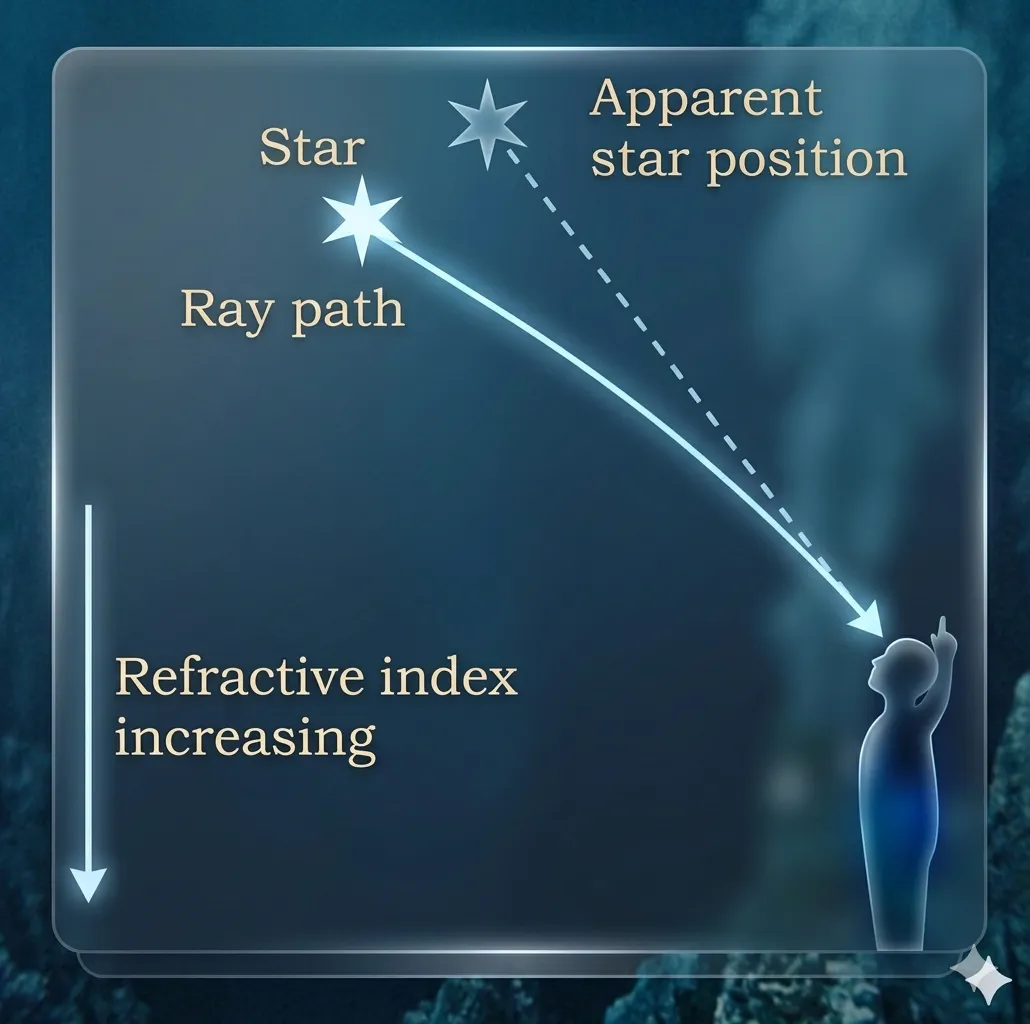
Apparent Position of Stars
Due to atmospheric refraction, stars appear slightly higher than their actual position.
Light bends towards the normal as it enters denser layers near Earth, making the apparent position shift upward.
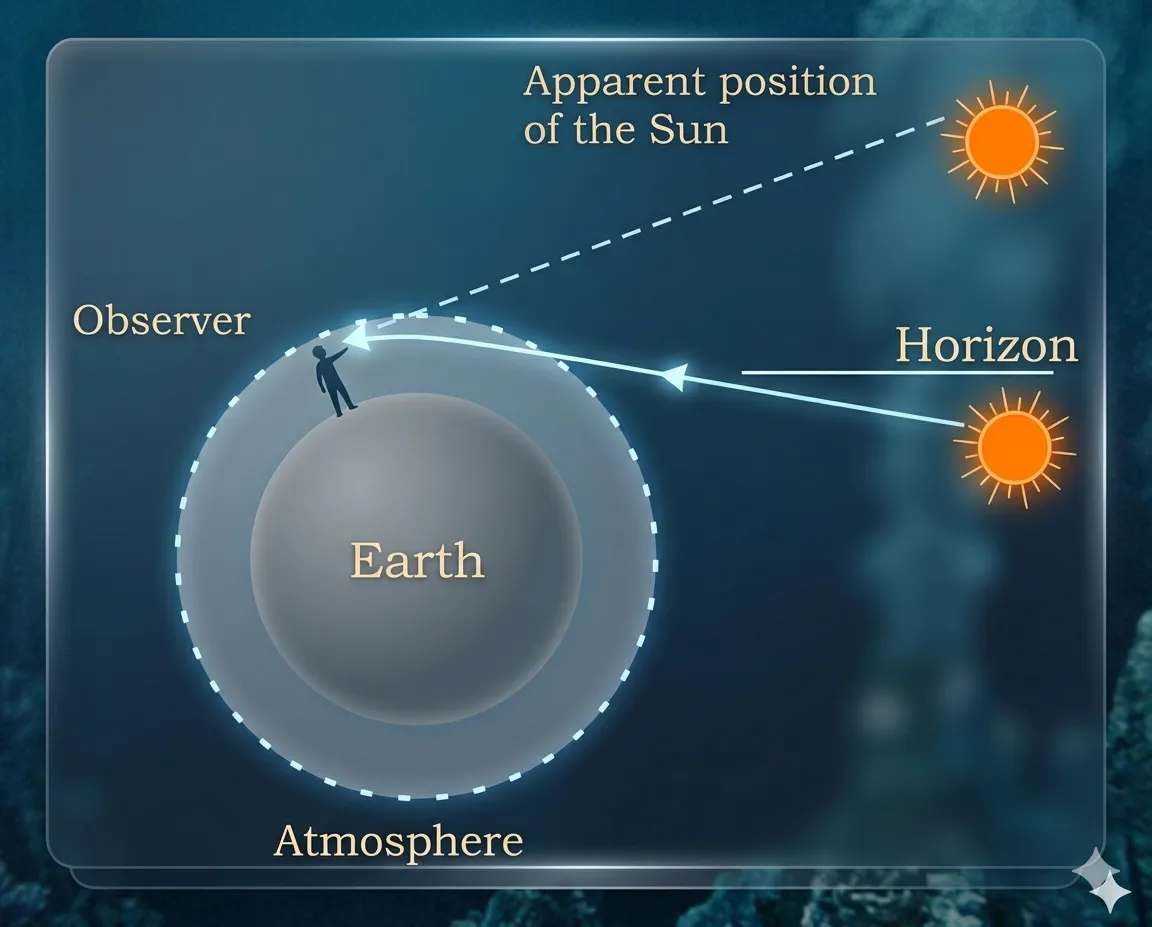
Advanced Sunrise and Delayed Sunset
The Sun appears earlier at sunrise and later at sunset due to bending of light in the atmosphere.
- Sun is visible about 2 minutes earlier before actual sunrise.
- Sun remains visible about 2 minutes after actual sunset.
Flattening of the Sun’s Disc
Scientific Explanation
- Confusing with dispersion.
- Writing straight-line propagation.
- Ignoring role of atmospheric layers.
A star appears at a higher position than its actual position near the horizon.
Question: Explain why.
Answer:
Due to atmospheric refraction, light bends towards denser layers, making the star appear higher than its true position.
Definition
The elastic scattering of light by particles (such as gas molecules) that are significantly smaller than the wavelength of the incident light (d << λ).Mechanism
The scattering intensity is inversely proportional to the fourth power of the wavelength (I ∝ 1/λ⁴), meaning shorter wavelengths (blue/violet) are scattered much more strongly than longer wavelengths (red).Examples
The blue appearance of the daytime sky, the reddish-orange hues during sunrise and sunset, and the blue color of the haze seen over distant mountains.Definition
The scattering of light by spherical particles that are comparable in size to the wavelength of the incident light (d ≈ λ).Mechanism
Unlike Rayleigh scattering, it is nearly wavelength-independent, meaning all wavelengths of visible light are scattered in a forward-peaked direction with similar intensity, resulting in a white or grayish appearance.Examples
The white appearance of clouds, the thick white look of fog and mist, and the scattering of light by water droplets or large aerosol particles in the atmosphere.Definition
The phenomenon where light is scattered by particles in a colloid or a very fine suspension.Mechanism
As a beam of light passes through a colloidal system, the dispersed particles (which are larger than those in a true solution) scatter the light in all directions, rendering the path of the beam visible to the observer.Examples:
The visible path of a laser beam through milk diluted in water, the "dusty" beam of sunlight entering a dark room through a small opening, and the visibility of car headlights in thick fog.Applications / Natural Phenomena
- Blue Colour of Sky: Caused by Rayleigh scattering, where gas molecules in the atmosphere preferentially scatter shorter blue wavelengths of sunlight in all directions.
- Red Sunset and Sunrise: During these times, sunlight travels through a longer path of the atmosphere; shorter wavelengths are scattered away, leaving only the longer-wavelength red and orange light to reach the observer.
- White Clouds: Caused by Mie scattering, where water droplets in clouds are large enough to scatter all visible wavelengths of light almost equally, resulting in a collective white appearance.
- Use Rayleigh scattering
- Compare wavelengths
- Confusing scattering with dispersion.
- Ignoring particle size role.
- Wrong explanation of red sunset.
The sky appears reddish during sunset.
Question: Explain the reason.
Answer:
During sunset, sunlight travels a longer path through the atmosphere, scattering shorter wavelengths (blue) away, leaving longer wavelengths (red) to reach the observer.
- Myopia (Near-sightedness): Image forms before retina → corrected by concave lens.
- Hypermetropia (Far-sightedness): Image forms beyond retina → corrected by convex lens.
- Presbyopia: Age-related loss of accommodation → corrected using convex or bifocal lenses.
Atmospheric & Natural Phenomena
- Atmospheric Refraction: Causes twinkling of stars and advanced sunrise.
- Scattering of Light: Responsible for blue colour of sky.
- Red Sunset: Due to longer path → scattering of shorter wavelengths.
The Human Eye & the Colourful World
Comprehensive AI Learning Engine — Concepts · Formulas · Solver · Practice · Interactive Modules
Structure of the Eye
Cornea, iris, lens, retina — explore every part and its optical role in forming images.
Defects of Vision
Myopia, Hypermetropia, Presbyopia — causes, ray diagrams, and corrective lens types.
Dispersion of Light
Prism, white light splitting, VIBGYOR spectrum and recombination principles.
Atmospheric Phenomena
Why the sky is blue, the sun appears red at sunrise/sunset — Tyndall Effect & scattering.
Step-by-Step Solver
Plug in values for lens power, focal length, range of vision — get full worked solutions.
Interactive Modules
Eye diagram explorer, spectrum simulator, quiz engine, flashcards — learn by doing.
Chapter 10 of NCERT Class X Science explores the optical instrument we carry everywhere — the human eye — and the spectacular phenomena it perceives. The chapter bridges biology and physics: how the eye adjusts focus (accommodation), the common defects of vision, and the physics of light dispersion that paints the world in colour.
Key Milestones to Master
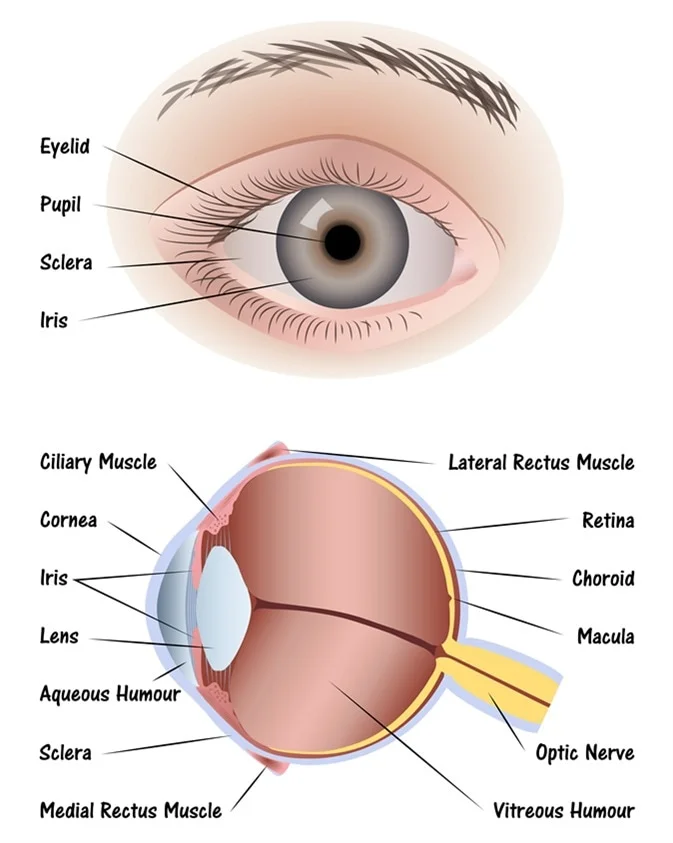
The human eye is a natural convex lens system. Light enters through the cornea, passes through the aqueous humour, is regulated by the iris/pupil, refracted by the crystalline lens, travels through the vitreous humour, and forms an inverted, real image on the retina.
| Part | Structure | Function |
|---|---|---|
| Cornea | Transparent, curved front surface | Refracts most incoming light (~70%) |
| Iris | Coloured muscular diaphragm | Controls pupil diameter → regulates light |
| Pupil | Opening in iris | Allows light to enter; expands in dim light |
| Crystalline Lens | Biconvex, flexible | Fine adjustment of focus (accommodation) |
| Ciliary Muscles | Ring of muscles around lens | Change curvature (hence focal length) of lens |
| Retina | Light-sensitive inner layer | Contains rods (dim light) & cones (colour) |
| Optic Nerve | Nerve bundle | Transmits image signals to brain |
| Yellow Spot | Fovea centralis | Sharpest, most detailed vision |
| Blind Spot | Where optic nerve exits | No photoreceptors — no vision here |
Cornea
The transparent, dome-shaped outermost layer. It performs roughly 70% of the eye's total refractive work. It has a fixed radius of curvature and thus a fixed focal contribution. It is covered by a thin layer called the conjunctiva.
Iris & Pupil
The iris is the pigmented (coloured) muscular ring that gives you your eye colour. It contains two sets of muscles:
- Circular muscles — contract to decrease pupil size (bright light).
- Radial muscles — contract to increase pupil size (dim light).
The Crystalline Lens
A biconvex, transparent, flexible structure made of layers of transparent protein fibres. Its curvature — and thus its focal length — is variable, unlike a glass lens.
The lens contributes ~30% of the eye's refractive power, but it is responsible for all of the adjustable part (accommodation).
The Retina
The innermost, light-sensitive layer. It contains approximately 125 million rods and 6 million cones.
| Receptor | Function | Location |
|---|---|---|
| Rods | Detect light intensity; night/dim-light vision; no colour | Peripheral retina |
| Cones | Colour vision (Red, Green, Blue sensitivities) | Concentrated at Fovea |
Power of Accommodation
The ability of the eye to adjust its focal length to focus objects at varying distances is called accommodation.
As we age, the ciliary muscles weaken and the lens loses elasticity, reducing the range of accommodation. This is called Presbyopia.
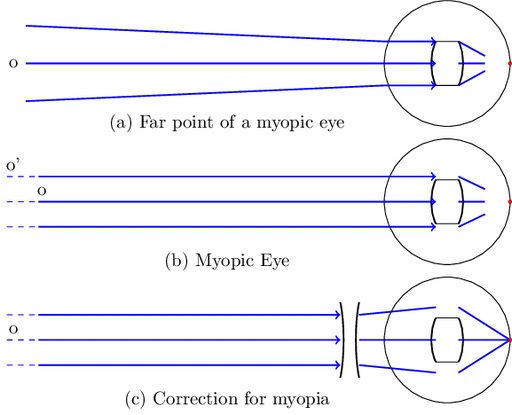
Myopia (Near-sightedness / Short-sightedness)
Causes
- Excessive curvature of the eye lens (too converging)
- Elongation of the eyeball (larger than normal)
What Happens
The image of a distant object forms in front of the retina instead of on it.
Far Point
The far point of a myopic eye is at a finite distance (say, d metres) — not at infinity.
f = − (far point distance in metres)
∴ P = −1 / (far point in m) [negative → concave lens]
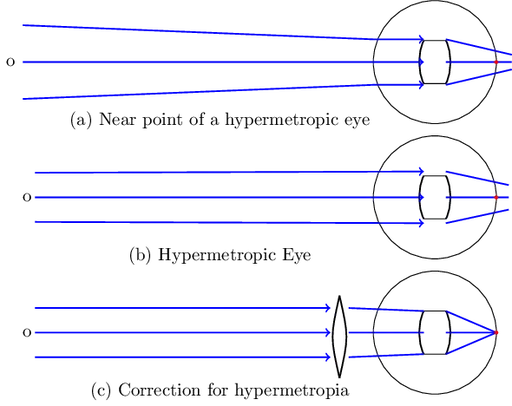
Hypermetropia (Far-sightedness / Long-sightedness)
Causes
- Focal length of the eye lens is too long (less converging)
- Eyeball too short (shorter than normal)
What Happens
The image of a near object would form behind the retina.
Near Point
The near point of a hypermetropic eye is further than 25 cm (e.g., 1 m or more).
1/f = 1/v − 1/u (using sign convention: u = −25 cm, v = −d)
P = +1/f [positive → convex lens]
Presbyopia (Age-related vision loss)
Cause
Gradual weakening of ciliary muscles and loss of flexibility of the crystalline lens with advancing age.
Effect
The person can neither see near objects nor distant objects clearly (if accompanied by myopia/hypermetropia).
Correction
Corrected using bifocal lenses: the upper part is a concave lens (for far vision) and the lower part is a convex lens (for near vision). Modern bifocals use a gradual curvature.
| Feature | Myopia | Hypermetropia | Presbyopia |
|---|---|---|---|
| Also called | Short-sightedness | Long-sightedness | Age-sight |
| Near vision | Clear ✓ | Blurred ✗ | Blurred ✗ |
| Far vision | Blurred ✗ | Clear ✓ | Blurred ✗ |
| Image falls | Before retina | Behind retina | Both affected |
| Eyeball size | Too large | Too small | Normal, lens stiff |
| Lens curvature | Too high | Too low | Reduced flexibility |
| Correction | Concave lens | Convex lens | Bifocal lens |
| Power sign | Negative (−) | Positive (+) | Both |
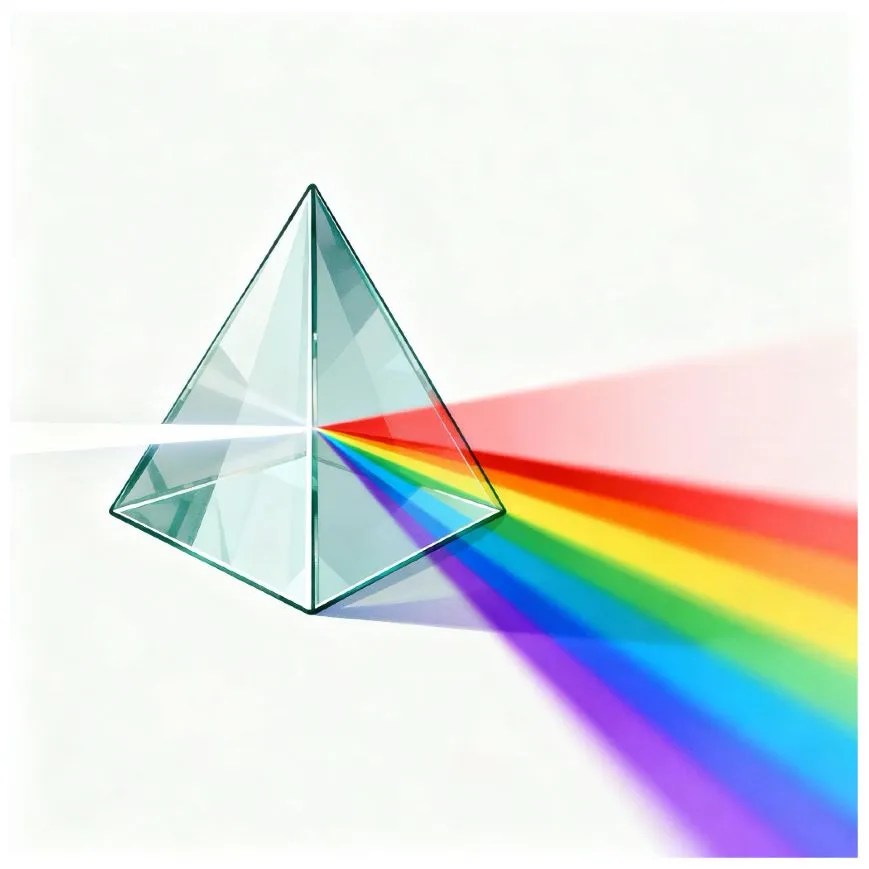
When white light passes through a glass prism, it gets refracted twice (at entry and exit) and dispersed — split into its constituent colours. This is because different wavelengths travel at different speeds in glass (different refractive indices).
Key Facts about Dispersion
- Violet light deviates the most (highest refractive index for glass, shortest wavelength ~380–450 nm).
- Red light deviates the least (lowest refractive index, longest wavelength ~620–750 nm).
- The band of colours produced is called the spectrum.
- Isaac Newton showed that a second inverted prism can recombine the spectrum back to white light.
Higher n → Slower speed → More bending
n(violet) > n(red) in glass
Rainbow Formation
A rainbow is formed by dispersion and internal reflection of sunlight in raindrops. It is always seen on the side opposite to the sun.
Why is the Sky Blue?
The atmosphere contains tiny gas molecules and fine dust particles much smaller than the wavelength of visible light. When sunlight passes through, these particles scatter shorter wavelengths (blue/violet) much more than longer wavelengths (red/orange) — this is Rayleigh Scattering.
λ(violet) < λ(blue) < λ(red)
∴ Violet & Blue scattered ~10× more than Red
Why is the Sun Red/Orange at Sunrise and Sunset?
At sunrise and sunset, sunlight travels a much longer path through the atmosphere to reach our eyes. By then, most of the blue and shorter wavelengths have been scattered away in other directions. Only the longer wavelengths (red, orange) remain to reach our eyes directly, making the sun appear red/orange.
Tyndall Effect
When a beam of light passes through a colloidal solution or a medium containing fine suspended particles, the path of the beam becomes visible due to scattering. This is the Tyndall Effect.
f = focal length, v = image distance, u = object distance (all in metres, with sign convention)
P = +ve for convex (converging)
P = −ve for concave (diverging)
P = −1 / (far point in m)
Example: Far point = 2 m → f = −2 m → P = −0.5 D
v = −(near point of patient, in m) [virtual image]
1/f = 1/v − 1/u → P = +1/f
Example: Near point = 1 m →
1/f = 1/(−1) − 1/(−0.25) = −1 + 4 = 3
P = +3 D
c = 3 × 10⁸ m/s (speed in vacuum)
(λ = wavelength of light)
Blue: 450 – 495 nm
Green: 495 – 570 nm
Yellow: 570 – 590 nm
Orange: 590 – 620 nm
Red: 620 – 750 nm
Far point = ∞ (infinity)
Persistence of vision = 1/16 s ≈ 0.0625 s
Approximate diameter of eyeball = 2.3 cm
- All distances measured from the optical centre of the lens.
- Distances in the direction of incident light → positive (+)
- Distances against the direction of incident light → negative (−)
- For a real object, u is always negative.
- For a virtual image (formed on the same side as the object), v is negative.
Select a problem type, enter values, and get a fully worked step-by-step solution.
A person cannot see objects clearly beyond 3 metres. Find the nature and power of the corrective lens.
A person's near point is 1 m. Find the corrective lens power to read at 25 cm.
Two lenses of power +2.5 D and −1.0 D are placed in contact. Find their combined focal length.
A person uses spectacles of power −2 D. What is the nature of defect and the far point of this person?
Original questions not from the textbook — click to reveal full step-by-step solutions.
Click the card to reveal the answer. Use arrows to navigate.
Explore the visible spectrum. Hover over a wavelength to see its colour and properties.
Violet 450 nm
Blue 500 nm
Green 570 nm
Yellow 620 nm
Orange 700 nm
Red
Dispersion Order Memory
Click on any labelled part to learn about its function.
| Condition | Corrective Lens | Power Sign | Effect |
|---|---|---|---|
| Myopia | Concave | Negative (−) | Diverges rays, shifts image back to retina |
| Hypermetropia | Convex | Positive (+) | Converges rays, pulls image forward to retina |
| Presbyopia (near) | Convex (lower) | Positive (+) | Reading correction |
| Presbyopia (far) | Concave (upper) | Negative (−) | Distance correction |
Recent posts
The Human Eye and the Colourful World — Learning Resources
Get in Touch
Let's Connect
Questions, feedback, or suggestions?
We'd love to hear from you.