
Angles in Trigonometry
In Trigonometry, an angle is a measure of rotation of a ray about its fixed endpoint in a plane. The fixed endpoint is called the vertex, the starting position of the ray is the initial side, and the position after rotation is known as the terminal side. The amount of rotation from the initial side to the terminal side determines the measure of the angle.
Unlike elementary geometry where angles are treated primarily as shapes, trigonometry studies angles as quantities representing rotation. This interpretation allows angles of any magnitude, including those greater than one full revolution or even negative angles.
Positive and Negative Angles
- If the rotation from the initial side to the terminal side is anticlockwise, the angle is called a positive angle.
- If the rotation is clockwise, the angle is considered a negative angle.
This convention is extremely useful in higher mathematics, physics, engineering, and computer graphics where direction of rotation matters.
Systems of Measuring Angles
Angles can be measured using two standard systems commonly used in mathematics and science:
-
Degree Measure
In the degree system, a complete revolution of a ray is divided into 360 equal parts. Each part is called one degree (1°). Smaller units include minutes (') and seconds (").
-
Radian Measure
In the radian system, the measure of an angle is defined as the ratio of the length of the arc subtended by the angle at the centre of a circle to the radius of that circle.
If an arc of length s is subtended in a circle of radius r, then
Angle (in radians) = Arc length / Radius
One complete revolution corresponds to 2π radians.
Important Angle Conversions
- 360° = 2π radians
- 180° = π radians
- 90° = π/2 radians
- 60° = π/3 radians
- 45° = π/4 radians
Example
Example: Convert 60° into radians.
Since
180° = π radians
Therefore,
60° = (π / 3) radians
Why Angles Are Important in Trigonometry
Understanding angles is fundamental for studying trigonometric functions such as sine, cosine, and tangent. Almost every concept in trigonometry—including unit circle, trigonometric identities, periodic functions, and graphs— depends on a clear understanding of angle measurement.
Importance for Board and Competitive Exams
- Angle conversion problems frequently appear in Class 11 board exams.
- Understanding radian measure is essential for JEE Main and Advanced.
- Trigonometric graphs and identities in NEET and BITSAT rely heavily on angle concepts.
- Concepts of positive, negative, and coterminal angles are important in advanced mathematics.
Therefore, mastering the concept of angles forms the foundation of the entire chapter on Trigonometric Functions.
Relation between Radian Measure and Real Numbers
In Class 11 Trigonometry, the concept of radian measure provides a natural connection between geometry and real numbers. Unlike the degree system, which divides a circle arbitrarily into 360 parts, radian measure is derived directly from the geometric properties of a circle.
Consider a circle with centre O and radius r. Suppose an angle \( \theta \) at the centre subtends an arc of length \( l \). The radian measure of the angle is defined as the ratio of the arc length to the radius of the circle.
\( \theta = \dfrac{\text{Arc Length}}{\text{Radius}} = \dfrac{l}{r} \)
Since both \( l \) and \( r \) are measured in the same unit (such as centimetres or metres), their ratio \( \frac{l}{r} \) is a dimensionless quantity. Therefore, the radian measure of an angle is simply a real number.
Why Every Angle Corresponds to a Real Number
Because the radian measure of an angle is expressed as a real number, there exists a one-to-one correspondence between angles and real numbers. This means:
- Every angle can be represented by a real number in radian measure.
- Every real number represents an angle of certain magnitude.
This relationship is extremely important because it allows trigonometric functions such as sin x, cos x, and tan x to be defined for all real values of x.
Definition of One Radian
If the arc length is equal to the radius of the circle, i.e.
\( l = r \)
then the radian measure of the angle becomes
\( \theta = \frac{r}{r} = 1 \)
Hence, an angle that subtends an arc equal in length to the radius of the circle is called one radian.
Radian Measure of a Complete Revolution
The circumference of a circle of radius \( r \) is \( 2\pi r \). Therefore, the radian measure of a complete angle is
\( \frac{2\pi r}{r} = 2\pi \)
Thus,
\( 360^\circ = 2\pi \text{ radians} \)
Important Degree–Radian Conversion Formula
\( 1^\circ = \dfrac{\pi}{180} \) radians
\( 1 \text{ radian} = \dfrac{180^\circ}{\pi} \)
Example
Example: Convert \( 120^\circ \) into radians.
\( 120^\circ = \frac{120\pi}{180} = \frac{2\pi}{3} \)
Importance for Board and Competitive Exams
- Direct conversion questions frequently appear in Class 11 board examinations.
- Radian measure is essential for solving trigonometric identities.
- Understanding radians is necessary for trigonometric graphs.
- Almost all problems in IIT JEE, NEET, and BITSAT use radian measure.
Hence, identifying angles with real numbers through radian measure forms the mathematical foundation of trigonometric functions.
Common Angles in Degree and Radian Measure
| Degree | \(30^\circ\) | \(45^\circ\) | \(60^\circ\) | \(90^\circ\) | \(180^\circ\) | \(270^\circ\) | \(360^\circ\) |
|---|---|---|---|---|---|---|---|
| Radian | \(\frac{\pi}{6}\) | \(\frac{\pi}{4}\) | \(\frac{\pi}{3}\) | \(\frac{\pi}{2}\) | \(\pi\) | \(\frac{3\pi}{2}\) | \(2\pi\) |
Notational Convention in Trigonometry
In Class 11 Trigonometric Functions, angles may be measured in either degree measure or radian measure. To avoid ambiguity while writing trigonometric expressions, NCERT follows a clear notational convention for representing angles.
According to this convention, when an angle is written with the symbol \( ^\circ \), such as \( \theta^\circ \), it explicitly indicates that the angle is measured in degrees. Thus, \( 30^\circ \), \( 45^\circ \), and \( 90^\circ \) denote angles whose magnitudes are measured using the degree system.
On the other hand, when an angle is written simply as \( \theta \), \( x \), or \( \beta \) without the degree symbol, it is understood that the angle is expressed in radians. For example,
- \( \pi \) represents an angle of 180°
- \( \frac{\pi}{2} \) represents an angle of 90°
- \( \frac{\pi}{4} \) represents an angle of 45°
In higher mathematics and calculus, the unit “radian” is usually omitted. Therefore, the expression \( \pi \) automatically means \( \pi \) radians.
Fundamental Relation between Degree and Radian
From the geometry of a circle, one complete revolution corresponds to \( 360^\circ \) or \( 2\pi \) radians. Therefore,
\(180^\circ = \pi\) radians
\(1^\circ = \frac{\pi}{180}\) radians
Conversion Formulas
If the degree measure of an angle is known, the radian measure can be obtained using
Radian measure = \( \frac{\pi}{180} \times \text{Degree measure} \)
Conversely, if the radian measure is given, the degree measure is
Degree measure = \( \frac{180}{\pi} \times \text{Radian measure} \)
Example
Example: Convert \( 150^\circ \) into radians.
\(150^\circ = \frac{150\pi}{180} = \frac{5\pi}{6}\)
Importance in Trigonometry
- Trigonometric functions such as sin x, cos x, and tan x are usually defined using radian measure.
- Graphing trigonometric functions requires angles expressed as real numbers in radians.
- Radian notation is essential in calculus, physics, and engineering mathematics.
Importance for Board and Competitive Exams
- Questions on degree–radian conversion frequently appear in Class 11 board exams.
- Most trigonometric identities in JEE Main, JEE Advanced, NEET, and BITSAT use angles measured in radians.
- Understanding notation prevents errors while solving problems involving trigonometric graphs and limits.
Hence, following a consistent notational convention ensures clarity in the study of trigonometric functions and provides the foundation for advanced mathematical analysis.
Trigonometric Functions
In Class 11 Trigonometry, trigonometric functions are defined using the coordinates of a point on a circle. Consider a circle of radius \( r \) with centre at the origin \( O \) in the Cartesian plane. Let an angle \( \theta \) be measured from the positive direction of the \( x \)-axis.
Suppose the terminal side of the angle intersects the circle at a point \( P(x,y) \). The coordinates of this point allow us to define the six trigonometric functions.
Basic Trigonometric Functions
\( \sin \theta = \dfrac{y}{r} \)
\( \cos \theta = \dfrac{x}{r} \)
\( \tan \theta = \dfrac{y}{x}, \quad (x \ne 0) \)
These ratios relate the coordinates of a point on the circle to the measure of the angle \( \theta \).
Reciprocal Trigonometric Functions
The remaining trigonometric functions are obtained as reciprocals:
\( \csc \theta = \dfrac{1}{\sin \theta} = \dfrac{r}{y}, \quad (y \ne 0) \)
\( \sec \theta = \dfrac{1}{\cos \theta} = \dfrac{r}{x}, \quad (x \ne 0) \)
\( \cot \theta = \dfrac{1}{\tan \theta} = \dfrac{x}{y}, \quad (y \ne 0) \)
Sign of Trigonometric Functions
The signs of trigonometric functions depend on the quadrant in which the terminal side of the angle lies.
- First Quadrant: All trigonometric functions are positive.
- Second Quadrant: Only \( \sin \theta \) and \( \csc \theta \) are positive.
- Third Quadrant: Only \( \tan \theta \) and \( \cot \theta \) are positive.
- Fourth Quadrant: Only \( \cos \theta \) and \( \sec \theta \) are positive.
Fundamental Trigonometric Identity
The equation of the circle is
\( x^2 + y^2 = r^2 \)
Dividing both sides by \( r^2 \), we obtain the most important identity in trigonometry:
\( \sin^2 \theta + \cos^2 \theta = 1 \)
This identity forms the foundation for many other trigonometric identities studied later in the chapter.
Example
Suppose a point on the circle has coordinates \( (3,4) \) and the radius is \( r=5 \). Then
\( \sin \theta = \frac{4}{5}, \quad \cos \theta = \frac{3}{5}, \quad \tan \theta = \frac{4}{3} \)
Importance for Board and Competitive Exams
- Definitions of trigonometric functions form the basis of the entire chapter.
- Frequently tested in Class 11 board examinations.
- Essential for solving problems in IIT JEE, NEET, and BITSAT.
- Used extensively in trigonometric identities, equations, and graphs.
Thus, trigonometric functions provide a powerful framework for relating angles with real numbers and for analysing geometric and algebraic problems in mathematics, physics, and engineering.
Sign of Trigonometric Functions
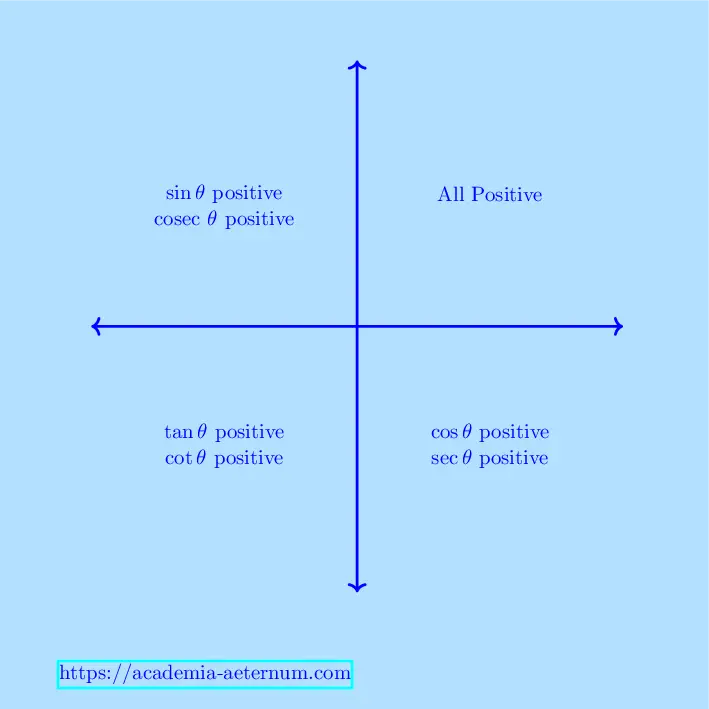
In Class 11 Trigonometry, once angles extend beyond acute angles, it becomes necessary to determine the signs of trigonometric functions for angles lying in different quadrants of the Cartesian plane.
Consider a circle of radius \( r \) with centre at the origin \( O \). Let an angle \( \theta \) be measured from the positive direction of the \( x \)-axis. Suppose the terminal side of the angle intersects the circle at a point \( P(x,y) \).
The basic trigonometric functions are defined as
\( \sin \theta = \dfrac{y}{r}, \quad \cos \theta = \dfrac{x}{r}, \quad \tan \theta = \dfrac{y}{x} \ (x \ne 0) \)
Since the radius \( r \) is always positive, the signs of these functions depend entirely on the signs of the coordinates \( x \) and \( y \), which vary according to the quadrant in which the point \( P \) lies.
Signs in Different Quadrants
- First Quadrant (0° to 90°): Both \( x \) and \( y \) are positive. Therefore, sin θ, cos θ, and tan θ are all positive.
- Second Quadrant (90° to 180°): \( x \) is negative while \( y \) is positive. Thus, sin θ is positive, but cos θ and tan θ are negative.
- Third Quadrant (180° to 270°): Both \( x \) and \( y \) are negative. Hence, tan θ is positive, while sin θ and cos θ are negative.
- Fourth Quadrant (270° to 360°): \( x \) is positive and \( y \) is negative. Therefore, cos θ is positive, while sin θ and tan θ are negative.
ASTC Rule (Easy Memory Trick)
The signs of trigonometric functions in different quadrants can be remembered using the mnemonic:
- All functions are positive in the first quadrant.
- Sine is positive in the second quadrant.
- Tangent is positive in the third quadrant.
- Cosine is positive in the fourth quadrant.
Signs of Reciprocal Functions
The reciprocal trigonometric functions inherit the same sign as their corresponding basic functions:
\( \csc \theta = \dfrac{1}{\sin \theta}, \quad \sec \theta = \dfrac{1}{\cos \theta}, \quad \cot \theta = \dfrac{1}{\tan \theta} \)
Therefore:
- \(\csc \theta\) has the same sign as \(\sin \theta\)
- \(\sec \theta\) has the same sign as \(\cos \theta\)
- \(\cot \theta\) has the same sign as \(\tan \theta\)
Fundamental Identity
The signs of sine and cosine also satisfy the basic trigonometric identity:
This identity remains valid in every quadrant, although the individual signs of sine and cosine may change.
Importance for Board and Competitive Exams
- Determining the correct sign is crucial when evaluating trigonometric expressions.
- Very common in Class 11 board examination problems.
- Used extensively in solving identities and equations in IIT JEE, NEET, and BITSAT.
- Essential for understanding the behaviour of trigonometric graphs.
Thus, the sign convention for trigonometric functions provides a consistent framework for evaluating trigonometric ratios for angles in any quadrant.
Important Trigonometric Identities and Ratios
In Class 11 Trigonometry, several important identities relate the six trigonometric functions. These identities are widely used in solving trigonometric equations, simplifications, and competitive exam problems such as those appearing in IIT JEE, NEET, and BITSAT.
1. Fundamental Trigonometric Identities
\(1+\tan^2 x=\sec^2 x\)
\(1+\cot^2 x=\csc^2 x\)
2. Periodicity Identities
\(\cos(2n\pi+x)=\cos x\)
\(\sin(2n\pi+x)=\sin x\)
3. Even–Odd Function Identities
\(\sin(-x)=-\sin x\)
\(\cos(-x)=\cos x\)
4. Angle Addition and Subtraction Formulas
\(\cos(x+y)=\cos x\cos y-\sin x\sin y\)
\(\cos(x-y)=\cos x\cos y+\sin x\sin y\)
\(\sin(x+y)=\sin x\cos y+\cos x\sin y\)
\(\sin(x-y)=\sin x\cos y-\cos x\sin y\)
5. Complementary Angle Identities
\(\cos\left(\frac{\pi}{2}-x\right)=\sin x\)
\(\sin\left(\frac{\pi}{2}-x\right)=\cos x\)
6. Allied Angle Identities
\(\cos(\pi-x)=-\cos x\)
\(\sin(\pi-x)=\sin x\)
\(\cos(2\pi-x)=\cos x\)
\(\sin(2\pi-x)=-\sin x\)
7. Tangent and Cotangent Addition Formulas
\(\tan(x+y)=\frac{\tan x+\tan y}{1-\tan x\tan y}\)
\(\tan(x-y)=\frac{\tan x-\tan y}{1+\tan x\tan y}\)
\(\cot(x+y)=\frac{\cot x\cot y-1}{\cot x+\cot y}\)
\(\cot(x-y)=\frac{\cot x\cot y+1}{\cot y-\cot x}\)
8. Double Angle Formulas
\(\cos2x=\cos^2x-\sin^2x\)
\(\cos2x=2\cos^2x-1\)
\(\cos2x=1-2\sin^2x\)
\(\sin2x=2\sin x\cos x\)
\(\tan2x=\frac{2\tan x}{1-\tan^2x}\)
9. Triple Angle Formulas
\(\sin3x=3\sin x-4\sin^3x\)
\(\cos3x=4\cos^3x-3\cos x\)
\(\tan3x=\frac{3\tan x-\tan^3x}{1-3\tan^2x}\)
10. Sum to Product Identities
\(\cos x+\cos y=2\cos\frac{x+y}{2}\cos\frac{x-y}{2}\)
\(\cos x-\cos y=-2\sin\frac{x+y}{2}\sin\frac{x-y}{2}\)
\(\sin x+\sin y=2\sin\frac{x+y}{2}\cos\frac{x-y}{2}\)
\(\sin x-\sin y=2\cos\frac{x+y}{2}\sin\frac{x-y}{2}\)
11. Product to Sum Identities
\(2\cos x\cos y=\cos(x+y)+\cos(x-y)\)
\(2\sin x\cos y=\sin(x+y)+\sin(x-y)\)
\(2\cos x\sin y=\sin(x+y)-\sin(x-y)\)
Importance for Exams
- These identities are frequently used in simplifying trigonometric expressions.
- Essential for solving problems in Class 11 board exams.
- Highly important for IIT JEE Main & Advanced, NEET, and BITSAT.
- Form the basis for advanced topics like trigonometric equations and calculus.
Graphs of Trigonometric Functions
The graphs of trigonometric functions describe how the values of sine, cosine, tangent, cotangent, secant, and cosecant vary with the angle. These graphs are periodic in nature and play an important role in Class 11 Mathematics, physics, engineering, and signal analysis.
Understanding these graphs helps students determine the domain, range, periodicity, symmetry, and behaviour of trigonometric functions. These properties are frequently tested in board examinations, IIT JEE, NEET, and BITSAT.
Basic Periodic Trigonometric Functions
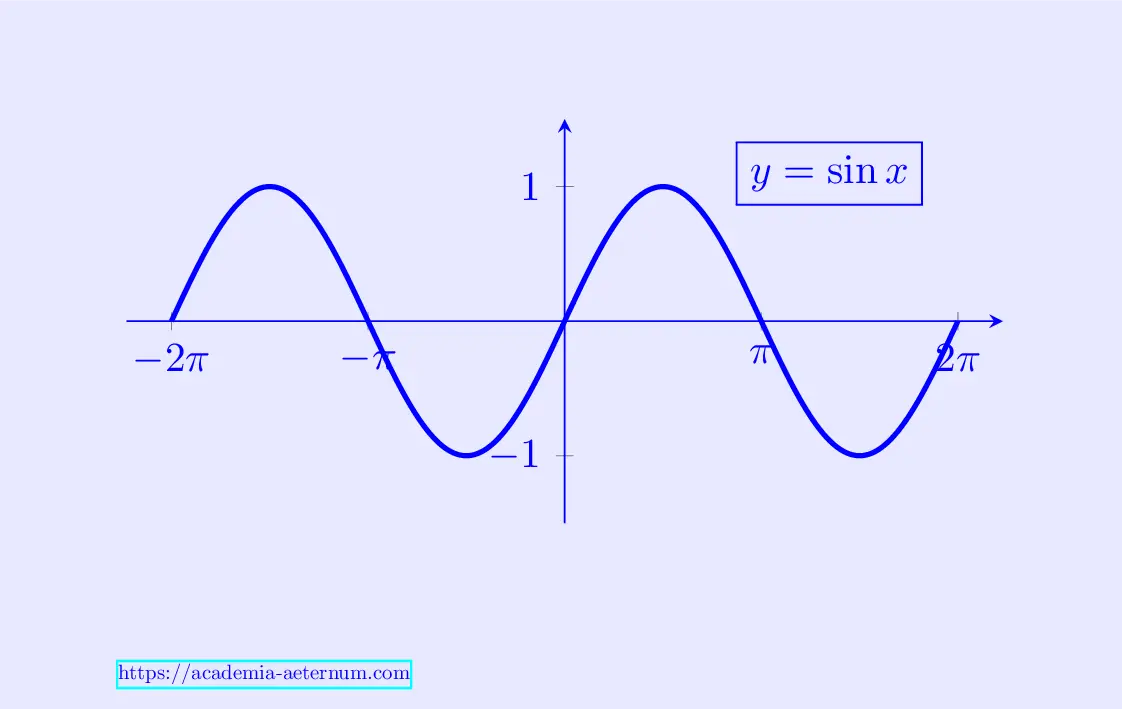
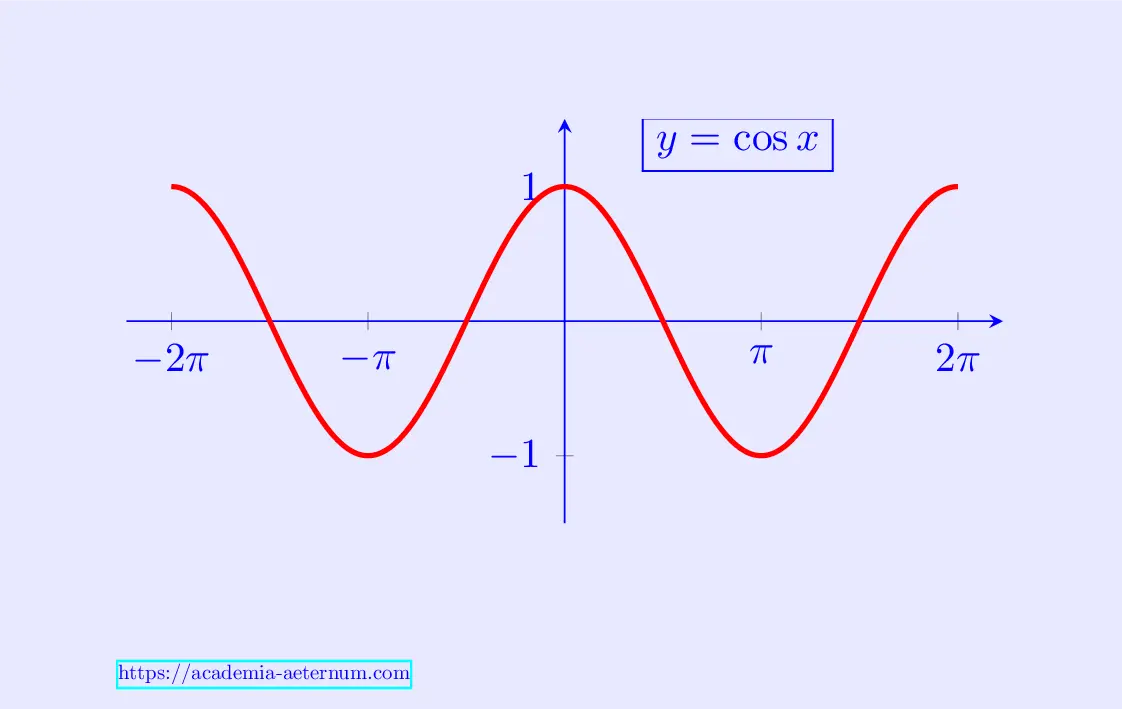
The sine and cosine functions are periodic with period \(2\pi\).
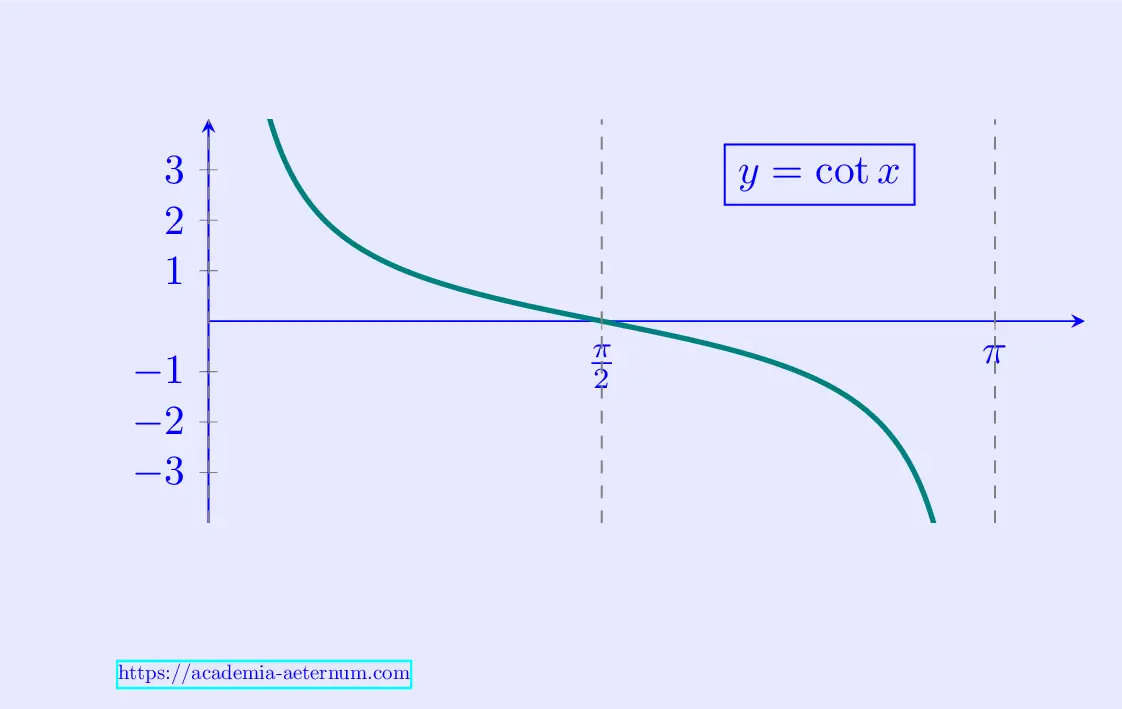
Graphs of Tangent and Cotangent
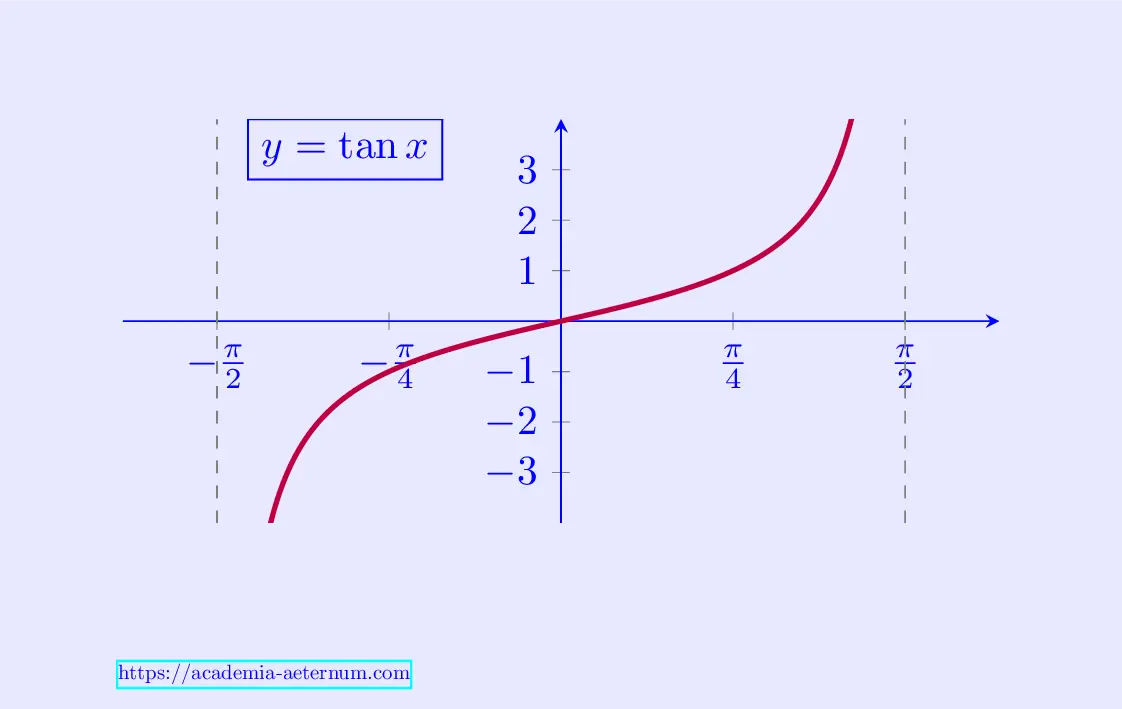
The tangent and cotangent functions are periodic with period \( \pi \). These graphs contain vertical asymptotes where the function is undefined.
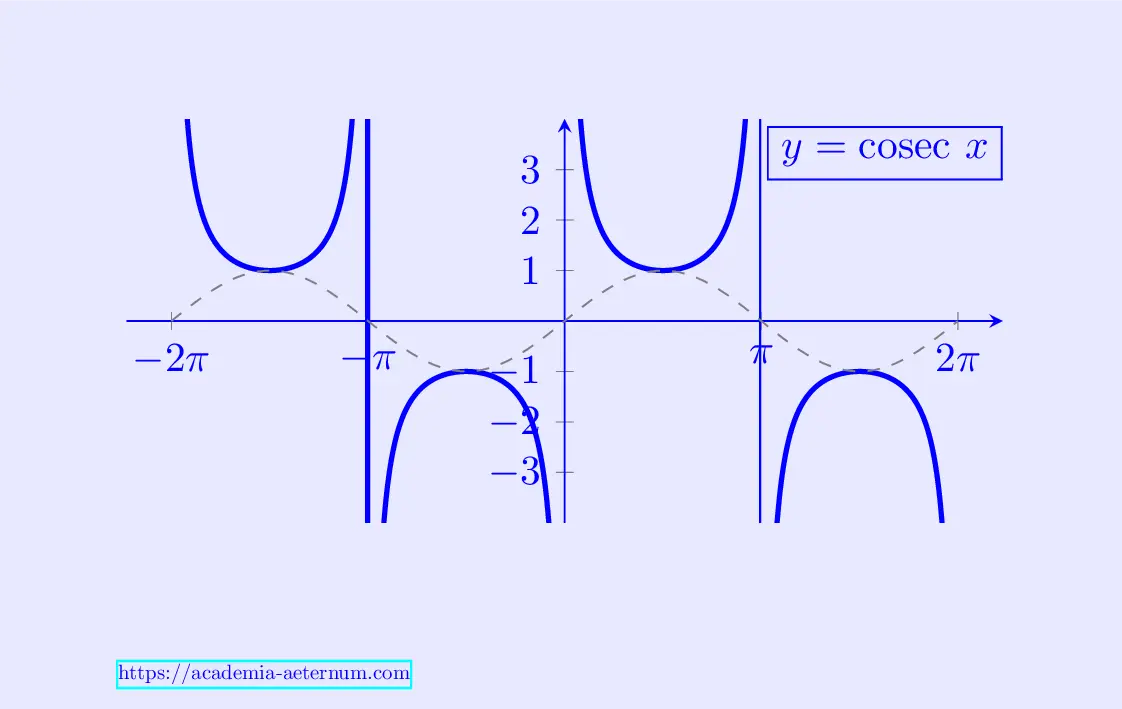
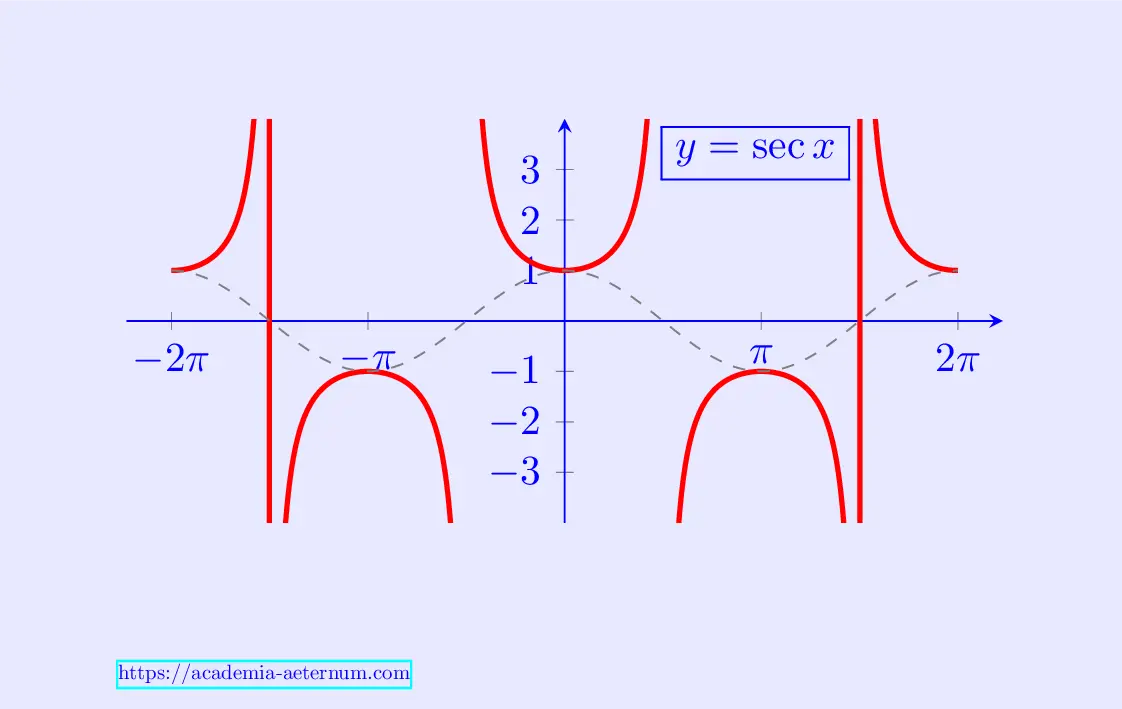
Graphs of Secant and Cosecant
The secant and cosecant functions are reciprocal functions of cosine and sine respectively. Their graphs contain discontinuities corresponding to the zeros of sine and cosine.
Key Observations from Trigonometric Graphs
- \(y=\sin x\) and \(y=\cos x\) have period \(2\pi\).
- \(y=\tan x\) and \(y=\cot x\) have period \(\pi\).
- Sine and cosine functions are bounded between \(-1\) and \(1\).
- Tangent and cotangent functions are unbounded.
- Secant and cosecant graphs contain vertical asymptotes.
Importance for Exams
- Graph-based questions frequently appear in Class 11 board exams.
- Understanding graphs helps solve problems on domain and range.
- Important for IIT JEE, NEET, and BITSAT problems involving periodicity.
- Useful in studying transformations of trigonometric functions.
Example 1: Finding Trigonometric Functions in the Third Quadrant
If \( \cos x = -\dfrac{3}{5} \) and the angle \(x\) lies in the third quadrant, find the values of the other five trigonometric functions.
Solution
We are given that \( \cos x = -\dfrac{3}{5} \) and the angle lies in the third quadrant. In the third quadrant:
- \(\sin x\) is negative
- \(\cos x\) is negative
- \(\tan x\) is positive
Step 1: Use the Fundamental Identity
The basic trigonometric identity is
Substitute \( \cos x = -\dfrac{3}{5} \).
\( \sin^2 x = 1 - \cos^2 x \)
\( = 1 - \left(-\dfrac{3}{5}\right)^2 \)
\( = 1 - \dfrac{9}{25} = \dfrac{16}{25} \)
Step 2: Find \( \sin x \)
\( \sin x = \pm \sqrt{\dfrac{16}{25}} = \pm\dfrac{4}{5} \)
Since \(x\) lies in the third quadrant, sine is negative.
\( \sin x = -\dfrac{4}{5} \)
Step 3: Find \( \tan x \)
\( \tan x = \dfrac{\sin x}{\cos x} \)
\( = \dfrac{-\frac{4}{5}}{-\frac{3}{5}} = \dfrac{4}{3} \)
Step 4: Find Remaining Functions
\( \cot x = \dfrac{1}{\tan x} = \dfrac{3}{4} \)
\( \sec x = \dfrac{1}{\cos x} = -\dfrac{5}{3} \)
\( \csc x = \dfrac{1}{\sin x} = -\dfrac{5}{4} \)
Final Values
| Function | Value |
|---|---|
| \(\sin x\) | \(-\dfrac{4}{5}\) |
| \(\tan x\) | \(\dfrac{4}{3}\) |
| \(\cot x\) | \(\dfrac{3}{4}\) |
| \(\sec x\) | \(-\dfrac{5}{3}\) |
| \(\csc x\) | \(-\dfrac{5}{4}\) |
Exam Tip
In problems like this, always determine the quadrant first. The quadrant tells you the sign of sine, cosine, and tangent, which helps select the correct root while solving identities.
Example 2: Using Periodicity of the Sine Function
Find the value of \( \sin \dfrac{31\pi}{3} \).
Solution
To evaluate \( \sin \dfrac{31\pi}{3} \), we use the periodicity property of the sine function. The sine function repeats its values after every \(2\pi\).
where \(n\) is any integer.
Step 1: Express the Angle Using Multiples of \(2\pi\)
\( \dfrac{31\pi}{3} = \dfrac{30\pi}{3} + \dfrac{\pi}{3} \)
\( = 10\pi + \dfrac{\pi}{3} \)
\( = 5(2\pi) + \dfrac{\pi}{3} \)
Step 2: Apply the Periodicity Property
\( \sin\left(5(2\pi) + \dfrac{\pi}{3}\right) = \sin\dfrac{\pi}{3} \)
Step 3: Evaluate the Standard Trigonometric Value
\( \sin\dfrac{\pi}{3} = \dfrac{\sqrt{3}}{2} \)
Final Answer
\( \boxed{\sin\dfrac{31\pi}{3} = \dfrac{\sqrt{3}}{2}} \)
Exam Shortcut
Instead of rewriting the entire expression, reduce the angle using modulo \(2\pi\).
\( \dfrac{31\pi}{3} \mod 2\pi = \dfrac{\pi}{3} \)
Therefore,
\( \sin\dfrac{31\pi}{3} = \sin\dfrac{\pi}{3} = \dfrac{\sqrt{3}}{2} \)
This technique is widely used in solving trigonometric problems in Class 11 board exams, IIT JEE, NEET, and BITSAT.
Example 3: Verifying a Trigonometric Identity
Prove that \(3\sin \dfrac{\pi}{6}\sec\dfrac{\pi}{3}-4\sin\dfrac{5\pi}{6}\cot \dfrac{\pi}{4}=1\).
Solution
To prove the identity, we start with the left-hand side (LHS) and simplify using the standard values of trigonometric functions.
Step 1: Write Standard Trigonometric Values
| Function | Value |
|---|---|
| \(\sin \dfrac{\pi}{6}\) | \(\dfrac{1}{2}\) |
| \(\sec \dfrac{\pi}{3}\) | 2 |
| \(\sin \dfrac{5\pi}{6}\) | \(\dfrac{1}{2}\) |
| \(\cot \dfrac{\pi}{4}\) | 1 |
Step 2: Substitute Values in LHS
\( \text{LHS} = 3\sin \dfrac{\pi}{6}\sec\dfrac{\pi}{3}-4\sin\dfrac{5\pi}{6}\cot \dfrac{\pi}{4} \)
\( = 3 \times \dfrac{1}{2} \times 2 - 4 \times \dfrac{1}{2} \times 1 \)
Step 3: Simplify
\( = 3 - 2 \)
\( = 1 \)
Conclusion
Since the left-hand side simplifies to \(1\), which is equal to the right-hand side, the given identity is verified.
\( \text{LHS} = \text{RHS} = 1 \)
Exam Tip
Problems of this type often rely on standard trigonometric values. Memorizing key values such as
helps solve such questions quickly in Class 11 board exams and competitive exams like IIT JEE, NEET, and BITSAT.
Example 4: Finding the Exact Value of \(\sin 15^\circ\)
Find the value of \( \sin 15^\circ \).
Solution
The angle \(15^\circ\) can be written as the difference of two standard angles:
\(15^\circ = 45^\circ - 30^\circ\)
To evaluate the expression, we use the sine subtraction identity.
Step 1: Apply the Identity
\( \sin 15^\circ = \sin(45^\circ - 30^\circ) \)
\( = \sin45^\circ\cos30^\circ - \cos45^\circ\sin30^\circ \)
Step 2: Substitute Standard Values
\( \sin45^\circ = \dfrac{1}{\sqrt{2}}, \quad \cos30^\circ = \dfrac{\sqrt{3}}{2}, \quad \sin30^\circ = \dfrac{1}{2} \)
\( = \dfrac{1}{\sqrt{2}}\cdot\dfrac{\sqrt{3}}{2} - \dfrac{1}{\sqrt{2}}\cdot\dfrac{1}{2} \)
Step 3: Simplify
\( = \dfrac{\sqrt{3}}{2\sqrt{2}} - \dfrac{1}{2\sqrt{2}} \)
\( = \dfrac{\sqrt{3}-1}{2\sqrt{2}} \)
Step 4: Rationalize the Denominator
\( = \dfrac{\sqrt{3}-1}{2\sqrt{2}}\times\dfrac{\sqrt{2}}{\sqrt{2}} \)
\( = \dfrac{\sqrt{6}-\sqrt{2}}{4} \)
Final Answer
\( \boxed{\sin 15^\circ = \dfrac{\sqrt{6}-\sqrt{2}}{4}} \)
Exam Tip
Values such as \( \sin15^\circ \), \( \cos15^\circ \), and \( \tan15^\circ \) are commonly derived using angle addition or subtraction formulas. These results frequently appear in Class 11 board exams, IIT JEE, NEET, and BITSAT.
Example 5: Evaluate \( \tan \dfrac{13\pi}{12} \)
Find the value of \( \tan \dfrac{13\pi}{12} \).
Solution
We use the periodicity property of the tangent function. The tangent function repeats its values after every \( \pi \).
Step 1: Reduce the Angle
\( \dfrac{13\pi}{12} = \pi + \dfrac{\pi}{12} \)
\( \tan \dfrac{13\pi}{12} = \tan\left(\pi+\dfrac{\pi}{12}\right) \)
\( = \tan\dfrac{\pi}{12} \)
Now convert the angle into degrees for easier evaluation.
\( \dfrac{\pi}{12} = 15^\circ \)
Step 2: Use the Tangent Subtraction Formula
Since \(15^\circ = 45^\circ - 30^\circ\), we apply
\( \tan(A-B)=\dfrac{\tan A-\tan B}{1+\tan A\tan B} \)
Step 3: Substitute Standard Values
\( \tan15^\circ =\dfrac{\tan45^\circ-\tan30^\circ}{1+\tan45^\circ\tan30^\circ} \)
\(=\dfrac{1-\dfrac{1}{\sqrt3}}{1+\dfrac{1}{\sqrt3}} \)
Step 4: Simplify
\(=\dfrac{\sqrt3-1}{\sqrt3+1}\)
\(=\dfrac{(\sqrt3-1)^2}{3-1}\)
\(=\dfrac{4-2\sqrt3}{2}\)
\(=2-\sqrt3\)
Final Answer
\( \boxed{\tan\dfrac{13\pi}{12}=2-\sqrt3} \)
Exam Tip
Many trigonometric problems become easier by first reducing the angle using periodicity. After reduction, use standard angles like \(30^\circ\), \(45^\circ\), and \(60^\circ\). This technique is widely used in Class 11 board exams, IIT JEE, NEET, and BITSAT.
Example 6: Prove a Trigonometric Identity
Show that \( \tan 3x \tan 2x \tan x = \tan 3x - \tan 2x - \tan x \).
Solution
To prove the identity, we use the tangent addition formula.
Step 1: Express \( \tan 3x \)
Write \(3x\) as \(2x+x\).
\( \tan 3x = \tan(2x+x) \)
\( = \dfrac{\tan 2x + \tan x}{1 - \tan 2x \tan x} \)
Step 2: Multiply Both Sides
Multiply both sides by \(1-\tan 2x \tan x\).
\( \tan3x(1-\tan2x\tan x)=\tan2x+\tan x \)
Step 3: Expand the Expression
\( \tan3x-\tan3x\tan2x\tan x=\tan2x+\tan x \)
Step 4: Rearrange the Terms
Move the terms appropriately.
\( \tan3x-\tan2x-\tan x=\tan3x\tan2x\tan x \)
Conclusion
Hence,
\( \tan3x\tan2x\tan x=\tan3x-\tan2x-\tan x \)
Therefore, the given identity is proved.
Exam Tip
In many trigonometric identity proofs, rewriting angles such as \(3x=2x+x\) helps apply addition formulas effectively. This strategy is frequently used in Class 11 board exams, IIT JEE, NEET, and BITSAT.
Example 7: Proving a Trigonometric Identity
Prove that \( \dfrac{\cos 7x+\cos 5x}{\sin 7x-\sin 5x}=\cot x \).
Solution
We start with the left-hand side (LHS) and simplify it using the sum-to-product trigonometric identities.
Step 1: Apply the Identity for Cosine Sum
\( \cos7x+\cos5x =2\cos\left(\frac{7x+5x}{2}\right)\cos\left(\frac{7x-5x}{2}\right) \)
\( =2\cos6x\cos x \)
Step 2: Apply the Identity for Sine Difference
\( \sin A-\sin B =2\cos\left(\frac{A+B}{2}\right)\sin\left(\frac{A-B}{2}\right) \)
\( \sin7x-\sin5x =2\cos\left(\frac{7x+5x}{2}\right)\sin\left(\frac{7x-5x}{2}\right) \)
\( =2\cos6x\sin x \)
Step 3: Substitute into the Given Expression
\( \text{LHS} =\dfrac{2\cos6x\cos x}{2\cos6x\sin x} \)
Step 4: Simplify
\( =\dfrac{\cos x}{\sin x} \)
\( =\cot x \)
Conclusion
Since the left-hand side simplifies to \( \cot x \), which is equal to the right-hand side, the given identity is verified.
\( \text{LHS}=\text{RHS}=\cot x \)
Exam Tip
When expressions contain sums or differences such as \( \cos7x+\cos5x \) or \( \sin7x-\sin5x \), the quickest method is to apply the sum-to-product identities. These identities are commonly used in Class 11 board exams, IIT JEE, NEET, and BITSAT.
🚀 Interactive Unit Circle + Trigonometric Graph Explorer
Drag the point on the circle to explore how sin θ, cos θ and tan θ change with the angle. Observe quadrant signs and the connection between the unit circle and trigonometric graphs.
Angle: 0°
sin θ = 0
cos θ = 1
tan θ = 0
🧠 Trigonometry Visual Lab
Drag the point on the unit circle or animate the angle to explore sin θ, cos θ, tan θ and their graphs.
Unit Circle Explorer
θ = 0°
sin θ = 0
cos θ = 1
tan θ = 0
Graph Explorer
Identity Verifier
Recent posts
Share this Chapter
Found this helpful? Share this chapter with your friends and classmates.
💡 Exam Tip: Share helpful notes with your study group. Teaching others is one of the fastest ways to reinforce your own understanding.