Draw a triangle: Mass, Moles, Particles. Cover any corner to get the formula.
02
Valency Table
Memorise valencies of 20 common ions — it unlocks all formula-writing questions.
03
Step-by-Step
Show all working in numericals. Partial marks are given even for wrong final answers.
04
Unit Vigilance
Always write units: g/mol, u, mol — unit errors cost marks in board exams.
Chapter 1 · CBSE · Class IX
⚛️
Kanad's Atomic Theory
NCERTClass 9ScienceAtomsMoleculesLaws of Chemical CombinationLaw of Conservation of MassLaw of Definite ProportionsDalton Atomic TheoryAtomic StructureMolecules of ElementsMolecules of CompoundsIonsCationsAnionsChemical FormulaMolecular FormulaWriting Chemical FormulaeValencyMole ConceptAvogadro NumberMolar MassAtomic Mass UnitRelative Atomic MassMolecular MassFormula MassMass of a MoleBalancing Chemical EquationsSymbols of ElementsPolyatomic IonsCombination ReactionDecomposition Reaction
Kanad's Atomic Theory – The Earliest Concept of Atoms
Long before the development of modern chemistry, ancient philosophers attempted to understand the nature
of matter. Among them, Maharishi Kanad, an Indian philosopher and founder of the Vaisheshika School of
Philosophy, proposed one of the earliest known atomic theories around 500 BCE. His ideas laid the
foundation for the concept that all matter is composed of extremely small particles called
Parmanu (atoms).
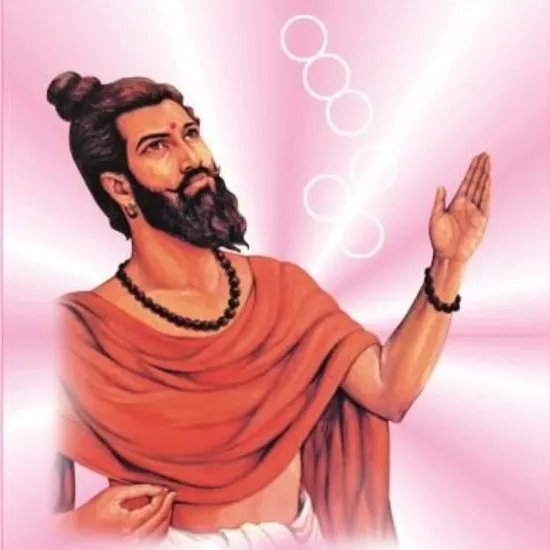
🖼️ Figure
Maharishi Kanad (approximately 500 BCE), one of the earliest thinkers to propose an atomic model of matter.
🏛️ Historical Note
Historical Background
During ancient times, philosophers observed that substances could be broken into smaller pieces.
Kanad questioned whether this process could continue indefinitely. He concluded that a stage must
eventually be reached where further division is impossible. The smallest indivisible particle obtained
was called a Parmanu.
This idea emerged nearly two thousand years before modern scientists such as
John Dalton proposed scientific atomic theory based on experimental evidence.
📘 Definition
Definition of Parmanu
Parmanu is the smallest indivisible and indestructible particle of matter according to
Maharishi Kanad's atomic theory.
A Parmanu was considered so small that it could not be perceived directly by human senses.
🗒️ Major Postulates Of Kanad's Atomic Theory
All matter is composed of extremely small particles called Parmanu.
Parmanu are indivisible and cannot be further broken down.
Atoms are eternal and cannot be created or destroyed.
Different substances are formed by different combinations of atoms.
Atoms remain unchanged during physical and chemical transformations.
Changes in matter occur because atoms combine, separate, or rearrange themselves.
Atoms may exist in two states: motion and rest.
The properties of substances depend upon the arrangement and combination of atoms.
🗂️ Types / Category
Six Fundamental Categories (Padarthas)
Dravya
Substance or matter
Guna
Quality or property
Karma
Action or motion
Samanya
Universality or common characteristics
Visesa
Particularity or uniqueness
Samavaya
Inherence or inseparable relationship
🤔 Did You Know?
How Did Kanad Explain Formation of Matter?
According to Kanad, atoms combine in different ways to form larger particles and eventually
visible matter.
For example:
Single atoms combine to form small clusters.
Several clusters combine to form larger particles.
Large numbers of particles produce observable matter.
Thus, different arrangements of the same basic particles can produce different substances.
⚖️ Comparison
Comparison with Modern Atomic Theory
Kanad's View
Modern Scientific View
Matter consists of tiny particles called Parmanu.
Matter consists of atoms.
Atoms are indivisible.
Atoms contain electrons, protons, and neutrons.
Atoms combine to form substances.
Atoms combine to form molecules and compounds.
Atoms are eternal.
Atoms can undergo nuclear changes.
Based mainly on philosophical reasoning.
Based on experimental evidence.
🏛️ Historical Note
Democritus and Leucippus
Around the same period, Greek philosophers Democritus and Leucippus proposed a similar idea.
They suggested that matter could not be divided endlessly. Eventually, a smallest indivisible
particle would be obtained.
Democritus called these particles Atomos, meaning
indivisible. The modern term atom is derived from this Greek word.
⚖️ Kanad and Democritus: Similarities
Both believed matter is composed of tiny particles.
Both considered these particles indivisible.
Both proposed that different substances arise from different combinations of particles.
Neither theory was supported by experimental evidence.
🌟 Importance of Kanad's Atomic Theory
One of the earliest known atomic theories in human history.
Introduced the concept that matter consists of tiny particles.
Provided a philosophical foundation for later scientific developments.
Demonstrates India's contribution to the history of science.
Forms the historical background of modern atomic theory taught in chemistry.
⚡ Exam Tip
Who proposed the concept of Parmanu?
What was meant by Parmanu?
Who coined the term Atomos?
Compare Kanad's idea with modern atomic theory.
❌ Common Mistakes
Confusing Parmanu with the modern atom.
Assuming Kanad's theory was experimentally proven.
Writing Democritus as the founder of modern atomic theory instead of Dalton.
Believing ancient atomic theories explained subatomic particles.
✏️ Example
Concept Check Question
Why is Kanad's atomic theory considered important even though it lacked experimental evidence?
1
Identify the main idea proposed by Kanad.
2
Connect it with modern atomic theory.
3
Explain its historical significance.
Kanad was among the first thinkers to suggest that matter consists of extremely small indivisible
particles called Parmanu. Although his ideas were philosophical and not experimentally verified,
they introduced the fundamental concept of atomic structure. This concept later became the basis
of modern atomic theories developed through scientific experiments.
📋 CBSE Competency-Based Case Study Question
A student reads that ancient Indian philosopher Kanad proposed that matter consists of tiny
indivisible particles called Parmanu. He also learns that modern atoms contain electrons,
protons, and neutrons.
Question 1: Which feature of Kanad's theory matches modern atomic theory?
Answer: Matter is composed of tiny particles.
Question 2: Which feature is not accepted today?
Answer: The idea that atoms are indivisible.
Question 3: Why is Kanad still remembered in science?
Answer: He introduced one of the earliest atomic concepts in history.
⚡ Quick Revision
Maharishi Kanad proposed the concept of Parmanu around 500 BCE.
Parmanu was considered the smallest indivisible particle.
Atoms combine to form different substances.
Kanad's theory was philosophical rather than experimental.
Democritus used the term Atomos meaning indivisible.
Modern atomic theory developed much later through scientific experiments.
🎨 SVG Diagram
Atomic Concept Proposed by Kanad
⚛️
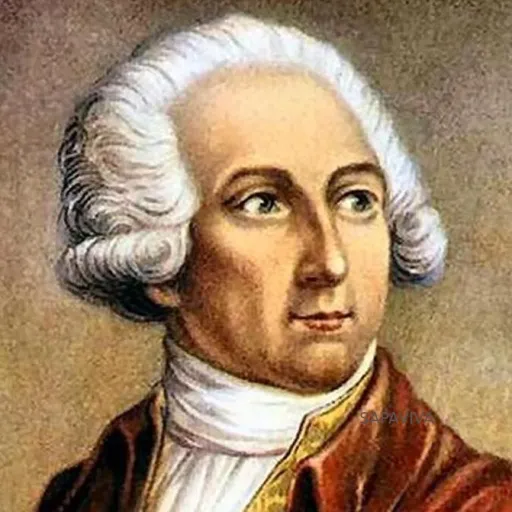
Lavoisier's Theory and the Law of Conservation of Mass
Antoine Lavoisier is widely regarded as the Father of Modern Chemistry. Through carefully
designed quantitative experiments, he established one of the most important laws in chemistry:
the Law of Conservation of Mass. This law states that matter can neither be created nor
destroyed during a chemical reaction. Lavoisier's work transformed chemistry from a qualitative subject
into a quantitative science based on precise measurements.
🖼️ Figure
Antoine Lavoisier (1743–1794), Father of Modern Chemistry
🏛️ Historical Note
Before Lavoisier's work, chemists often relied on observations rather than measurements.
Many scientists believed in the Phlogiston Theory, which attempted to explain burning
substances. Lavoisier conducted experiments using sealed containers and highly accurate balances.
His observations proved that the total mass remains unchanged during chemical reactions.
Lavoisier introduced the practice of weighing reactants and products accurately, making chemistry a
measurement-based science.
📘 Definition
Law of Conservation of Mass
Mass can neither be created nor destroyed in a chemical reaction. Therefore, the total mass of
reactants is always equal to the total mass of products.
In other words, atoms only rearrange themselves during a chemical reaction. No atom is lost and no new
atom is created.
Mathematical Representation
The law can be represented mathematically as:
\[
\text{Mass of Reactants}
=
\text{Mass of Products}
\]
Or,
\[
m_r = m_p
\]
where:
\(m_r\) = Total mass of reactants
\(m_p\) = Total mass of products
🗒️ Lavoisier's Experimental Verification
Lavoisier's Experimental Verification
Lavoisier heated substances in sealed containers and measured their masses before and after the
reaction.
The mass of the sealed vessel and reactants was measured.
The chemical reaction was allowed to occur.
The vessel was weighed again.
No change in total mass was observed.
This demonstrated that matter is conserved during chemical reactions.
🎨 SVG Diagram
Experimental Verification of Conservation of Mass
🌟 Importance in Atomic Theory
Lavoisier's law played a crucial role in the development of atomic theory.
It suggested that atoms are not destroyed during chemical reactions.
Atoms merely rearrange to form new substances.
It provided experimental support for Dalton's Atomic Theory.
It became one of the fundamental laws of chemical combination.
✏️ Example
Solved Example
Hydrogen reacts with oxygen to form water.
If 4 g of hydrogen reacts completely with 32 g of oxygen, what mass of water will be formed?
1
Identify masses of reactants.
2
Apply conservation of mass.
3
Mass of products equals mass of reactants.
Given:Hydrogen = 4 g
Oxygen = 32 g
Total mass of reactants:\[4 + 32 = 36\text{ g}\]
According to the Law of Conservation of Mass:\[\text{Mass of water}=36\text{ g}\]
Answer: 36 g of water is formed.
✏️ Example
Examples from Everyday Life
Rusting of iron follows conservation of mass.
Burning of magnesium ribbon follows conservation of mass.
Formation of water from hydrogen and oxygen follows conservation of mass.
Photosynthesis and respiration also obey this law.
Apparent loss of mass is often observed because gases escape into the atmosphere. In a closed system,
total mass remains constant.
🤔 Did You Know?
Why Does Mass Sometimes Appear to Change?
Students often observe that burning wood leaves only a small amount of ash. This may suggest a loss of
mass, but actually gases such as carbon dioxide and water vapour escape into the air.
If all products are collected and measured, the total mass remains unchanged.
📘 Definition
Lavoisier's Definition of an Element
Lavoisier defined an element as a substance that cannot be broken down into simpler substances by
ordinary chemical methods.
This definition became the basis of the modern concept of chemical elements.
🗒️ Contribution
Contribution to Chemical Nomenclature
Lavoisier helped develop a systematic method of naming chemicals. Prior to this, chemical names were
often confusing and inconsistent.
Modern chemical nomenclature originated from the system introduced by Lavoisier and his collaborators.
🗒️ Rejection
Rejection of the Phlogiston Theory
The Phlogiston Theory claimed that combustible materials released an invisible substance called
phlogiston during burning.
Lavoisier demonstrated that combustion involves oxygen from air rather than the release of phlogiston.
This discovery revolutionized chemistry and established the modern understanding of combustion.
⚡ Exam Tip
Lavoisier → Law of Conservation of Mass
Dalton → Atomic Theory
Proust → Law of Constant Proportions
❌ Common Mistakes
Common Mistakes Made by Students
Writing that mass is conserved only in physical changes.
Confusing mass with volume.
Ignoring gaseous products while applying conservation of mass.
Assuming matter disappears during burning.
📋 CBSE Competency-Based Case Study
A student burns magnesium ribbon in a covered crucible. The mass of magnesium before heating is 2.4 g.
After the reaction, 4.0 g of magnesium oxide is formed.
Question 1:
Why is the mass of product greater than the mass of magnesium?
Answer:
Oxygen from the air combines with magnesium.
Question 2:
Does this violate conservation of mass?
Answer:
No. The mass of oxygen added must also be included.
Question 3:
Which law explains this observation?
Answer:
Law of Conservation of Mass.
⚡ Quick Revision
Antoine Lavoisier is called the Father of Modern Chemistry.
He proposed the Law of Conservation of Mass.
Total mass of reactants equals total mass of products.
Atoms are neither created nor destroyed during chemical reactions.
He rejected the Phlogiston Theory.
He helped define elements and modern chemical nomenclature.
During the eighteenth and nineteenth centuries, chemists observed that substances always react in
predictable ways. Careful experimental investigations revealed that elements combine according to definite
patterns. These observations led to the formulation of the Laws of Chemical Combination,
which became the foundation of modern chemistry and ultimately inspired Dalton's Atomic Theory.
The Laws of Chemical Combination explain how elements combine to form compounds and why chemical reactions
follow fixed quantitative relationships.
🌟 Why are the Laws of Chemical Combination Important?
They provide experimental evidence for the existence of atoms.
They explain how elements combine to form compounds.
They form the basis of stoichiometry and chemical calculations.
They support Dalton's Atomic Theory.
They help scientists predict the composition of compounds.
They establish that chemical reactions follow fixed quantitative rules.
⚖️ Laws
Major Laws of Chemical Combination
Law
Scientist
Main Idea
Law of Conservation of Mass
Antoine Lavoisier
Mass is neither created nor destroyed during a chemical reaction.
Law of Definite Proportions
Joseph Proust
A compound always contains the same elements in a fixed ratio by mass.
⚖️ Law of Conservation of Mass
Mass can neither be created nor destroyed in a chemical reaction. Therefore, the total mass of
reactants is always equal to the total mass of products.
Mathematical Representation
\[
\text{Total Mass of Reactants}
=
\text{Total Mass of Products}
\]
\[
m_r = m_p
\]
Explanation
During a chemical reaction, atoms are neither created nor destroyed. They only rearrange themselves to
form new substances. Since the number of atoms remains unchanged, total mass also remains constant.
Experimental Verification
Lavoisier performed chemical reactions in sealed containers and measured masses before and after the
reaction. He found that the total mass remained unchanged, leading to the formulation of this law.
✏️ Example
Solved Example
10 g of calcium reacts with 18 g of water. Calculate the total mass of products formed.
1
Find total mass of reactants.
2
Apply conservation of mass.
3
Mass of products equals mass of reactants.
Mass of Reactants = 10 + 18 = 28 g
According to the Law of Conservation of Mass:\[\text{Mass of Products} = 28\text{ g}\]
28 g
⚖️ Law of Definite Proportions (Law of Constant Proportions)
Scientist
This law was proposed by Joseph Proust in 1799.
Statement
A pure chemical compound always contains the same elements combined together in the same fixed
proportion by mass, irrespective of its source or method of preparation.
No matter where a compound is found or how it is prepared, the ratio of masses of its constituent
elements remains constant.
For example, water obtained from:
Rain
River
Sea
Laboratory preparation
always contains hydrogen and oxygen in the same mass ratio.
bg-dark bg-gradient p-2 rounded
Water consists of hydrogen and oxygen.
\[
\text{Mass of Hydrogen}
:
\text{Mass of Oxygen}
=
1:8
\]
Thus, every 1 g of hydrogen combines with 8 g of oxygen to form water.
Example of Carbon Dioxide
Carbon dioxide always contains carbon and oxygen in a fixed mass ratio.
\[
\text{Carbon}
:
\text{Oxygen}
=
3:8
\]
This ratio remains unchanged irrespective of the source of carbon dioxide.
Illustration of Constant Composition
✏️ Example
Water obtained from different sources contains:
11.1% hydrogen by mass
88.9% oxygen by mass
Therefore, all pure samples of water have identical composition.
✏️ Example
Solved Example
A sample of water contains 2 g hydrogen and 16 g oxygen. Does it obey the Law of Definite Proportions?
\[2:16 = 1:8\]
Since the mass ratio remains 1:8, the sample obeys the Law of Definite Proportions.
⚖️ Comparison
Difference Between the Two Laws
Law of Conservation of Mass
Law of Definite Proportions
Concerned with total mass during a reaction.
Concerned with composition of a compound.
Proposed by Lavoisier.
Proposed by Proust.
Mass remains constant.
Mass ratio remains constant.
Applicable to chemical reactions.
Applicable to chemical compounds.
🗒️ Connection with Dalton's Atomic Theory
Dalton proposed his Atomic Theory to explain these laws.
Atoms cannot be created or destroyed → explains Conservation of Mass.
Atoms combine in fixed whole-number ratios → explains Definite Proportions.
Compounds are formed by combination of atoms in simple ratios.
⚡ Exam Tip
Remember the sequence:
Lavoisier → Conservation of Mass
Proust → Definite Proportions
Dalton → Atomic Theory
❌ Common Mistakes
Confusing Conservation of Mass with Constant Proportions.
Writing volume ratio instead of mass ratio.
Ignoring gaseous reactants or products in mass calculations.
Assuming compounds may have variable composition.
📋 CBSE Competency-Based Case Study
Two students prepare water in different laboratories. One obtains water from river water purification,
while the other prepares it by combining hydrogen and oxygen in a laboratory.
Analysis shows that both samples contain hydrogen and oxygen in the mass ratio 1:8.
Question 1:
Which law is illustrated?
Answer:
Law of Definite Proportions.
Question 2:
Why is the composition identical?
Answer:
Pure compounds always contain elements in fixed mass ratios.
Question 3:
Which scientist proposed this law?
Answer:
Joseph Proust.
⚡ Quick Revision
Laws of Chemical Combination form the basis of modern chemistry.
Lavoisier proposed the Law of Conservation of Mass.
Proust proposed the Law of Definite Proportions.
Total mass remains constant during chemical reactions.
Compounds always have fixed composition by mass.
These laws provided evidence for Dalton's Atomic Theory.
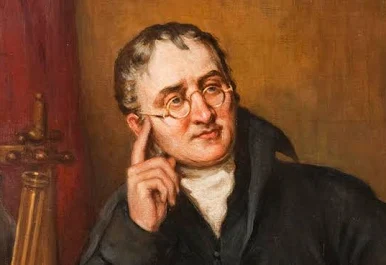
In 1808, John Dalton proposed the first scientifically accepted atomic theory to explain
the laws of chemical combination. Dalton's theory transformed chemistry by suggesting
that all matter is composed of tiny particles called atoms. His theory provided a logical
explanation for the Law of Conservation of Mass and the Law of Definite Proportions.
🏛️ Historical Note
Before Dalton's work, scientists had already discovered several important laws of
chemical combination. However, no satisfactory explanation existed for why elements
combined in fixed ratios or why mass remained conserved during chemical reactions.
Dalton proposed that matter consists of tiny indivisible particles called atoms,
and this idea successfully explained the experimental observations of his time.
Dalton's Atomic Theory was the first theory to explain chemical reactions using
particles of matter.
🤔 Did You Know?
Why Was Dalton's Atomic Theory Needed?
To explain the Law of Conservation of Mass.
To explain the Law of Definite Proportions.
To understand how compounds are formed.
To provide a scientific model for matter.
To explain chemical reactions at the particle level.
📘 Definition
Definition of Dalton's Atomic Theory
Dalton's Atomic Theory states that all matter is composed of tiny indivisible particles
called atoms, which combine in fixed whole-number ratios to form compounds and participate
in chemical reactions without being created or destroyed.
🗂️ Postulates of Dalton's Atomic Theory
Postulate 1: Matter is Made of Atoms
All matter, whether an element, compound, or mixture, is made up of extremely tiny
particles called atoms.
These atoms are the basic building blocks of matter.
Postulate 2: Atoms are Indivisible
Dalton believed that atoms cannot be divided into smaller particles and cannot be
created or destroyed during chemical reactions.
This postulate explained the Law of Conservation of Mass.
Postulate 3: Atoms of the Same Element are Identical
All atoms of a particular element have identical masses and similar chemical properties.
Example:
All oxygen atoms were believed to be identical.
All hydrogen atoms were believed to be identical.
Postulate 4: Atoms of Different Elements Differ
Atoms of different elements possess different masses and chemical properties. Example:
Hydrogen atoms differ from oxygen atoms.
Carbon atoms differ from nitrogen atoms.
Postulate 5: Atoms Combine in Simple Whole-Number Ratios
Atoms combine in simple whole-number ratios to form compounds. Examples:
Water (\(H_2O\)) contains 2 hydrogen atoms and 1 oxygen atom.
Carbon dioxide (\(CO_2\)) contains 1 carbon atom and 2 oxygen atoms.
Ammonia (\(NH_3\)) contains 1 nitrogen atom and 3 hydrogen atoms.
Postulate 6: Composition of a Compound Remains Fixed
The relative number and kinds of atoms remain constant in a given compound.
Therefore, water always contains hydrogen and oxygen in the same proportion.
🎨 SVG Diagram
Visual Representation of Dalton's Atomic Theory
🔍 How Dalton's Theory Explained the Laws of Chemical Combination
Explanation of Conservation of Mass
Dalton proposed that atoms cannot be created or destroyed during chemical reactions.
Therefore, total mass remains constant.
Explanation of Definite Proportions
Dalton stated that compounds are formed by fixed combinations of atoms.
Hence, compounds always have a constant composition.
Examples Based on Dalton's Atomic Theory
Example 1: Formation of Water
Water contains hydrogen and oxygen atoms in a fixed ratio:
\[
H_2O
\]
Every water molecule contains two hydrogen atoms and one oxygen atom.
Example 2: Formation of Carbon Dioxide
\[
CO_2
\]
Every carbon dioxide molecule contains one carbon atom and two oxygen atoms.
⚠️ Limitations of Dalton's Atomic Theory
Although Dalton's theory was revolutionary, later discoveries showed that some
of its postulates were not entirely correct.
Dalton's Postulate
Modern Discovery
Atoms are indivisible.
Atoms contain electrons, protons, and neutrons.
Atoms cannot be created or destroyed.
Nuclear reactions can create or destroy atoms.
All atoms of an element are identical.
Isotopes of the same element have different masses.
Atoms of different elements always differ in mass.
Different elements may have atoms with the same mass number.
📌 Modern View of the Atom
Modern atomic theory accepts Dalton's basic idea that matter consists of atoms.
However, atoms are now known to contain subatomic particles:
Electron
Proton
Neutron
These discoveries refined and improved Dalton's original model.
⚡ Exam Tip
State the postulates of Dalton's Atomic Theory.
Which postulates explain the laws of chemical combination?
Write any two limitations of Dalton's Atomic Theory.
Explain how Dalton justified the Law of Conservation of Mass.
❌ Common Mistakes
Writing Dalton instead of Lavoisier for Conservation of Mass.
Confusing atoms with molecules.
Memorising postulates without understanding their significance.
Ignoring the limitations of Dalton's theory.
Writing modern atomic concepts as Dalton's original ideas.
📋 CBSE Competency-Based Case Study
A student observes that water always contains hydrogen and oxygen in a fixed composition.
He also notices that the total mass remains unchanged when hydrogen reacts with oxygen
to form water.
Question 1:
Which theory explains these observations?
Answer:
Dalton's Atomic Theory.
Question 2:
Which law is related to fixed composition?
Answer:
Law of Definite Proportions.
Question 3:
Which postulate explains conservation of mass?
Answer:
Atoms cannot be created or destroyed during chemical reactions.
🗒️ Assertion and Reason Practice
Assertion (A):
Water always contains hydrogen and oxygen in a fixed ratio.
Reason (R):
Atoms combine in simple whole-number ratios.
Answer:
Both Assertion and Reason are true, and Reason correctly explains Assertion.
⚡ Quick Revision
Dalton proposed the first modern atomic theory in 1808.
All matter is made of atoms.
Atoms combine in simple whole-number ratios.
Compounds possess fixed composition.
Dalton explained the laws of chemical combination.
Modern discoveries revealed certain limitations in his theory.
An atom is the smallest particle of an element that retains the chemical properties of that
element. Atoms are the basic building blocks of all matter. Every substance around us, whether solid,
liquid, or gas, is ultimately made up of atoms.
The word Atom is derived from the Greek word "Atomos", meaning
indivisible.
📘 Definition
An atom is the smallest particle of an element that can take part in a chemical reaction and retains
the identity of that element. Although atoms can be divided into smaller particles, they remain the smallest unit that participates
in ordinary chemical reactions.
🌟 Why are Atoms Important?
Atoms are the basic building blocks of matter.
All elements are composed of atoms.
Atoms combine to form molecules and compounds.
Chemical reactions involve rearrangement of atoms.
The study of atoms helps explain the behaviour of matter.
🔷 Characteristics of Atoms
🔷Characteristics
Atoms are extremely small particles.
Atoms cannot be seen with the naked eye.
Atoms of different elements differ in mass and properties.
Atoms participate in chemical reactions.
Atoms generally combine to form molecules.
Atoms retain the chemical identity of their element.
🤔 Did You Know?
How Small is an Atom?
Atoms are extraordinarily small. Their size is measured in nanometres (nm).\[1\ \text{nm}=10^{-9}\ \text{m}\]
Typical atomic sizes are of the order:\[10^{-10}\ \text{m}\]
To appreciate this size:
A sheet of paper contains billions of atoms.
A human hair is approximately one million carbon atoms thick.
Atoms are far too small to be observed directly with ordinary microscopes.
⚖️ Comparison of Sizes
Object
Approximate Size
Football
\(10^{-1}\) m
Ant
\(10^{-2}\) m
Human Hair Thickness
\(10^{-4}\) m
Bacterium
\(10^{-6}\) m
Atom
\(10^{-10}\) m
🎨 SVG Diagram
Visualising the Tiny Size of Atoms
📌 Symbols of Elements
Since writing complete element names repeatedly is inconvenient, scientists use short symbols to represent elements.
Modern symbols are standardized by the International Union of Pure and Applied Chemistry (IUPAC).
A chemical symbol represents:
The name of an element.
One atom of that element.
A fixed quantity of that element.
📌 Note
Rules for Writing Symbols
The first letter is always written in capital form.
The second letter, if present, is written in lowercase.
Symbols may be derived from English names.
Some symbols originate from Latin names.
✏️ Example
Hydrogen → H
Carbon → C
Helium → He
Chlorine → Cl
Symbols Derived from Latin Names
Element
Symbol
Latin Name
Sodium
Na
Natrium
Potassium
K
Kalium
Iron
Fe
Ferrum
Copper
Cu
Cuprum
Silver
Ag
Argentum
Gold
Au
Aurum
Mercury
Hg
Hydrargyrum
🤔 Did You Know?
Why Do Most Atoms Not Exist Independently?
Most atoms are highly reactive and therefore combine with other atoms to achieve stability.
As a result, atoms usually exist in the form of:
Molecules
Compounds
Ions
Only a few elements such as helium, neon, argon, krypton and xenon exist as single atoms under normal conditions.
⚡ Exam Tip
Students frequently confuse:
Atom → Smallest particle of an element.
Molecule → Smallest particle of a substance capable of independent existence.
❌ Common Mistakes
Writing the second letter of a symbol in capital form (e.g., CL instead of Cl).
Confusing symbols derived from Latin names.
Assuming all atoms can exist independently.
Confusing atoms with molecules.
Using lowercase letters for the first letter of a symbol.
📋 CBSE Competency-Based Case Study
A student writes the symbols of sodium, potassium and iron as S, P and I respectively.
Question 1:
Are these symbols correct?
Answer:
No.
Question 2:
Write the correct symbols.
Answer:
Na, K and Fe.
Question 3:
Why are these symbols different from English names?
Answer:
They are derived from Latin names.
⚡ Quick Revision
Atom is the basic unit of an element.
Atoms are extremely small particles.
Symbols are standardized by IUPAC.
The first letter of a symbol is always capital.
Many symbols are derived from Latin names.
Most atoms do not exist independently.
⚛️
IUPAC (International Union of Pure and Applied Chemistry)
IUPAC stands for the International Union of Pure and Applied Chemistry.
It is the internationally recognized scientific organization responsible for standardizing chemical names,
symbols, terminology, atomic masses, units, and nomenclature systems used throughout the world.
What is IUPAC?
Scientists from different countries may use different languages and naming conventions. To ensure
uniformity and avoid confusion, IUPAC establishes globally accepted rules for chemistry.
IUPAC acts as the international authority that ensures chemists worldwide use the same scientific
language.
🌟 Major Functions of IUPAC
Standardizes symbols of chemical elements.
Approves names and symbols of newly discovered elements.
Develops international rules for naming chemical compounds.
Publishes standard atomic masses of elements.
Maintains internationally accepted chemical terminology.
Promotes collaboration among chemists worldwide.
🤔 Did You Know?
Why is IUPAC Important?
Ensures uniformity in scientific communication.
Prevents confusion caused by local names of chemicals.
Allows scientists from different countries to understand one another.
Provides globally accepted standards for chemistry education.
Maintains consistency in textbooks, research papers and laboratories.
Atoms are extremely small particles, and their actual masses are extraordinarily tiny.
Measuring atomic masses directly in grams is impractical. Therefore, scientists use a special unit called
the atomic mass unit (u) to express atomic masses conveniently.
🌟 Why Do We Need Atomic Mass?
Consider the mass of a hydrogen atom:\[0.00000000000000000000000167 \text{ g}\]
Such tiny values are difficult to work with. Therefore, chemists compare atomic masses relative to a standard atom.
📘 Definition
Atomic mass is the relative mass of an atom expressed in atomic mass units (u).
It indicates how heavy an atom is compared with the standard reference atom, Carbon-12.
Atomic Mass Unit (u)
Scientists selected the Carbon-12 atom as the international standard for measuring atomic masses.
One atomic mass unit is defined as:\[1u = \frac{1}{12}=\text{ of the mass of one Carbon-12 atom}\]
Carbon-12 is assigned an atomic mass of exactly 12 u.
🤔 Did You Know?
Why Was Carbon-12 Chosen as the Standard?
It is stable.
It is readily available.
It gives convenient atomic mass values.
It is accepted internationally.
📌 Understanding Relative Atomic Mass
Atomic mass does not represent the exact mass of an atom in grams. Instead, it compares the mass of an
atom with the Carbon-12 standard.
Example:
Hydrogen atom ≈ 1 u
Oxygen atom ≈ 16 u
Carbon atom = 12 u
This means an oxygen atom is approximately sixteen times heavier than one atomic mass unit.
🎨 SVG Diagram
Visual Comparison of Atomic Masses
ℹ️ Atomic Masses of Important Elements
Element
Symbol
Atomic Mass (u)
Hydrogen
H
1
Carbon
C
12
Nitrogen
N
14
Oxygen
O
16
Sodium
Na
23
Magnesium
Mg
24
Sulphur
S
32
Chlorine
Cl
35.5
Calcium
Ca
40
✏️ Example
Solved Example
Which atom is heavier: Oxygen or Carbon?
Atomic mass of Carbon:\[12u\]
Atomic mass of Oxygen:\[16u\]
Since \[16 \gt 12\]
therefore, Oxygen is heavier than Carbon.
❌ Common Mistakes
Confusing atomic mass with atomic number.
Writing atomic mass unit as "gm".
Assuming atomic mass means exact mass in grams.
Forgetting that Carbon-12 is the standard reference.
Confusing atomic mass with molecular mass.
📋 CBSE Competency-Based Question
A student states that oxygen has an atomic mass of 16 u while hydrogen has an atomic mass of 1 u.
Question:
What does this indicate?
Answer:
Oxygen atoms are approximately sixteen times heavier than one atomic mass unit and much heavier than
hydrogen atoms.
⚡ Quick Revision
Atomic masses are expressed in atomic mass units (u).
Carbon-12 is the international standard.
\(1u\) equals one-twelfth of the mass of a Carbon-12 atom.
Atomic mass represents relative mass.
Atomic mass should not be confused with atomic number.
A molecule is a group of two or more atoms chemically bonded together and held by
attractive forces. It is the smallest particle of an element or compound that can exist independently and
retains all the chemical properties of that substance.
A molecule behaves as a single unit and possesses all the characteristics of the substance to which it
belongs.
📘 Definition
A molecule is the smallest particle of an element or compound capable of independent existence and
showing all the properties of that substance. Molecules are formed when atoms combine chemically in fixed proportions.
🤔 Did You Know?
Why Do Molecules Form?
Most atoms cannot exist independently because they are unstable. To attain stability, atoms combine with other atoms and form molecules.
During this process, atoms become more stable and attain lower energy.
Examples
Two hydrogen atoms combine to form a hydrogen molecule (\(H_2\)).
Two oxygen atoms combine to form an oxygen molecule (\(O_2\)).
One carbon atom combines with two oxygen atoms to form carbon dioxide (\(CO_2\)).
🔷 Characteristics of Molecules
🔷Characteristics
Molecules consist of two or more atoms chemically bonded together.
Molecules are electrically neutral.
They can exist independently under suitable conditions.
They retain all properties of the substance.
Atoms combine in definite ratios to form molecules.
🗂️ Types of Molecules
Molecules of Elements
Molecules consisting of atoms of the same element are called molecules of elements.
Examples
Element
Molecular Formula
Number of Atoms
Hydrogen
\(H_2\)
2
Oxygen
\(O_2\)
2
Nitrogen
\(N_2\)
2
Ozone
\(O_3\)
3
Phosphorus
\(P_4\)
4
Sulphur
\(S_8\)
8
Molecules of Compounds
Molecules consisting of atoms of different elements combined in fixed proportions are called molecules
of compounds.
Examples
Compound
Formula
Constituent Atoms
Water
\(H_2O\)
Hydrogen and Oxygen
Carbon Dioxide
\(CO_2\)
Carbon and Oxygen
Ammonia
\(NH_3\)
Nitrogen and Hydrogen
Methane
\(CH_4\)
Carbon and Hydrogen
📘 Definition
Atomicity
The number of atoms present in one molecule of an element is called its
atomicity.
Atomicity = Total number of atoms present in one molecule.
Examples of Atomicity
Molecule
Atomicity
Type
He
1
Monoatomic
H₂
2
Diatomic
O₃
3
Triatomic
P₄
4
Tetra-atomic
S₈
8
Polyatomic
🗒️ Classification Of Molecules Based On Atomicity
Type
Number of Atoms
Examples
Monoatomic
1
He, Ne, Ar
Diatomic
2
H₂, O₂, N₂, Cl₂
Triatomic
3
O₃, CO₂
Tetra-atomic
4
P₄, NH₃ (4 atoms total)
Polyatomic
More than 4
S₈, C₆H₁₂O₆
⚖️ Difference Between Atom and Molecule
Atom
Molecule
Smallest particle of an element.
Smallest particle capable of independent existence.
May or may not exist independently.
Can exist independently.
Single particle.
Contains two or more atoms.
Example: H, O, Na
Example: H₂, O₂, H₂O
✏️ Example
Solved Example
Determine the atomicity of ozone (\(O_3\)).
1
Identify the number of atoms present.
2
Count the subscript.
3
State atomicity.
Ozone is represented by:
\[
O_3
\]
Therefore, one molecule contains 3 oxygen atoms.
Atomicity = 3 (Triatomic)
⚡ Exam Tip
Remember:
Atom = Smallest particle of an element.
Molecule = Smallest particle capable of independent existence.
Atomicity = Number of atoms in one molecule.
❌ Common Mistakes
Confusing atomicity with molecular mass.
Writing O₃ as a diatomic molecule.
Assuming all molecules contain atoms of different elements.
Confusing molecules with compounds.
Ignoring the concept of independent existence.
📋 CBSE Competency-Based Question
A student observes the molecules \(H_2\), \(O_3\), \(CO_2\), and \(P_4\).
Question 1:
Which molecule is triatomic?
Answer:
\(O_3\).
Question 2:
Which molecule contains atoms of different elements?
Answer:
\(CO_2\).
Question 3:
What is the atomicity of \(P_4\)?
Answer:
4 (Tetra-atomic).
⚡ Quick Revision
Molecules are formed by chemical combination of atoms.
Molecules can be of elements or compounds.
Atomicity is the number of atoms present in one molecule.
An ion is an atom or a group of atoms that carries a net electric charge due to the loss
or gain of one or more electrons. Ions are formed when the number of electrons becomes unequal to the
number of protons present in an atom or group of atoms. Atoms are electrically neutral, whereas ions carry positive or negative charges.
📘 Definition
Definition of an Ion
An ion is a charged particle formed when an atom or a group of atoms loses or gains electrons.
Since electrons are negatively charged, losing electrons produces a positive charge while gaining
electrons produces a negative charge.
🤔 Did You Know?
Why Do Ions Form?
Atoms tend to attain a more stable electronic configuration. To achieve stability, atoms may lose or
gain electrons and form ions.
Loss of electrons → Positive ion (cation)
Gain of electrons → Negative ion (anion)
🗂️ Formation of Ions
Formation of a Positive Ion
When sodium loses one electron:\[Na \rightarrow Na^{+} + e^{-}\]
Sodium becomes a positively charged ion because it has lost one negative electron.
Formation of a Negative Ion
When chlorine gains one electron:\[Cl + e^{-} \rightarrow Cl^{-}\]
Chlorine becomes a negatively charged ion because it gains an extra electron.
🗂️ Types of Ions
Cations
Positively charged ions formed by the loss of electrons are called
cations.
Loss of electrons → Positive charge → Cation
Examples
Atom
Ion Formed
Charge
Sodium
\(Na^+\)
+1
Potassium
\(K^+\)
+1
Calcium
\(Ca^{2+}\)
+2
Magnesium
\(Mg^{2+}\)
+2
Aluminium
\(Al^{3+}\)
+3
Anions
Negatively charged ions formed by the gain of electrons are called
anions.
Gain of electrons → Negative charge → Anion
Examples
Atom
Ion Formed
Charge
Chlorine
\(Cl^-\)
-1
Fluorine
\(F^-\)
-1
Oxygen
\(O^{2-}\)
-2
Sulphur
\(S^{2-}\)
-2
Nitrogen
\(N^{3-}\)
-3
📌 Classification of Ions
Ions may also be classified according to the number of atoms present.
Monoatomic Ions
Ions consisting of a single atom carrying a charge are called monoatomic ions.
Examples
Ion Name
Formula
Charge
Sodium
\(Na^+\)
+1
Potassium
\(K^+\)
+1
Magnesium
\(Mg^{2+}\)
+2
Chloride
\(Cl^-\)
-1
Oxide
\(O^{2-}\)
-2
Polyatomic Ions
Ions consisting of two or more atoms bonded together and carrying a net charge are called polyatomic ions.
Examples
Ion Name
Formula
Charge
Ammonium
\(NH_4^+\)
+1
Hydroxide
\(OH^-\)
-1
Nitrate
\(NO_3^-\)
-1
Carbonate
\(CO_3^{2-}\)
-2
Sulphate
\(SO_4^{2-}\)
-2
⚖️ Difference Between Atom and Ion
Atom
Ion
Electrically neutral.
Electrically charged.
Equal number of protons and electrons.
Unequal number of protons and electrons.
No net charge.
Positive or negative charge.
Example: Na, Cl
Example: Na⁺, Cl⁻
🌟 Importance of Ions
Ions help in the formation of ionic compounds.
They conduct electricity in molten or aqueous state.
They are essential for writing chemical formulae.
Many biological processes involve ions.
Understanding ions is necessary for learning valency.
✏️ Example
Solved Example
Identify whether Mg2+ is a cation or an anion.
Mg2+ carries a positive charge.
Positively charged ions are called cations.
Therefore, Mg2+ is a cation.
⚡ Exam Tip
Remember:
Cation = Positive charge = Loss of electrons
Anion = Negative charge = Gain of electrons
❌ Common Mistakes
Confusing cations with anions.
Writing chloride ion as \(Cl^+\).
Forgetting charges while writing polyatomic ions.
Assuming all ions consist of single atoms.
Confusing ions with molecules.
📋 CBSE Competency-Based Question
A student is given the species:
\(Na^+\), \(Cl^-\), \(NH_4^+\), \(SO_4^{2-}\).
Classify them as cations and anions.
Solution
Cations:
\(Na^+\), \(NH_4^+\)
Anions:
\(Cl^-\), \(SO_4^{2-}\)
⚡ Quick Revision
Ions are charged particles formed by loss or gain of electrons.
Cations are positively charged ions.
Anions are negatively charged ions.
Monoatomic ions contain one atom.
Polyatomic ions contain more than one atom.
Ions are essential for writing chemical formulae and understanding valency.
Valency is the combining capacity of an atom or a group of atoms. It indicates the number
of electrons an atom loses, gains, or shares while forming a chemical bond. Valency helps us understand how
atoms combine to form molecules and compounds.
Valency is one of the most important concepts in chemistry because it forms the basis for writing chemical
formulae and understanding the formation of compounds.
📘 Definition
Valency is the combining capacity of an atom or radical that determines how many atoms of one
element can combine with atoms of another element.
In simple words, valency tells us how many bonds an atom can form while combining with other atoms.
🌟 Why is Valency Important?
Helps predict how elements combine.
Used for writing chemical formulae.
Helps determine the composition of compounds.
Explains formation of molecules and ions.
Provides a foundation for studying chemical bonding.
🤔 Did You Know?
How Does Valency Arise?
Atoms combine with one another to attain a stable electronic arrangement. During this process, atoms
may lose, gain, or share electrons. The number of electrons involved in this process determines the valency of the atom.
For Class 9, remember:
Valency is mainly the combining capacity of an atom and is often equal to the charge on the ion formed
by that atom.
📌 Determination of Valency
For many main-group elements:
If the number of valence electrons is 1, 2, 3 or 4, then:
Valency = Number of valence electrons.
If the number of valence electrons is greater than 4, then:
Valency = 8 − Number of valence electrons.
Valencies of Common Elements
Element
Symbol
Valency
Hydrogen
H
1
Oxygen
O
2
Nitrogen
N
3
Carbon
C
4
Sodium
Na
1
Magnesium
Mg
2
Aluminium
Al
3
Chlorine
Cl
1
Calcium
Ca
2
Valencies of Important Radicals (Polyatomic Ions)
Radical
Formula
Valency
Ammonium
\(NH_4^+\)
1
Hydroxide
\(OH^-\)
1
Nitrate
\(NO_3^-\)
1
Carbonate
\(CO_3^{2-}\)
2
Sulphate
\(SO_4^{2-}\)
2
Phosphate
\(PO_4^{3-}\)
3
🎨 SVG Diagram
Visual Understanding of Valency
💡 Concept
Using Valency to Write Chemical Formulae
The valencies of combining atoms are used to determine the chemical formula of a compound.
Example: Magnesium Oxide
Element
Valency
Mg
2
O
2
Simplest ratio:
\[
MgO
\]
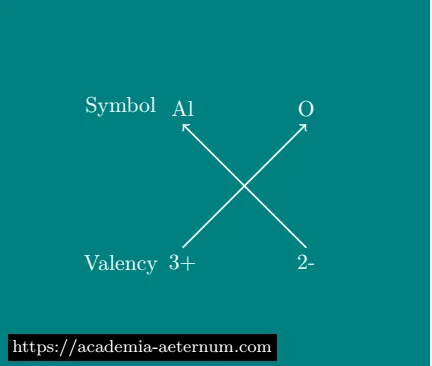
Introduction to the Criss-Cross Method
A convenient method for writing chemical formulae is the criss-cross method.
Example:
Aluminium → Valency = 3
Oxygen → Valency = 2
Cross the valencies:\[Al_2O_3\]
Thus, the formula of aluminium oxide is \(Al_2O_3\).
⚖️ Difference Between Valency and Charge
Valency
Charge
Combining capacity of an atom.
Electrical property of an ion.
Always expressed as a number.
Expressed as positive or negative sign.
Example: Oxygen = 2
Example: \(O^{2-}\)
✏️ Example
Solved Examples
What is the valency of oxygen?
Oxygen generally combines with two hydrogen atoms in water. Therefore:\[\text{Valency of Oxygen} = 2\]
What is the valency of aluminium?
Aluminium forms the ion: Al3+ Therefore: Valency of Aluminium = 3
⚡ Exam Tip
Frequently asked valencies:
H = 1
O = 2
N = 3
C = 4
Na = 1
Mg = 2
Al = 3
Cl = 1
❌ Common Mistakes
Confusing valency with atomicity.
Confusing valency with charge.
Writing valency of oxygen as 1.
Ignoring radicals while writing formulae.
Using charge signs instead of valencies during formula writing.
📋 CBSE Competency-Based Question
A student is given the following valencies:
Aluminium = 3
Oxygen = 2
Write the formula of the compound formed.
Solution
Applying the criss-cross method:
\[
Al_2O_3
\]
Therefore, the compound formed is aluminium oxide.
⚡ Quick Revision
Valency is the combining capacity of an atom or radical.
Valency helps in writing chemical formulae.
Oxygen has valency 2.
Carbon has valency 4.
Sodium has valency 1.
Valency should not be confused with atomicity or charge.
A chemical formula is the symbolic representation of a substance that shows the elements
present and the number of atoms of each element in one molecule or formula unit of the substance.
A chemical formula provides concise information about the composition of a compound without writing the full
names of its constituent elements.
📘 Definition
efinition of Chemical Formula
A chemical formula is a shorthand notation that represents the composition of a substance using the
symbols of elements and numerical subscripts.
Example
\(H_2O\) → Water
\(CO_2\) → Carbon dioxide
\(NaCl\) → Sodium chloride
\(CaCO_3\) → Calcium carbonate
🌟 Importance of Chemical Formulae
Shows the elements present in a compound.
Indicates the number of atoms of each element.
Helps determine molecular mass and formula unit mass.
Used in chemical equations.
Provides information about composition of compounds.
⚖️ Rules for Writing Chemical Formulae
The total positive charge must balance the total negative charge.
In compounds formed from a metal and a non-metal, the symbol of the metal is written first.
In compounds containing a positive ion and a negative ion, the positive ion is written first.
The valencies of the combining species are used to determine the formula.
For polyatomic ions, brackets are used when more than one ion is present.
If only one polyatomic ion is present, brackets are not required.
Examples
\(NaCl\)
\(CaO\)
\(Mg(OH)_2\)
\(Al_2(SO_4)_3\)
🔄 Steps for Writing Chemical Formulae
1
Write the symbols of the constituent ions or elements.
2
Write their valencies.
3
Criss-cross the valencies.
4
Write the crossed numbers as subscripts.
5
Simplify the ratio if possible.
6
Check that total positive and negative charges are balanced.
📘 The Criss-Cross Method
The criss-cross method is the easiest technique for writing chemical formulae using valencies. The valency of one ion becomes the subscript of the other ion.
Remember:
Write valencies → Cross them → Reduce if possible → Write final formula.
✏️ Writing Formulae Involving Polyatomic Ions
When a compound contains more than one polyatomic ion, brackets must be used.
Magnesium ion: Mg2+
Hydroxide ion: OH-
Applying the criss-cross method: Mg(OH)2
🌟 Important Valencies for Formula Writing
Ion / Element
Valency
Hydrogen (H)
1
Oxygen (O)
2
Nitrogen (N)
3
Carbon (C)
4
Sodium (Na)
1
Magnesium (Mg)
2
Aluminium (Al)
3
Chloride (Cl⁻)
1
Hydroxide (OH⁻)
1
Sulphate (SO₄²⁻)
2
Carbonate (CO₃²⁻)
2
✏️ Example
Solved Example
Write the formula of calcium hydroxide.
Calcium = 2 Hydroxide = 1 Ca(OH)2
Write the formula of sodium oxide.
Sodium = 1
Oxygen = 2
Na2O
⚖️ Difference Between Symbol and Chemical Formula
Symbol
Chemical Formula
Represents one element.
Represents a compound or molecule.
Example: H, O, Na
Example: H₂O, CO₂, NaCl
Represents one atom.
Represents a molecule or formula unit.
⚡ Exam Tip
Always balance valencies.
Reduce ratios if possible.
Use brackets for multiple polyatomic ions.
Write positive ion first and negative ion second.
❌ Common Mistakes
Writing metal symbols after non-metals.
Forgetting to simplify valency ratios.
Not using brackets with polyatomic ions.
Writing \(MgOH_2\) instead of \(Mg(OH)_2\).
Confusing valency with atomicity.
📋 CBSE Competency-Based Question
A student writes the formula of aluminium sulphate as:
\[
AlSO_4
\]
Is the formula correct?
Solution
Aluminium has valency 3 and sulphate has valency 2.
Applying the criss-cross method:
\[
Al_2(SO_4)_3
\]
Therefore, \(AlSO_4\) is incorrect.
⚡ Quick Revision
A chemical formula represents the composition of a substance.
The total positive and negative charges must balance.
Valencies are used to determine subscripts.
The criss-cross method helps write formulae easily.
Brackets are required for multiple polyatomic ions.
Formula writing is one of the most important CBSE examination skills.
The simplest compounds formed by the combination of two different elements are called
binary compounds. The chemical formula of a compound is written using the symbols and
valencies of its constituent elements.
Writing chemical formulae is one of the most important skills in chemistry because it helps us represent
compounds accurately and determine their composition.
🤔 Did You Know?
What are Binary Compounds?
Binary compounds are compounds formed by the combination of only two different elements.
Examples
\(HCl\) — Hydrogen chloride
\(H_2S\) — Hydrogen sulphide
\(NaCl\) — Sodium chloride
\(MgO\) — Magnesium oxide
\(Al_2O_3\) — Aluminium oxide
🔄 General Steps for Writing Chemical Formulae
1
Write the symbols of the combining elements or ions.
2
Write their valencies.
3
Criss-cross the valencies.
4
Use the crossed numbers as subscripts.
5
Reduce the ratio if possible.
6
Verify that the total positive and negative valencies balance.
✏️ Example
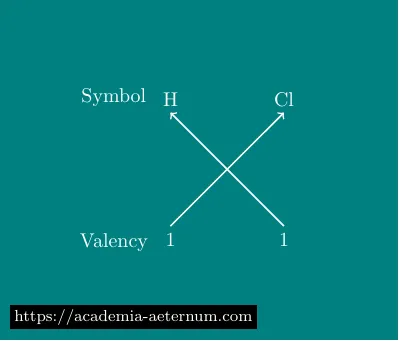
Formula of Hydrogen Chloride
Hydrogen and chlorine combine in a 1:1 ratio because both have valency 1.
Element
Symbol
Valency
Hydrogen
H
1
Chlorine
Cl
1
Hydrogen chloride contains one hydrogen atom and one chlorine atom.
\[HCl\]
✏️ Example
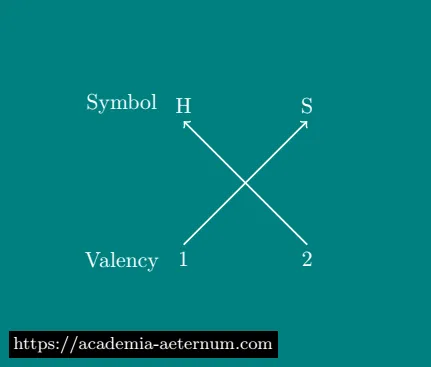
Formula of Hydrogen Sulphide
Hydrogen has valency 1 and sulphur has valency 2.
Element
Valency
Hydrogen (H)
1
Sulphur (S)
2
Hydrogen sulphide contains two hydrogen atoms and one sulphur atom.
\[H_2S\]
✏️ Example
Formula of Aluminium Oxide
Aluminium has valency 3 while oxygen has valency 2.
Element
Valency
Aluminium (Al)
3
Oxygen (O)
2
Aluminium oxide contains two aluminium atoms and three oxygen atoms.
Criss-Cross Method
\[
Al_2O_3
\]
✏️ Example
Formula of Ammonium Sulphate
Ammonium (\(NH_4^+\)) and sulphate (\(SO_4^{2-}\)) are polyatomic ions.
Ion
Valency
\(NH_4^+\)
1
\(SO_4^{2-}\)
2
Brackets are necessary because two ammonium ions are present.
Criss-Cross Method
\[
(NH_4)_2SO_4
\]
❌ Common Mistakes
Writing the non-metal before the metal.
Forgetting to simplify valencies.
Ignoring brackets for polyatomic ions.
Using charges instead of valencies directly.
Writing incorrect subscripts after criss-crossing.
📋 CBSE Competency-Based Question
A student writes the formula of calcium hydroxide as:
\[
CaOH_2
\]
Is the formula correct? Justify your answer.
Solution
Hydroxide is a polyatomic ion (\(OH^-\)).
Since two hydroxide ions are required, brackets must be used.
\[
Ca(OH)_2
\]
Therefore, the student's answer is incorrect.
⚡ Quick Revision
Binary compounds contain only two elements.
Chemical formulae are written using valencies.
The criss-cross method simplifies formula writing.
Positive ion is written before negative ion.
Brackets are used for multiple polyatomic ions.
Always verify that total positive and negative valencies balance.
The molecular mass of a substance is the sum of the atomic masses of all the atoms present
in one molecule of that substance. It represents the relative mass of a molecule and is expressed in
atomic mass units (u).
Molecular mass tells us how heavy a molecule is compared to one atomic mass unit (u).
📘 Definition
Molecular mass is the sum of the atomic masses of all atoms present in one molecule of a substance.
Since molecules are made of atoms, their mass is obtained by adding the atomic masses of all constituent atoms.
🔢 Formula
Formula for Molecular Mass
Molecular mass is calculated using:
\[\text{Molecular Mass} = \sum (\text{Atomic Mass} \times \text{Number of Atoms})\]
In simple words:
\[\text{Molecular Mass} = \text{Total of all atomic masses present in a molecule}\]
🌟 Why is Molecular Mass Important?
Helps identify the mass of molecules.
Used in mole concept calculations.
Useful in chemical equations.
Required for calculating percentage composition.
Forms the basis of quantitative chemistry.
🔄 Steps to Calculate Molecular Mass
1
Write the chemical formula.
2
Identify the number of atoms of each element.
3
Write their atomic masses.
4
Multiply atomic mass by the number of atoms.
5
Add all the values.
🎨 SVG Diagram
Visual Understanding of Molecular Mass
✏️ Example
Find Molecular Mass of Water (H₂O)
1
Water contains:
2 Hydrogen atoms
1 Oxygen atom
Given:Atomic mass of Hydrogen = 1 u
Atomic mass of Oxygen = 16 u
\[
\begin{aligned}\text{Molecular Mass of H}_2O &=(2 \times 1)+(1 \times 16)\\
&= 2 + 16\\
&=18
\end{aligned}
\]
Molecular mass of water = 18 u.
Calculate Molecular Mass of Nitric Acid (HNO₃)
1
One molecule of nitric acid contains:
1 Hydrogen atom
1 Nitrogen atom
3 Oxygen atoms
Given:
H = 1 u
N = 14 u
O = 16 u
\(
(1\times1)
+
(1\times14)
+
(3\times16)
\)
=1+14+48
=63u
Molecular mass of nitric acid = 63 u.
ℹ️ Molecular Masses of Common Compounds
Compound
Formula
Molecular Mass (u)
Water
\(H_2O\)
18
Carbon Dioxide
\(CO_2\)
44
Ammonia
\(NH_3\)
17
Methane
\(CH_4\)
16
Nitric Acid
\(HNO_3\)
63
Glucose
\(C_6H_{12}O_6\)
180
⚖️ Comparison
Atomic Mass
Molecular Mass
Mass of one atom.
Mass of one molecule.
Applicable to elements.
Applicable to molecules.
Example: O = 16 u.
Example: O₂ = 32 u.
⚡ Exam Tip
Always multiply the atomic mass by the number of atoms present before adding.
Students often forget to multiply by subscripts.
❌ Common Mistakes
Ignoring subscripts while calculating mass.
Using atomic number instead of atomic mass.
Adding atomic masses incorrectly.
Confusing molecular mass with formula unit mass.
Not counting atoms inside brackets.
📋 CBSE Competency-Based Question
A student calculates the molecular mass of carbon dioxide as:
\[
12 + 16 = 28u
\]
Identify the mistake.
Solution
Carbon dioxide contains two oxygen atoms.
\[
12 + (2\times16)
\]
\[
=44u
\]
The student ignored the subscript 2.
⚡ Quick Revision
Molecular mass = Sum of atomic masses of all atoms in a molecule.
Unit of molecular mass is u.
Always multiply atomic mass by the number of atoms.
The formula unit mass of a substance is the sum of the atomic masses of all atoms present
in the formula unit of an ionic compound. It is expressed in atomic mass units (u).
Formula unit mass is used for ionic compounds because they do not exist as individual molecules.
📘 Definition
Formula unit mass is the sum of the atomic masses of all atoms present in one formula unit of an
ionic compound. The calculation method is similar to molecular mass. The only difference is that formula unit mass is
used for compounds whose constituent particles are ions.
🤔 Did You Know?
Why Do We Use Formula Unit Mass?
Covalent compounds such as water (\(H_2O\)) and carbon dioxide (\(CO_2\)) exist as independent
molecules. Therefore, we calculate their molecular masses.
Ionic compounds such as sodium chloride (\(NaCl\)) and magnesium oxide (\(MgO\)) do not exist as
separate molecules. Instead, they exist as large ionic lattices made up of positive and negative ions.
Therefore, the term formula unit mass is used for ionic compounds.
🔢 Formula
\[
\text{Formula Unit Mass}
=
\sum
(\text{Atomic Mass} \times \text{Number of Atoms})
\]
The method of calculation is exactly the same as molecular mass.
⚖️ Comparison
Formula Unit vs Molecule
Molecule
Formula Unit
Exists independently.
Represents the simplest ratio of ions.
Found in covalent compounds.
Found in ionic compounds.
Used for molecular mass.
Used for formula unit mass.
\(H_2O\), \(CO_2\)
\(NaCl\), \(MgO\)
✏️ Example
Solved Example
Formula Unit Mass of Sodium Chloride (NaCl)
Given:Atomic mass of Sodium = 23 u
Atomic mass of Chlorine = 35.5 u
This section provides a concise revision of the most important concepts, laws, definitions, formulae, and
examination facts from the chapter Atoms and Molecules.
⚖️ Laws
Fundamental Laws of Chemical Combination<
Law of Conservation of Mass:
During a chemical reaction, mass is neither created nor destroyed.
The total mass of reactants is always equal to the total mass of products.
Law of Definite Proportions:
A pure chemical compound always contains the same elements combined in a fixed proportion by mass,
irrespective of its source or method of preparation.
📘 Definition
Important Definitions
Atom:
The smallest particle of an element that participates in chemical reactions.
Molecule:
The smallest particle of an element or compound capable of independent existence.
Atomicity:
Number of atoms present in one molecule of an element.
Ion:
A charged particle formed by the loss or gain of electrons.
Valency:
The combining capacity of an atom or radical.
Polyatomic Ion:
A group of atoms carrying a net charge and behaving as a single ion.
🗒️ Important Atomicities to Remember
Important Atomicities to Remember
Element
Formula
Atomicity
Helium
\(He\)
1
Hydrogen
\(H_2\)
2
Nitrogen
\(N_2\)
2
Oxygen
\(O_2\)
2
Ozone
\(O_3\)
3
Phosphorus
\(P_4\)
4
Sulphur
\(S_8\)
8
🌟 Importance
Common Valencies
Element / Ion
Valency
Hydrogen (H)
1
Oxygen (O)
2
Nitrogen (N)
3
Carbon (C)
4
Sodium (Na)
1
Magnesium (Mg)
2
Aluminium (Al)
3
Chlorine (Cl)
1
Hydroxide (\(OH^-\))
1
Sulphate (\(SO_4^{2-}\))
2
Carbonate (\(CO_3^{2-}\))
2
Ammonium (\(NH_4^+\))
1
🔢 Formula
Important Formulae
Molecular Mass
\[
\text{Molecular Mass}
=
\sum
(\text{Atomic Mass} \times \text{Number of Atoms})
\]
Formula Unit Mass
Sum of atomic masses of all atoms present in one formula unit of an ionic compound.
Atomic Mass Unit
\[
1u=
\frac{1}{12}
\text{ of the mass of one Carbon-12 atom}
\]
🔎 Key Fact
High-Yield Examination Facts
IUPAC standardizes chemical symbols, nomenclature, and atomic masses.
Carbon-12 is the international standard used for measuring atomic masses.
Noble gases such as He, Ne, and Ar are monoatomic.
Most elements do not exist independently as atoms and form molecules for stability.
Ionic compounds are represented by formula units rather than molecules.
Positive ions are called cations, while negative ions are called anions.
Chemical formulae are written by balancing valencies or ionic charges.
Brackets are used when more than one polyatomic ion is present in a compound.
NCERT Science · Class IX · Chapter 3
Atoms and Molecules
From Dalton’s bold postulates to Avogadro’s giant number — master the building blocks of matter with interactive tools, concept clarity, and deep practice.
⚛ Dalton’s Atomic Theory🔬 Laws of Chemical Combination🧮 Mole Concept📐 Atomic & Molecular Mass🧪 Chemical Formulae⚖ Avogadro’s Number
Core Concepts
Eight foundational concept blocks with clear explanations, real-world connections, and key takeaways.
⚖
Concept 01
Laws of Chemical Combination
The two foundational laws that made atomic theory necessary
Law of Conservation of Mass (Lavoisier, 1774): In any chemical reaction, the total mass of all reactants equals the total mass of all products. Mass is neither created nor destroyed. If you burn 12 g of carbon in 32 g of oxygen, you get exactly 44 g of carbon dioxide — no mass disappears into thin air.
Law of Definite Proportions (Proust, 1799): A pure chemical compound always contains the same elements combined in a fixed mass ratio, regardless of its source or method of preparation. Water is always H : O = 1 : 8 by mass, whether from a river, lab synthesis, or mineral extraction.
Conservation of mass means no atoms are created or destroyed in a reaction — they only rearrange.
Definite proportions prove compounds are not random mixtures but have fixed atomic arrangements.
Both laws were direct experimental evidence that matter consists of discrete particles.
Water: H : O = 1 : 8 by mass. CO₂: C : O = 3 : 8 by mass.
🔵
Concept 02
Dalton’s Atomic Theory
The first scientific model — atoms as indivisible, indestructible spheres
John Dalton (1808) proposed the first comprehensive atomic theory to explain the two laws of chemical combination. His postulates were revolutionary for their time, though modern science has partially revised them.
All matter is made of atoms. Atoms are indivisible and indestructible tiny particles.
Atoms of the same element are identical in mass and chemical properties.
Atoms of different elements differ in mass and chemical properties.
Compounds form by combination of atoms of different elements in small whole-number ratios.
Atoms cannot be created or destroyed in chemical reactions — only rearranged.
Modern revision: Atoms ARE divisible (sub-atomic particles exist). Isotopes show same-element atoms can differ in mass.
🔤
Concept 03
Atomic Symbols & Atomic Mass
How we name atoms and measure their incredibly tiny masses
Symbols: Berzelius introduced 1–2 letter symbols. First letter always uppercase, second always lowercase. Some come from Latin: Fe (Ferrum = Iron), Na (Natrium = Sodium), K (Kalium = Potassium), Cu (Cuprum = Copper), Pb (Plumbum = Lead), Ag (Argentum = Silver), Au (Aurum = Gold).
Atomic Mass Unit (u / amu): One u is defined as ¹/₁₂ the mass of one Carbon-12 atom. This gives H ≈ 1 u, O = 16 u, C = 12 u exactly. Using u avoids working with impossibly small numbers like 1.67 × 10⁻²⁴ g.
Atomic mass is a relative measure — it compares atoms to 1/12 of C-12. It has no unit of its own, though u is often written.
Cl has mass 35.5 u because it is an average of isotopes Cl-35 (75%) and Cl-37 (25%).
🧩
Concept 04
Molecules, Valency & Chemical Formulae
How atoms group, the rules of valency, and reading formulae correctly
Molecules are the smallest particles of elements or compounds capable of independent existence. Elemental molecules: monoatomic (noble gases), diatomic (H₂, O₂, N₂, F₂, Cl₂, Br₂, I₂), triatomic (O₃), polyatomic (P₄, S₈).
Valency is the combining capacity of an atom. H and Na = 1; O, Mg = 2; Al, N = 3; C = 4. To write a formula, use the criss-cross rule: swap the valencies of the combining ions and use them as subscripts, then simplify.
Molecular Mass = sum of atomic masses of all atoms in the molecule. H₂O: 2(1)+16 = 18 u. Glucose C₆H₁₂O₆: 6(12)+12(1)+6(16) = 180 u.
Always simplify ratios after criss-cross: Ca²⁺ + O²⁻ → Ca₂O₂ → CaO (same valency = 1:1 ratio)
Formula unit mass (not molecular mass) is used for ionic compounds like NaCl, MgCl₂.
⚛
Concept 05
Ions & Polyatomic Ions
Charged particles and the special groups that behave as a single unit
Ions are atoms or groups of atoms that carry an overall electric charge. Cations (positive) form when atoms lose electrons — typical of metals. Anions (negative) form when atoms gain electrons — typical of non-metals.
Polyatomic ions are groups of atoms acting as one unit with an overall charge. When writing formulae with polyatomic ions, always enclose the ion in brackets before applying the criss-cross rule if its subscript will be greater than 1.
Al³⁺ + OH⁻ → Al(OH)₃ — brackets are essential here
NH₄⁺ + SO₄²⁻ → (NH₄)₂SO₄
🔢
Concept 06
The Mole Concept
The chemist’s counting unit — a bridge between atoms and grams
Atoms are too small to count individually. Chemists use the mole as a counting unit, just as a dozen = 12. One mole = 6.022 × 10²³ particles (Avogadro’s Number, Nₐ). This number was chosen so that the molar mass in grams equals the atomic/molecular mass in u — a magical and useful coincidence.
Molar mass: The mass of one mole of a substance in grams. Molar mass of O = 16 g/mol; of H₂O = 18 g/mol. One mole of any gas at STP occupies 22.4 L (molar volume).
Nₐ = 6.022 × 10²³ mol⁻¹ (Avogadro’s Number)
Moles = Given mass ÷ Molar mass (n = m/M)
Number of particles N = n × Nₐ
Mass of 1 atom or molecule = Molar mass ÷ Nₐ
At STP, 1 mole of any gas = 22.4 L
Molar mass numerically equals atomic/molecular mass but unit changes: u → g/mol
📊
Concept 07
Formula Unit Mass of Ionic Compounds
Why ionic compounds don’t have “molecules” — and how to calculate their mass
Ionic compounds like NaCl do not exist as discrete molecules. They exist as a giant three-dimensional lattice of cations and anions. Therefore we use formula unit mass — the sum of atomic masses of all atoms in one formula unit.
NaCl formula unit mass = 23 + 35.5 = 58.5 u. One mole of NaCl = 58.5 g, containing Nₐ formula units, Nₐ Na⁺ ions, and Nₐ Cl⁻ ions.
NaCl = 58.5 u | CaCO₃ = 100 u | NaOH = 40 u | H₂SO₄ = 98 u | HCl = 36.5 u
Use “molecular mass” only for covalent compounds. Use “formula unit mass” for ionic compounds.
For ionic compounds: molar mass (g/mol) = formula unit mass (u) numerically. The calculation method is identical.
🌌
Concept 08
Avogadro’s Hypothesis & Diatomic Molecules
Why Gay-Lussac’s law forced scientists to accept diatomic molecules
Gay-Lussac (1808) discovered gases react in simple whole-number volume ratios. But Dalton’s theory could not explain why 1 vol H₂ + 1 vol Cl₂ gives 2 vol HCl (not 1 vol). Avogadro (1811) resolved this by proposing that equal volumes of gases at same T and P contain equal numbers of molecules — and that elemental gases like H₂ and Cl₂ are diatomic, so each molecule can split and recombine.
Equal volumes of gases at same T and P contain equal numbers of molecules
This is why H₂, O₂, N₂, etc. are diatomic — Dalton incorrectly assumed H and O were monoatomic
1 mol of any gas at STP = 22.4 L is a direct consequence of this hypothesis
Avogadro’s hypothesis was ignored for 50 years until Cannizzaro unified it with atomic theory in 1860
Formula Reference
Every key formula and relationship — logically grouped and exam-ready.
Mole Conversions
Formula 01
Number of Moles (from mass)
n = m / M
n = moles | m = given mass (g) | M = molar mass (g/mol). M numerically equals atomic/molecular mass in u.
Formula 02
Number of Particles
N = n × Nₐ
N = number of particles | n = moles | Nₐ = 6.022 × 10²³ mol⁻¹ (Avogadro’s number).
Formula 03
Mass from Number of Particles
m = (N / Nₐ) × M
First find moles from N by dividing by Nₐ, then multiply by molar mass M.
Formula 04
Mass of One Atom or Molecule
m₁ = M / Nₐ
Divide molar mass by Avogadro’s number. Result is in grams. E.g. mass of 1 O atom = 16/(6.022×10²³) g.
Formula 05
Volume at STP (ideal gas)
V = n × 22.4 L
Valid for ideal gases at STP (0°C, 1 atm). 1 mole of any gas = 22.4 L at STP.
Formula 06
Moles from Gas Volume at STP
n = V / 22.4
V in litres. Combine with N = n × Nₐ to find number of molecules in any gas volume.
Mass Calculations
Formula 07
Molecular Mass
M = Σ(atomic mass × count)
H₂O = 2(1)+16 = 18 u | CO₂ = 12+2(16) = 44 u | NH₃ = 14+3(1) = 17 u
Formula 08
Formula Unit Mass (Ionic)
M = Σ(atomic mass × subscript)
Identical calculation to molecular mass. NaCl = 23+35.5 = 58.5 u | CaCO₃ = 40+12+48 = 100 u
Formula 09
Mass Ratio of Elements in Compound
Ratio = (nₐ × Mₐ) : (nₒ × Mₒ)
Water H:O = 2(1) : 1(16) = 1:8 by mass. This ratio is fixed regardless of quantity taken.
Formula 10
Definition of Atomic Mass Unit
1 u = &frac112; mass of C-12 atom
1 u = 1.66 × 10⁻²⁴ g = 1.66 × 10⁻²⁷ kg. All atomic masses are expressed relative to this standard.
The Mole Triangle — Visual Reference
Navigate between mass, moles, and number of particles using this triangle
Tips, Tricks & Common Mistakes
Master the exam mindset — know exactly where marks are won and lost.
Smart Strategies
✓
Memorise the 7 diatomic elements as “HONClBrIF” — they appear constantly in formulae and equation balancing.
✓
Always simplify the formula after criss-crossing. Write CaO not Ca₂O₂; write AlN not Al₃N₃.
✓
Write Nₐ = 6.022 × 10²³ the moment the exam paper arrives — it is needed in almost every mole problem.
✓
For “number of atoms” questions: moles × Nₐ × atoms per molecule. Always multiply the final step by the count of atoms in the molecule.
✓
Use the Mole Triangle: identify which two of {mass, moles, particles} you have, then apply the right operation to reach the third.
✓
For ionic compounds write “formula unit mass” not “molecular mass” — examiners deduct marks for this distinction.
✓
Latin-symbol elements to memorise: Fe (Iron), Cu (Copper), Ag (Silver), Au (Gold), Na (Sodium), K (Potassium), Pb (Lead), Hg (Mercury), Sn (Tin).
Common Mistakes
✗
Writing “molecular mass” for NaCl, MgCl₂, CaCO₃. These are ionic — use formula unit mass.
✗
Forgetting to simplify after criss-cross. MgO not Mg₂O₂ (both have valency 2 → 1:1 ratio).
✗
Confusing atomic mass (u) with molar mass (g/mol). Same number, completely different scale and context.
✗
Not multiplying by subscripts. CO₂: students write 12+16 = 28 instead of 12+2(16) = 44.
✗
Mixing molecules with atoms. 1 mol H₂O has Nₐ molecules but 3Nₐ atoms (2H + 1O per molecule).
✗
Omitting brackets for polyatomic ions. Al(OH)₃ written as AlOH₃ completely changes the meaning.
✗
Stating Dalton’s theory as still fully correct. Modern corrections: atoms ARE divisible; isotopes exist.
6.022 × 10²³ — say it aloud 10 times right now. It’s the chemist’s dozen and the most important constant in this chapter.
Units cancel check — g ÷ (g/mol) = mol. If your units cancel to give moles, you’re doing it right.
Latin metals shortlist — “Fe Cu Ag Au Na K Pb Hg Sn” — memorise this row of symbols for objective questions.
Step-by-Step AI Solver
Type any Atoms & Molecules problem. The AI breaks it into clear numbered steps with formula references and a final answer.
Your Problem
Quick Problems
Solution
Your step-by-step solution will appear here
Practice Questions with Solutions
Original concept-building questions — not from the textbook. Every question has a complete step-by-step solution. Filter by concept or difficulty.
Interactive Learning Modules
Five hands-on activities to reinforce concepts through active recall, game-like challenges, and visual exploration.
🎯
MCQ Challenge
20 exam-style multiple choice questions across all topics. Instant feedback with explanations after each answer.
20 Questions
🃏
Flashcard Deck
Flip through 18 beautifully designed cards covering terms, definitions, key values, and formulae.
18 Cards
🔗
Match the Pairs
Match ions to their formulae, symbols to element names, and compounds to molar masses across 3 rounds.
3 Rounds
✏️
Fill in the Blanks
Complete equations, definitions, and numerical statements by typing the missing values and formulae.
12 Blanks
⚛️
Atom Explorer
Click elements to see a Bohr model with atomic mass, symbol, valency, protons, electrons, and neutrons.
12 Elements
📚
ACADEMIA AETERNUMतमसो मा ज्योतिर्गमय · Est. 2025
Sharing this chapter
Atoms And Molecules | Science Class 9 | Academia Aeternum
Atoms And Molecules | Science Class 9 | Academia Aeternum — Complete Notes & Solutions · academia-aeternum.com
Atoms and Molecules form the foundation of Chemistry, helping us understand the makeup of everything in our universe. This chapter introduces the concept of atoms—the smallest indivisible particles of matter postulated by ancient philosophers and confirmed through scientific discoveries. You'll learn how scientists like Dalton, Lavoisier, and others developed ideas about atoms, elements, and molecules, and how these concepts explain the formation of substances we see around us. The chapter…
🎓 Class 9📐 Science📖 NCERT✅ Free Access🏆 CBSE · JEE