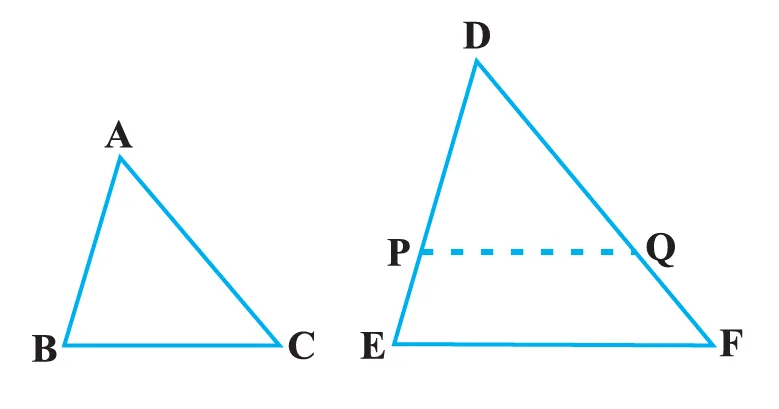
Definition
- All corresponding angles are equal.
- All corresponding sides are proportional.
Visual Understanding
Important Formula
- \( \dfrac{AB}{DE} = \dfrac{BC}{EF} = \dfrac{AC}{DF} \)
- \( \dfrac{\text{Area of } \triangle ABC}{\text{Area of } \triangle DEF} = \left( \dfrac{AB}{DE} \right)^2 \)
Core Properties
- Ratio of corresponding sides is constant (called scale factor).
- Corresponding angles are equal.
- Ratio of perimeters = ratio of sides.
- Ratio of areas = square of ratio of sides.
Solved Example
Using area property:
- \( \text{Ratio of areas} = \left(\dfrac{3}{5}\right)^2 = \dfrac{9}{25} \)
Final Answer: 9 : 25
Derivation Insight
- When two similar triangles are scaled by a factor k, their corresponding sides become k times. Since area depends on square of dimensions:
- \( \text{Area} \propto (\text{side})^2 \Rightarrow \text{Area ratio} = k^2 \)
Exam Tip
- Always write corresponding sides in correct order
- Use similarity criteria (AA, SAS, SSS) before applying ratios.
- Area questions are frequently asked (2โ3 marks).
- Diagram-based reasoning gives step marks.
Common Mistakes
- Mixing up corresponding sides.
- Using linear ratio instead of squared ratio for area.
- Assuming similarity without proving criteria.
- Incorrect labeling of triangles.
CBSE Case Study (HOTS)
- Scale factor = \( \dfrac{30}{1.5} = 20 \)
- Area scale factor = \( 20^2 = 400 \)
- Actual area = \( 200 \times 400 = 80,000 \, \text{cm}^2 \)
Answer: 80,000 cmยฒ
Similarity of Triangles
Visual Understanding
Visual Representation
Key Results & Formulas
- \( \dfrac{AB}{DE} = \dfrac{BC}{EF} = \dfrac{AC}{DF} \)
- Ratio of areas = square of ratio of sides
- \( \dfrac{\text{Area}_1}{\text{Area}_2} = \left( \dfrac{Side_1}{Side_2} \right)^2 \)
Solved Example
- Since two angles are equal:
- \( \triangle ABC \sim \triangle DEF \) (AA criterion)
Conclusion: Triangles are similar.
Exam Tip
- Always state the criterion (AA/SAS/SSS) clearly.
- Maintain correct order while writing similarity: ABC ~ DEF.
- Diagram labeling must match written correspondence.
- Proof-based questions carry 2โ4 marks frequently.
Common Mistakes
- Wrong correspondence (e.g., mixing A with E instead of D).
- Using SSS without checking proportionality properly.
- Skipping justification of similarity criterion.
- Confusing similarity with congruence.
CBSE Case Study (HOTS)
- By similarity:
- \( \dfrac{\text{Height of tree}}{2} = \dfrac{10}{1} \)
- Height = \( 20 \, m \)
Answer: 20 m
Importance for Board Exams
- Core foundation of entire chapter (appears in almost every question).
- Used in proofs, constructions, and applications.
- Direct link to Basic Proportionality Theorem.
- High scoring with predictable patterns.
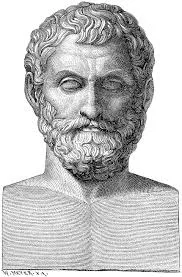
Thales of Miletus
Basic Proportionality Theorem (BPT) / Thales' Theorem
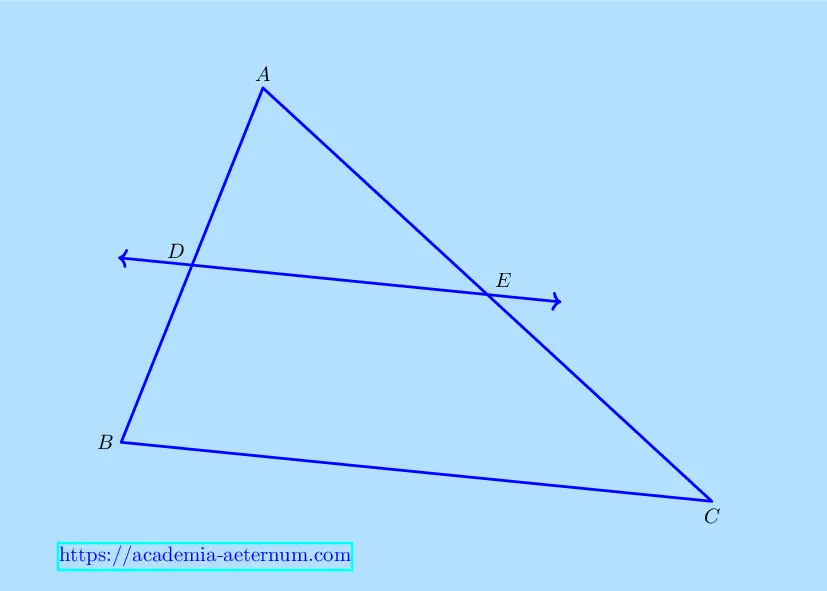
Diagram โ BPT Triangle
Mathematical Form
- In โณABC, if DE โฅ BC, then:
- \( \dfrac{AD}{DB} = \dfrac{AE}{EC} \)
Concept Simplified
Derivation Insight
In โณABC, DE โฅ BC:
- \(\angle ADE = \angle ABC (alternate interior angles)\)
- \(\angle AED = \angle ACB\)
- \(\Rightarrow \triangle ADE \sim \triangle ABC (AA similarity)\)
- \(\Rightarrow \dfrac{AD}{AB} = \dfrac{AE}{AC} \)
- \(\Rightarrow \dfrac{AD}{DB} = \dfrac{AE}{EC} \)
Solved Example
- Let ratio = 2 : 3
- If smaller part = 4 cm โ scale factor = 2
- Larger part = \( 3 \times 2 = 6 \) cm
- Answer: 6 cm
Exam Tip
- Always mention DE โฅ BC before applying BPT.
- Use similarity before writing proportionality.
- Steps must include reason (angles, similarity, ratio).
- Frequently asked in 2โ3 mark proof questions.
Common Mistakes
- Applying BPT without checking parallel condition.
- Writing incorrect ratios (wrong order).
- Skipping similarity step in proofs.
- Confusing with converse theorem.
CBSE Case Study (HOTS)
- By BPT:
- Same ratio applies โ 3 : 5
- Answer: 3 : 5
Importance for Board Exams
- Foundation for triangle similarity and constructions.
- Used in coordinate geometry and real-life scaling problems.
- Very high probability in CBSE exams.
- Direct concept-based scoring (easy marks if understood).
Theorem 1: Basic Proportionality Theorem (Proof)
Derivation Insight
Given
In โณABC, DE โฅ BC, where D lies on AB and E lies on AC.
- To Prove
- \[\dfrac{AD}{DB} = \dfrac{AE}{EC}\]
Construction
- Join BE and CD.
- Draw DM โ AC and EN โ AB.
- Proof
- Area of triangle ADE:
- \[ar(ADE) = \dfrac{1}{2} \times AD \times EN\]
- Area of triangle BDE:
- \[ar(BDE) = \dfrac{1}{2} \times BD \times EN\]
- \[\dfrac{ar(ADE)}{ar(BDE)} = \dfrac{AD}{DB} \tag{1}\]
- Also, using altitude DM:
- \[ar(ADE) = \dfrac{1}{2} \times AE \times DM\]
- \[ar(DEC) = \dfrac{1}{2} \times EC \times DM\]
- Dividing
- \[\dfrac{ar(ADE)}{ar(DEC)} = \dfrac{AE}{EC} \tag{2}\]
- Triangles BDE and DEC lie on the same base DE and between the same parallels BC and DE.
- \[ar(BDE) = ar(DEC) \tag{3}\]
- From (1), (2), and (3):
- \[\boxed{\bbox[indigo,5pt]{\dfrac{AD}{DB} = \dfrac{AE}{EC}}}\]
Key Insight
Exam Tip
- Always mention same base & same parallels โ equal areas.
- Tag equations (1), (2), (3) for clarity and marks.
- Diagram labeling must match steps exactly.
- This proof is frequently asked for 3โ4 marks.
Common Mistakes
- Writing \( \dfrac{AE}{AC} \) instead of \( \dfrac{AE}{EC} \).
- Skipping construction (DM โ AC, EN โ AB).
- Not justifying equal areas of triangles.
- Improper step linking between equations.
Theorem 2: Converse of Basic Proportionality Theorem
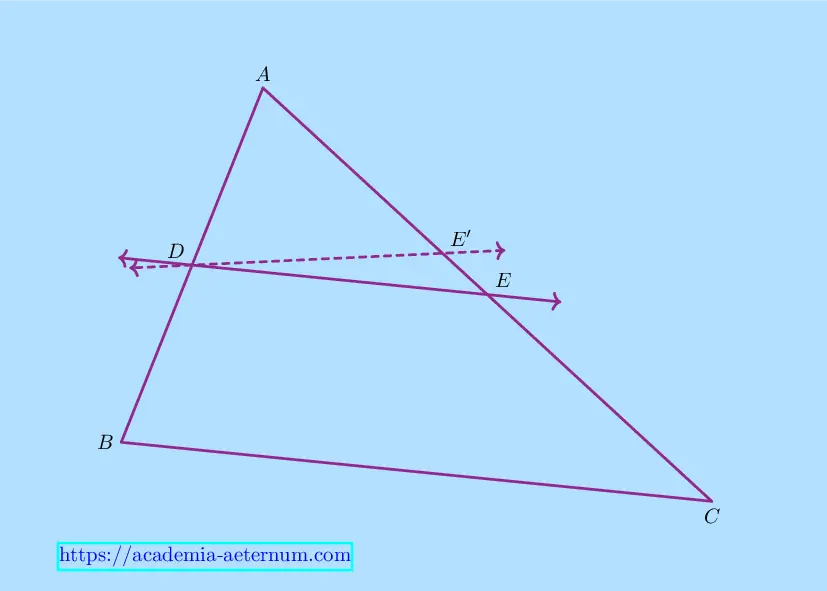
Converse of BPT Diagram
Derivation
- In \(\triangle \)ABC, points D and E lie on AB and AC respectively such that: \[ \dfrac{AD}{DB} = \dfrac{AE}{EC} \tag{1} \]
- To Prove
- \[DE \parallel BC\]
Construction
- Through point D, draw a line parallel to BC intersecting AC at E.
- Proof
- Since \( DE' \parallel BC \), by Basic Proportionality Theorem:
- \[\dfrac{AD}{DB} = \dfrac{AE'}{E'C} \tag{2}\]
- From (1) and (2):
- \[\dfrac{AE}{EC} = \dfrac{AE'}{E'C} \tag{3}\]
- Adding 1 to both sides:
- \[\dfrac{AE + EC}{EC} = \dfrac{AE' + E'C}{E'C}\]
- \[\Rightarrow \dfrac{AC}{EC} = \dfrac{AC}{E'C}\]
- This is possible only when:
- \[EC = E'C\]
- Hence, point E coincides with E'. Therefore, the line DE is the same as DE'.
Key Insight
Exam Tip
- Always construct a parallel line (DE').
- Apply BPT first, then compare ratios.
- Clearly state โE coincides with E'โ.
- This theorem is frequently asked with reasoning steps (3โ4 marks).
Common Mistakes
- Skipping construction of E'.
- Not proving uniqueness of point.
- Jumping directly to conclusion without ratio comparison.
- Incorrect algebra while adding ratios.
Quick Example
- If a line divides sides of a triangle in ratio 4:5 on both sides, then the line is parallel to the third side.
- Conclusion: Converse of BPT applies โ line is parallel.
Solved Example
Fig. 6.13
To Prove \[\dfrac{AD}{AB} = \dfrac{AE}{AC}\]
Proof
- Since \( DE \parallel BC \), by Basic Proportionality Theorem:
- \[\dfrac{AD}{DB} = \dfrac{AE}{EC}\]
- Taking reciprocal:
- \[\dfrac{DB}{AD} = \dfrac{EC}{AE} \tag{1}\]
- Adding 1 to both sides of (1):
- \[\dfrac{DB}{AD} + 1 = \dfrac{EC}{AE} + 1\]
- \[\Rightarrow \dfrac{DB + AD}{AD} = \dfrac{EC + AE}{AE}\]
- Using segment addition:
- \[DB + AD = AB \quad \text{and} \quad EC + AE = AC\]
- \[\Rightarrow \dfrac{AB}{AD} = \dfrac{AC}{AE}\]
- Taking reciprocal:
- \[\boxed{\bbox[indigo,5pt]{\dfrac{AD}{AB} = \dfrac{AE}{AC}}}\]
Key Insight
Exam Tip
- Always start with BPT before transforming ratios.
- Clearly show โtaking reciprocalโ and โadding 1โ steps.
- Use segment addition explicitly (AB = AD + DB).
- Final step must match exactly what is asked.
Common Mistakes
- Skipping reciprocal step.
- Incorrect addition of segments.
- Jumping directly to final result.
- Writing wrong final ratio order.
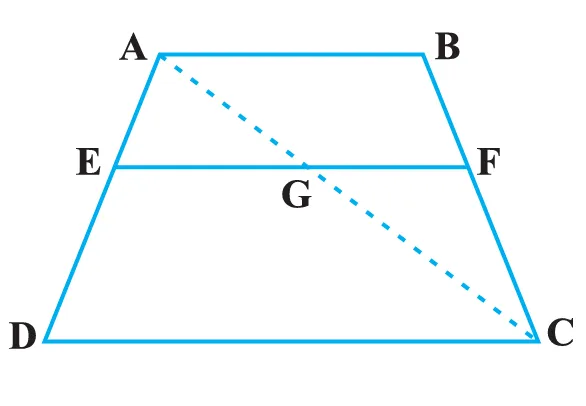
Solved Example : BPT in a Trapezium
Theory + Roadmap (How to Think)
- When a trapezium is involved โ draw diagonal AC
- Parallel lines suggest โ use Basic Proportionality Theorem (BPT)
- Break figure into two triangles:
- \( \triangle ADC \)
- \( \triangle ABC \)
- Find a common ratio (AG/GC) using both triangles.
- Equate results โ get required proof.
Fig. 6.14
To Prove
Given
Construction
Proof
- In \( \triangle ADC \):
- Since \( EG \parallel DC \) (as \( EF \parallel DC \)), by BPT:
- \[\dfrac{AE}{ED} = \dfrac{AG}{GC} \tag{1}\]
- In \( \triangle ABC \):
- Since \( GF \parallel AB \) (as \( EF \parallel AB \)), by BPT:
- \[\dfrac{BF}{FC} = \dfrac{AG}{GC} \tag{2}\]
- From (1) and (2):
- \[\boxed{\bbox[indigo,5pt]{\dfrac{AE}{ED} = \dfrac{BF}{FC}}}\]
Key Insight
Exam Tip
- Always draw diagonal when dealing with trapezium.
- Identify two triangles where BPT can be applied.
- Clearly mention parallel lines before applying BPT.
- Equate common ratios (AG/GC) to conclude.
Common Mistakes
- Not defining point G (intersection on AC).
- Writing incorrect final ratio (AE/AD instead of AE/ED).
- Confusing which lines are parallel.
- Skipping triangle identification step.
Criteria for Similarity of Triangles (AA, SAS, SSS)
- In two triangles, two angles are equal. Prove that the triangles are similar.
- Two sides of two triangles are proportional and the included angle is equal. Are the triangles similar?
- The sides of two triangles are in the ratio 2:3, 4:6, and 6:9. Check similarity.
- Identify which similarity criterion (AA, SAS, SSS) applies in each case.
Theory + Roadmap (How to Decide Criterion)
- Angles given? โ Use AA
- Two sides + included angle? โ Use SAS
- All sides proportional? โ Use SSS
Decision Shortcut: Count known elements โ Match pattern โ Apply correct criterion
Visual Understanding
Similarity Criteria Explained
Solutions
Q1: Two angles equal โ AA similarity โ Triangles are similar.
Q2: Two sides proportional + included angle equal โ SAS similarity.
Q3: Ratios:
โ All sides proportional โ SSS similarity.
Q4: Identify based on given data using roadmap above.
Exam Tips
- Always state the criterion name (AA, SAS, SSS).
- Maintain correct order of vertices.
- Justification step is compulsory for full marks.
- AA is most frequently used in proofs.
Common Mistakes
- Using SAS without included angle.
- Incorrect ratio comparison in SSS.
- Not checking correspondence order.
- Forgetting to mention criterion name.
Question
Theory + Roadmap
- Given angles equal โ think AA similarity
- Construct a triangle equal in size using given sides.
- Use congruency (SAS) to match triangles.
- Then apply BPT to prove proportionality.
Strategy: Equal angles โ Construct equal sides โ Use congruency โ Apply BPT โ Get ratios
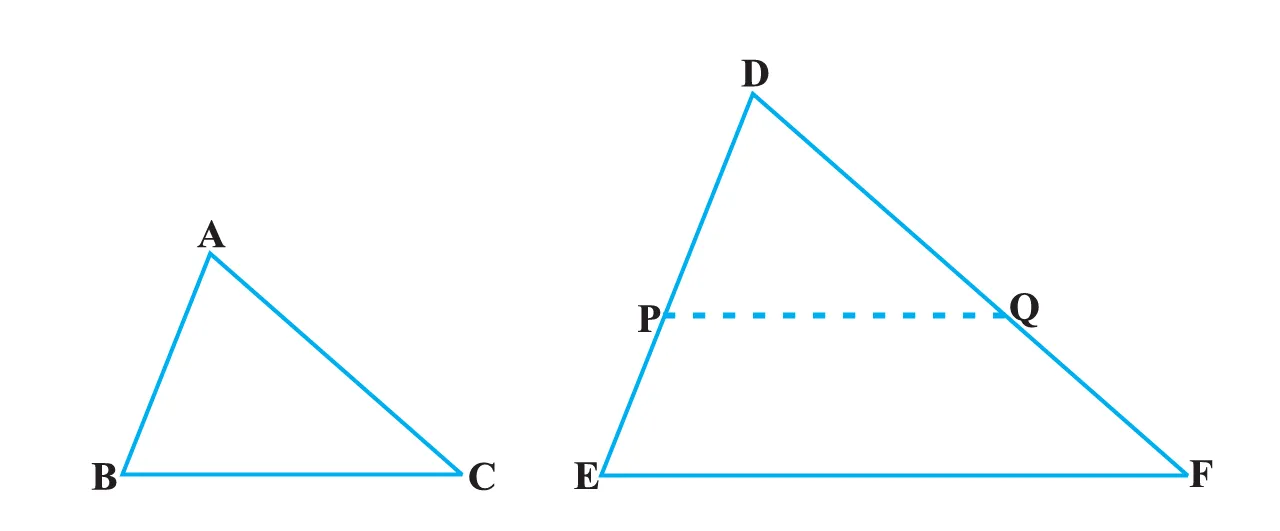
AA Similarity Theorem Diagram
Given
To Prove
Construction
- On DE, mark point P such that \( DP = AB \).
- On DF, mark point Q such that \( DQ = AC \).
- Join PQ.
Proof
โ \( \triangle ABC \cong \triangle DPQ \) (SAS)
โ \( \angle B = \angle P,\quad \angle C = \angle Q \) (CPCT)
Step 2: Parallel Lines
Given \( \angle B = \angle E \), and from above \( \angle B = \angle P \),
โ \( \angle P = \angle E \)
Similarly, \( \angle Q = \angle F \)
โ \( PQ \parallel EF \)
Step 3: Apply BPT
In triangle DEF, since \( PQ \parallel EF \):
\[ \dfrac{DP}{PE} = \dfrac{DQ}{QF} \]Substituting \( DP = AB \) and \( DQ = AC \):
\[ \dfrac{AB}{DE} = \dfrac{AC}{DF} \]Similarly,
\[ \dfrac{AB}{DE} = \dfrac{BC}{EF} \]Hence,
\[ \boxed{\dfrac{AB}{DE} = \dfrac{BC}{EF} = \dfrac{AC}{DF}} \]โ \( \triangle ABC \sim \triangle DEF \)
In \(\triangle\) ABC and \(\triangle\) DPQ:
- \(DP = AB \) (construction)
- \(DQ = AC \) (construction)
- \(\angle PDQ = \angle A \)
Key Insight
Exam Tips
- AA is the most used similarity criterion in CBSE.
- Always justify parallel lines using equal angles.
- Clearly mention SAS and BPT steps.
- Maintain correct triangle correspondence order.
Common Mistakes
- Skipping construction steps.
- Not proving parallelism before BPT.
- Incorrect correspondence of vertices.
- Jumping directly to similarity without ratios.
If two angles of one triangle are equal to two angles of another triangle, then the triangles are similar (AA Similarity Criterion).
Question
Theory + Roadmap
- Given all three sides proportional โ think SSS similarity
- Create a triangle with equal sides using construction.
- Use congruency (SSS) to match shapes.
- Then compare angles โ prove similarity.
Strategy: Proportional sides โ Construct equal triangle โ Use congruency โ Conclude similarity
SSS Similarity Theorem Diagram
Given
To Prove
- On DE, mark point P such that \( DP = AB \).
- On DF, mark point Q such that \( DQ = AC \).
- Join PQ.
Proof
Step 1: Use Given Ratios
Given:
\[ \dfrac{AB}{DE} = \dfrac{AC}{DF} \]Substitute \( DP = AB \) and \( DQ = AC \):
\[ \dfrac{DP}{DE} = \dfrac{DQ}{DF} \]โ \( \dfrac{DP}{DE} = \dfrac{DQ}{DF} \)
โ By Converse of BPT, \( PQ \parallel EF \)
Step 2: Angle Equality
Since \( PQ \parallel EF \):
- \( \angle DPQ = \angle E \)
- \( \angle DQP = \angle F \)
Step 3: Compare Triangles
In triangles ABC and DPQ:
- \( DP = AB \)
- \( DQ = AC \)
- \( \angle PDQ = \angle A \)
โ \( \triangle ABC \cong \triangle DPQ \) (SAS)
โ \( \angle A = \angle D,\ \angle B = \angle E,\ \angle C = \angle F \)
โ \( \triangle ABC \sim \triangle DEF \)
Key Insight
Exam Tips
- Always start with given ratios.
- Use Converse of BPT carefully.
- Clearly justify parallel lines.
- Write final similarity statement explicitly.
Common Mistakes
- Using BPT instead of Converse of BPT.
- Incorrect substitution of constructed lengths.
- Skipping parallel proof step.
- Confusing congruency and similarity.
Final Result
Question
Theory + Roadmap
- Given: one angle equal + two sides proportional โ think SAS similarity.
- Construct equal sides to form a comparable triangle.
- Use congruency (SAS) to match triangles.
- Then extend result to full triangle โ prove similarity.
Strategy: Proportional sides + included angle โ Construct โ Congruency โ Extend โ Similarity
SAS Similarity Theorem Diagram
Given
To Prove
- On DE, mark point P such that \( DP = AB \).
- On DF, mark point Q such that \( DQ = AC \).
- Join PQ.
Proof
Step 1: Use Given Ratio
\[ \dfrac{AB}{DE} = \dfrac{AC}{DF} \]Substitute \( DP = AB \), \( DQ = AC \):
\[ \dfrac{DP}{DE} = \dfrac{DQ}{DF} \]โ By Converse of BPT, \( PQ \parallel EF \)
Step 2: Angle Equality
Since \( PQ \parallel EF \):
- \( \angle DPQ = \angle E \)
- \( \angle DQP = \angle F \)
Step 3: Congruency
In triangles ABC and DPQ:
- \( DP = AB \)
- \( DQ = AC \)
- \( \angle PDQ = \angle A \)
โ \( \triangle ABC \cong \triangle DPQ \) (SAS)
โ \( \angle B = \angle P,\ \angle C = \angle Q \)
Step 4: Final Comparison
From above:
- \( \angle B = \angle E \)
- \( \angle C = \angle F \)
โ All corresponding angles equal, therfore
Key Insight
Exam Tips
- Always verify the angle is included angle
- Use Converse of BPT carefully.
- Clearly mention parallel lines before angle comparison.
- SAS is often used in coordinate geometry applications.
Common Mistakes
- Using non-included angle.
- Skipping construction step.
- Wrong use of BPT instead of Converse.
- Incorrect angle correspondence.
Final Result
Question
Theory + Roadmap
- Parallel lines โ think alternate interior angles
- Intersecting lines โ give vertically opposite angles
- Two equal angles are enough โ use AA similarity
Strategy: Parallel lines โ angle equality โ apply AA similarity
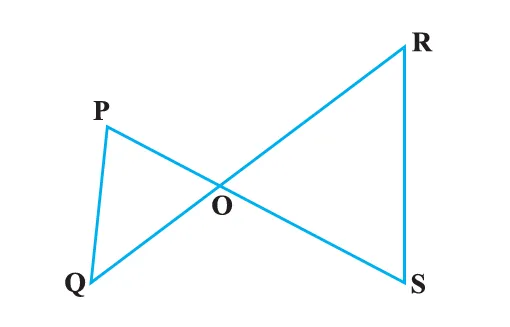
Parallel Lines Triangle Similarity Diagram
Solution
Given
To Prove
Proof
In triangles \( \triangle POQ \) and \( \triangle SOR \):
- \( \angle OPQ = \angle OSR \) (Alternate interior angles, since \( PQ \parallel RS \))
- \( \angle OQP = \angle ORS \) (Alternate interior angles)
- \( \angle POQ = \angle SOR \) (Vertically opposite angles)
Since corresponding angles are equal:
Key Insight
Exam Tips
- Always name angles properly (e.g., \( \angle OPQ \), not just \( \angle P \))
- Two angles are sufficient โ no need to prove all three.
- Always mention AA similarity explicitly.
Common Mistakes
- Writing incomplete angles (like โ P instead of โ OPQ).
- Not mentioning reason (alternate / vertically opposite).
- Skipping similarity criterion name.
Quick Check (Exam Revision)
- When are two figures similar?
- What is the difference between similarity and congruence?
- Which conditions define similarity of polygons?
- When can BPT and its converse be applied?
- How do AA, SAS, and SSS criteria differ?
Concept Roadmap
- Shape same โ Similarity
- Shape + size same โ Congruence
- Parallel lines โ BPT
- Angles equal โ AA
- Sides proportional โ SSS
- Sides + included angle โ SAS
Core Theoretical Points
- Two figures having the same shape but not necessarily the same size are called similar figures.
- All congruent figures are similar, but similar figures are not necessarily congruent.
- Two polygons are similar if:
- Corresponding angles are equal
- Corresponding sides are proportional
- Basic Proportionality Theorem (BPT):
A line parallel to one side of a triangle divides the other two sides in the same ratio. - Converse of BPT:
If a line divides two sides in the same ratio, then it is parallel to the third side. - SSS (SideโSideโSide) Similarity:
All corresponding sides proportional โ triangles are similar. - SAS (SideโAngleโSide) Similarity:
Two sides proportional + included angle equal โ triangles are similar.
Important Formulas
- \( \dfrac{AB}{DE} = \dfrac{BC}{EF} = \dfrac{AC}{DF} \)
- \( \dfrac{\text{Area}_1}{\text{Area}_2} = \left(\dfrac{\text{Side}_1}{\text{Side}_2}\right)^2 \)
Exam Tips
- Always mention the similarity criterion name
- Check correspondence order carefully
- Use diagrams for better clarity and step marks.
- BPT and similarity are frequently linked in questions.
Common Mistakes
- Confusing similarity with congruence.
- Using SAS without included angle.
- Applying BPT without parallel condition.
- Incorrect ratio formation.
Final Tip
Recent posts
TRIANGLES โ Learning Resources
Get in Touch
Let's Connect
Questions, feedback, or suggestions?
We'd love to hear from you.